
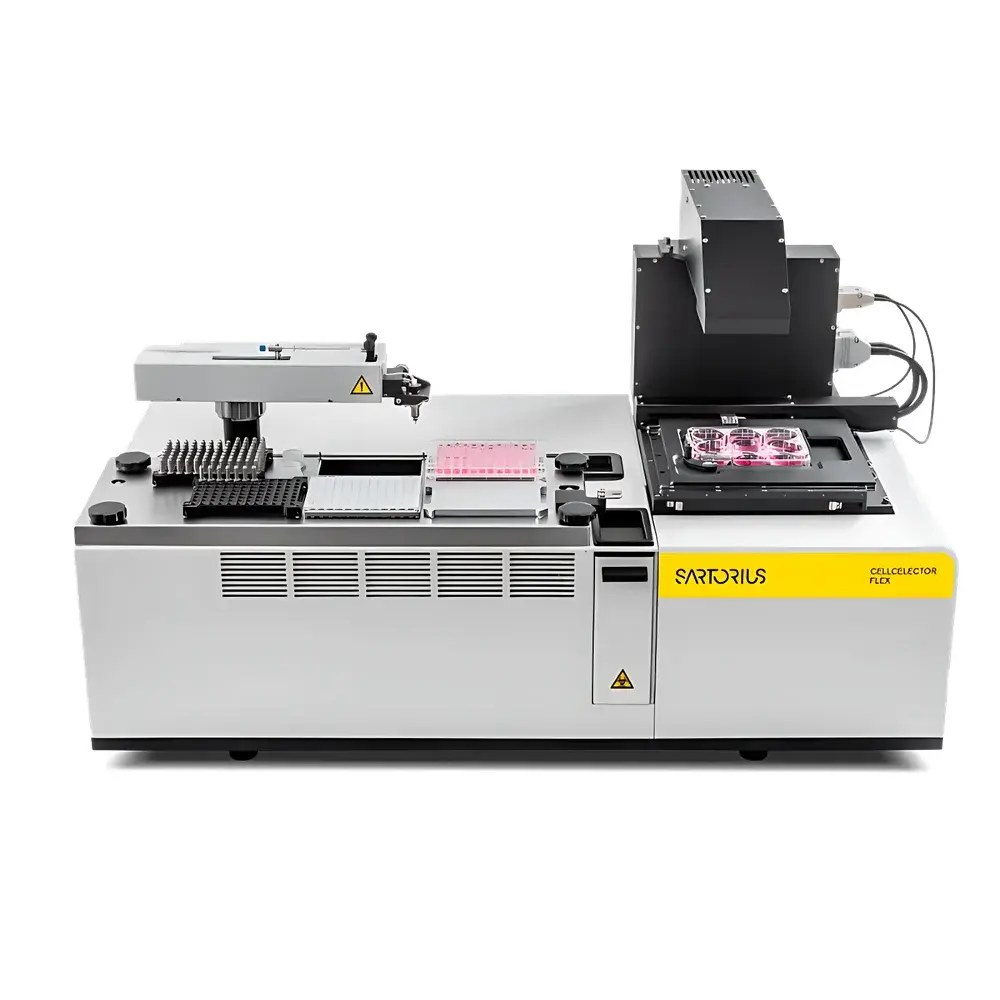
Sartorius CellCelector Flex Automated Non-Destructive Single-Cell Isolation System
| Brand | Sartorius |
|---|---|
| Origin | USA |
| Manufacturer Type | Authorized Distributor |
| Origin Category | Imported |
| Model | CellCelector Flex |
| Separation Method | Fully Automated Image-Guided Microaspiration |
Overview
The Sartorius CellCelector Flex is an automated, non-destructive single-cell isolation platform engineered for high-fidelity, morphology- and fluorescence-guided selection of individual viable cells, cell clusters, spheroids, organoids, and adherent colonies. It operates on the principle of high-resolution inverted fluorescence microscopy coupled with computer-vision-based image analysis and contact-free microaspiration via proprietary low-shear fluidic handling. Unlike conventional FACS or magnetic bead-based separation methods, the CellCelector Flex preserves native cell physiology by avoiding enzymatic dissociation, mechanical stress, or labeling artifacts—making it uniquely suited for applications demanding functional viability post-isolation, including clonal expansion, transcriptomic profiling, and functional secretion assays.
Key Features
- Integrated inverted fluorescence microscope with high-NA optics and multi-channel LED excitation for real-time morphological and fluorescent phenotype assessment.
- Three interchangeable, application-optimized pick-up modules: (1) Single-cell aspiration module for ultra-low-volume (<1 nL), gentle transfer; (2) Adherent colony module with precision z-axis control for intact monolayer detachment; (3) Spheroid/organoid module enabling selective substructure isolation (e.g., core vs. periphery).
- Automated scanning and detection across 96-, 384-, and custom nanowell plates—compatible with Sartorius’ proprietary Nanowell™ technology for high-throughput single-B-cell screening.
- FlowBox environmental incubation chamber maintaining precise, independent control of temperature (±0.2 °C), CO2 (±0.1%), and relative humidity (±2%) during imaging and aspiration—ensuring physiological stability throughout workflow execution.
- Patented microaspiration technology achieving >95% post-pick survival rate in validated single-cell cloning workflows, even for fragile primary cells and slow-growing lines.
Sample Compatibility & Compliance
The CellCelector Flex accommodates a broad spectrum of biological samples: suspension cells (e.g., PBMCs, hybridomas), adherent cultures (HEK293, CHO, iPSCs), 3D models (tumor spheroids, cerebral organoids), and rare populations including circulating tumor cells (CTCs), fetal nucleated red blood cells (fnRBCs), and single B cells from peripheral blood. All hardware and software components comply with ISO 13485 design controls for IVD-related development use and support GLP/GMP-aligned documentation requirements. Audit trails, electronic signatures, and user-access logging are fully enabled to meet FDA 21 CFR Part 11 compliance when deployed in regulated bioprocess environments.
Software & Data Management
The CellCelector Control Software v5.x provides end-to-end workflow orchestration—from plate mapping and autofocus calibration to AI-assisted object segmentation, feature extraction (size, intensity, texture, shape asymmetry), and rule-based decision logic for automated selection. Raw image stacks, metadata (timestamp, coordinates, aspiration pressure profile), and export-ready CSV/JSON reports are stored in a structured local database. Export formats include TIFF (for downstream FIJI/ImageJ analysis), HDF5 (for ML training pipelines), and MIAME-compliant MAGE-TAB for integration into LIMS or ELN systems. Optional API access enables bidirectional communication with third-party sequencing platforms and robotic liquid handlers.
Applications
- Single-cell omics: Isolation of 100% pure, unamplified single cells for scRNA-seq, scATAC-seq, and targeted NGS library prep—eliminating batch effects introduced by pooling or bulk sorting.
- Therapeutic cell line development: One-step monoclonality verification via direct imaging + physical isolation; parallel validation of >2,000 clones per run with integrated growth monitoring in destination plates.
- Antibody discovery: Co-detection of surface IgG/IgM and intracellular cytokine secretion in live B cells within nanowells, followed by immediate aspiration for ELISA, SPR, or recombinant expression.
- Stem cell research: Sub-colony dissection of edited iPSC clones, spatially resolved harvesting from methylcellulose hematopoietic colonies, and removal of spontaneously differentiated regions without compromising neighboring pluripotent cells.
- Clinical & forensic cytology: Non-invasive isolation of intact fetal cells from maternal blood for cbNIPT, and trace-level sperm cell retrieval from mixed biological evidence samples under chain-of-custody protocols.
FAQ
Does the CellCelector Flex require cell labeling for identification?
No—label-free detection is supported via phase contrast, DIC, and autofluorescence imaging. Fluorescent markers are optional and used only when phenotypic resolution demands additional specificity.
Can the system integrate with existing robotic workcells?
Yes—standardized SLIM (Standard Labware Interface Module) footprint and RS-232/Ethernet APIs enable seamless integration with Hamilton STAR, Tecan Freedom EVO, and other ANSI/SLAS-compliant automation platforms.
What is the minimum required cell concentration for reliable detection?
As low as 10 cells/mL in nanowell plates; detection sensitivity is governed by optical SNR and well geometry—not absolute density.
Is remote operation supported?
Yes—secure web-based remote monitoring and queue management are available via TLS-encrypted client interface, with role-based access control aligned to institutional IT policies.
How is monoclonality verified post-isolation?
By combining time-lapse imaging of the source well prior to aspiration with post-transfer confirmation imaging in the destination plate—generating a full digital chain-of-custody record compliant with ICH Q5D and USP .




