
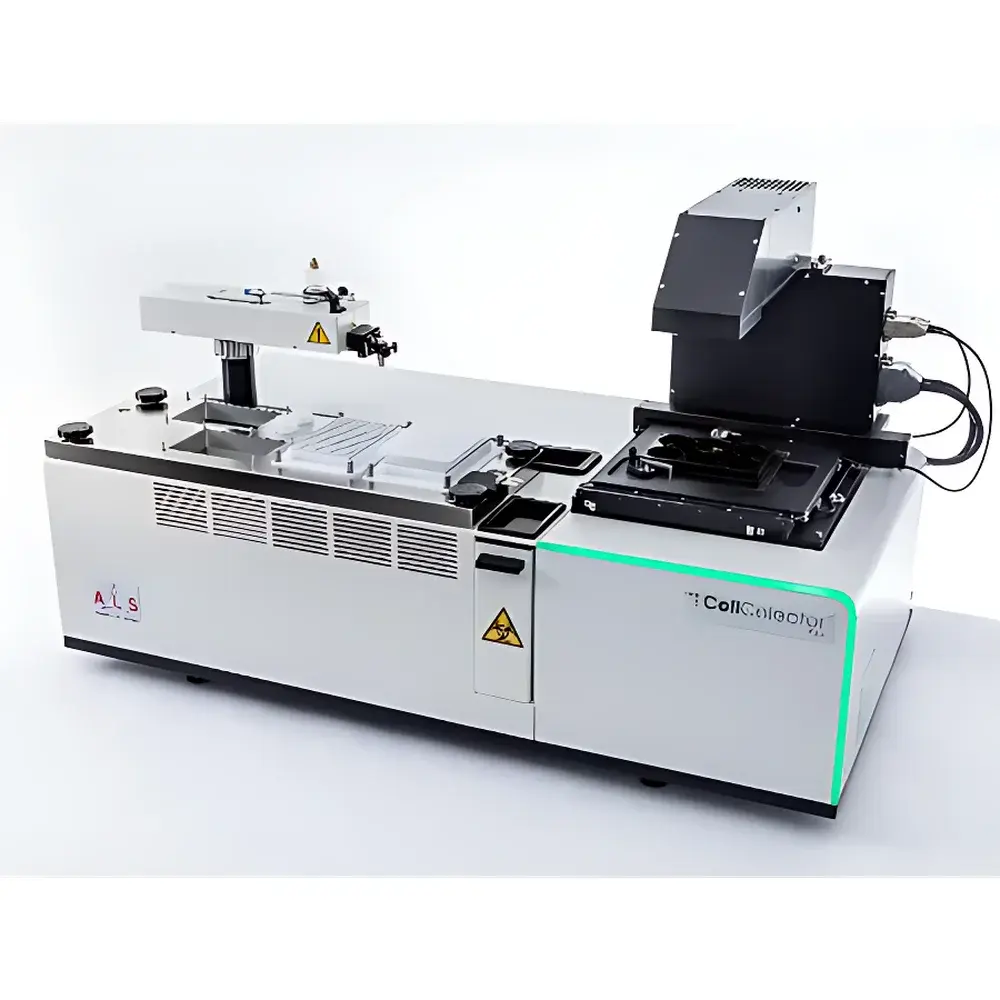
Sartorius CellCelector Flex Automated Single-Cell Isolation and Cloning Analysis System
| Brand | Sartorius |
|---|---|
| Origin | Shanghai, China |
| Model | CellCelector Flex |
| Separation Method | Fully Automated |
| Regulatory Compliance | GLP/GMP-Compliant Workflow Architecture |
| Imaging Modes | Brightfield, Phase Contrast, Fluorescence |
| Throughput | Up to 100+ single-cell picks per hour |
| Pick Accuracy | >95% for targeted subpopulations |
| Viability Post-Pick | ≥95% for monoclonal applications |
| Minimum Dispense Volume | ~1 nL |
| Compatible Vessels | Standard microplates (6–1536-well), Petri dishes, slides, filters, chips, PCR tubes, custom substrates |
Overview
The Sartorius CellCelector Flex is an integrated, fully automated platform engineered for high-fidelity single-cell and multicellular structure isolation—designed specifically for demanding applications in cell line development, antibody discovery, stem cell research, and rare cell analysis. It combines high-content digital microscopy with a patented non-contact capillary-based pick-and-transfer mechanism grounded in precision fluidics and real-time image-guided robotics. Unlike conventional FACS or limiting dilution methods, the CellCelector Flex operates on a deterministic, morphology- and fluorescence-based selection principle: every candidate object—be it a single adherent cell, suspended cell, spheroid, organoid, colony, or hybridoma—is optically characterized, spatially registered, and physically isolated without shear stress or enzymatic dissociation. Its core architecture supports both upstream enrichment compatibility (e.g., magnetic bead-based isolation, size-based filtration) and downstream molecular workflows (single-cell RNA-seq, scDNA amplification, mini-pool screening, titer assessment), making it a central node in modern bioprocess development pipelines compliant with ICH Q5D, USP , and FDA 21 CFR Part 11 data integrity requirements.
Key Features
- Deterministic, Image-Guided Isolation: Real-time acquisition of brightfield, phase contrast, and multi-channel fluorescence images enables morphological, intensity-, and location-based gating prior to pick execution—no reliance on labeling or viability dyes unless required.
- Gentle Capillary Transfer Technology: Patented low-shear fluidic aspiration and deposition minimizes mechanical perturbation; validated for intact transfer of fragile primary cells, iPSCs, and CTCs with ≥95% post-isolation viability and clonogenic capacity.
- Adaptable Vessel Compatibility: Supports standard and non-standard formats including 6–1536-well plates, Petri dishes, glass slides, membrane filters, microfluidic chips, and custom-designed nanowell arrays—enabling seamless integration into existing labware ecosystems.
- Dynamic Re-Localization & Retry Logic: Integrated stage feedback control automatically re-acquires target coordinates if sample drift occurs during imaging or handling; failed picks trigger autonomous re-attempt with adjusted parameters.
- Full Traceability & Audit Trail: Each picked object receives a unique digital ID; time-stamped pre- and post-pick images, coordinate metadata, environmental logs (CO₂, humidity, temperature), and operator actions are embedded in encrypted, tamper-evident records compliant with ALCOA+ principles.
Sample Compatibility & Compliance
The CellCelector Flex accommodates diverse biological specimens without requiring extensive pre-processing: adherent mammalian lines (CHO, HEK293, iPSCs), suspension cultures (hybridomas, PBMCs), semi-solid matrices (methylcellulose, agarose), and complex 3D structures (spheroids, organoids, bacterial colonies). It accepts both live and fixed samples, enabling parallel workflows across discovery and QC stages. All operational software modules adhere to 21 CFR Part 11 Annex 11 and ISO/IEC 17025 traceability frameworks. Instrument qualification packages—including IQ/OQ/PQ documentation, electronic signature support, and role-based access control—are available to meet GMP manufacturing and GLP-regulated study requirements.
Software & Data Management
The CellCelector Flex runs on Sartorius’ proprietary CellStudio software—a modular, scriptable environment supporting batch processing, machine-learning-assisted object classification (via optional trained models), and API-driven integration with LIMS and ELN systems. Raw image stacks, pick logs, environmental telemetry, and export-ready CSV/JSON datasets are stored in vendor-neutral formats. Built-in QC dashboards visualize pick success rate, positional accuracy, viability correlation, and temporal consistency across runs—critical for comparability in longitudinal clone stability studies or regulatory submissions.
Applications
- Monoclonal Cell Line Development: Direct isolation of single viable cells from nanowell plates or semi-solid media with verified monoclonality tracking from Day 0 through expansion.
- Rare Cell Enrichment: Enumeration and recovery of circulating tumor cells (CTCs), fetal nucleated red blood cells (fnRBCs), or antigen-specific B cells from heterogeneous backgrounds.
- Antibody Discovery: High-confidence retrieval of single IgG-secreting hybridomas or native B cells for next-generation sequencing of heavy/light chain pairs.
- Stem Cell Engineering: Clonal derivation of edited iPSCs post-CRISPR/Cas9 transfection, with concurrent morphology-based quality filtering.
- Microbiome & Synthetic Biology: Colony picking from selective agar plates or encapsulated droplets for strain banking, metabolic profiling, or phage display screening.
FAQ
Does the CellCelector Flex require fluorescent labeling for cell identification?
No—label-free identification is supported via high-resolution brightfield and phase contrast imaging; fluorescence is optional and used only when phenotypic markers or reporter expression are essential to the selection criteria.
Can it handle cells grown in viscous or semi-solid media?
Yes—the system’s adaptive aspiration algorithm compensates for variable media rheology; specialized capillaries and pressure profiles are optimized for methylcellulose, Matrigel™, and collagen-based 3D cultures.
Is remote operation and monitoring supported?
Yes—CellStudio includes secure web-based remote access with real-time video streaming, live status dashboards, and push notifications for run completion or error events.
What validation documentation is provided for regulated environments?
Sartorius delivers comprehensive qualification kits (IQ/OQ/PQ), electronic audit trail reports, and 21 CFR Part 11 compliance statements—all aligned with current ICH, EMA, and FDA expectations for analytical instrument qualification in biopharmaceutical development.
How does it ensure monoclonality for regulatory submissions?
By combining automated image-based singularity verification at pick time with continuous lineage tracking via time-lapse imaging and positional mapping—generating a defensible, image-supported monoclonality report per clone, accepted by major global health authorities.





