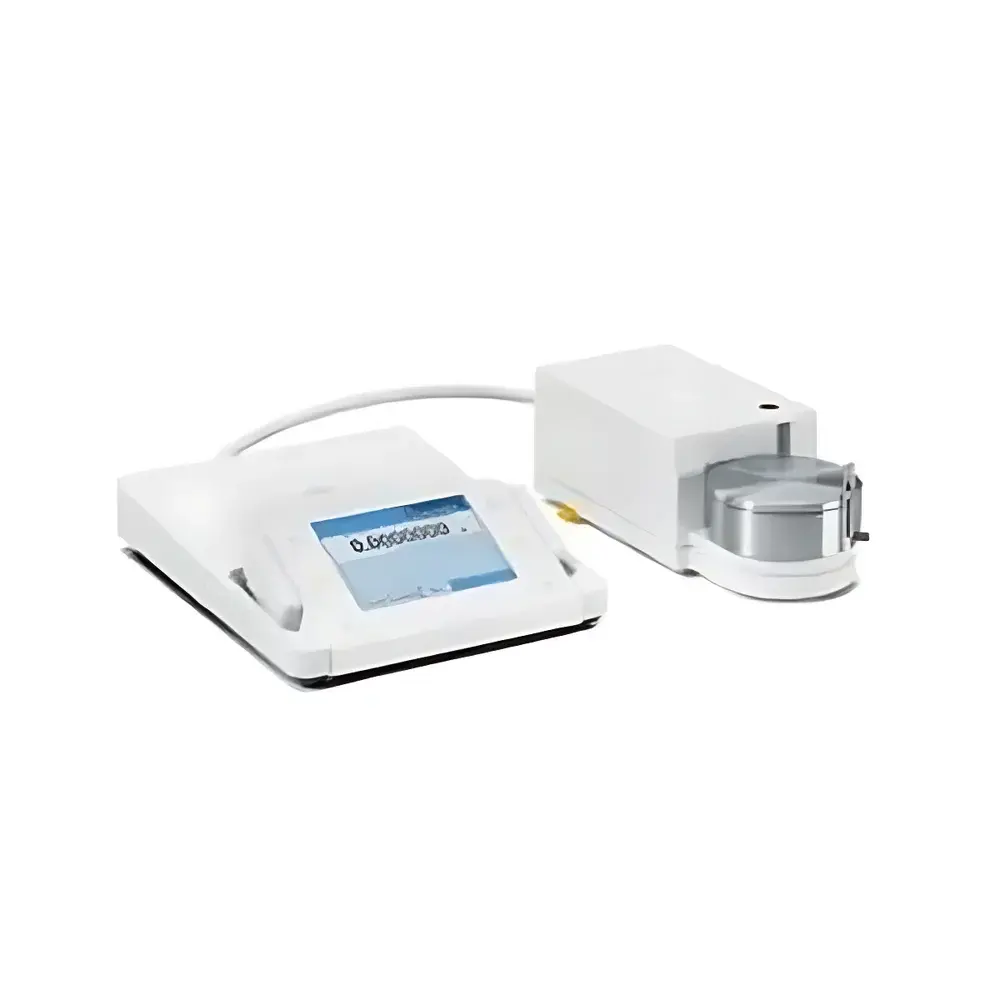
Sartorius Cubis® MSA2.7S-0TR-DF Ultra-Micro Balance
| Brand | Sartorius |
|---|---|
| Origin | Germany |
| Model | Cubis® MSA2.7S-0TR-DF |
| Instrument Type | Ultra-Micro Balance |
| Maximum Capacity | 2.1 g |
| Readability | 0.0001 mg |
| Calibration | Internal, isoCAL |
| Compliance | ISO/IEC 17025, USP <41>, <1251>, FDA 21 CFR Part 11 (with Q-Apps & audit trail enabled) |
Overview
The Sartorius Cubis® MSA2.7S-0TR-DF is an ultra-micro balance engineered for laboratories requiring sub-microgram mass resolution in regulated and high-precision environments. Operating on electromagnetic force compensation (EMFC) principle, it delivers a readability of 0.0001 mg (0.1 µg) within a 2.1 g maximum capacity range—optimized for applications demanding trace-level quantification, such as reference standard preparation, catalyst dosing, pharmaceutical active ingredient (API) formulation, and nanomaterial characterization. Its monolithic weighing cell design minimizes thermal drift and mechanical hysteresis, ensuring long-term stability and high reproducibility across repeated measurements. The balance is manufactured in Germany under strict ISO 9001-certified production conditions and complies with international metrological standards including OIML R 76-1 and EN 45501.
Key Features
- isoCAL™ Intelligent Internal Calibration: Fully automated, temperature-triggered calibration with dual internal weights—ensures traceable accuracy without manual intervention or external mass standards.
- Q-Level™ Active Leveling System: First-of-its-kind auto-leveling technology that detects inclination, initiates motorized adjustment, and documents the leveling event—including timestamp, angle deviation, and final status—in the audit trail.
- Modular Hardware Architecture: Interchangeable display/control units (Touch, Smart, or Compact), draft shield configurations (including glove-box compatible options), and mounting interfaces enable seamless integration into fume hoods, isolators, or automated synthesis platforms.
- Q-Guide™ Guided Workflow Interface: Context-sensitive, SOP-driven user interface that suppresses non-essential functions during task execution—reducing operator error and accelerating routine procedures like minimum weight verification per USP <41>.
- Q-Apps™ Embedded Application Suite: Pre-validated, re-loadable software modules (e.g., “Minimum Weight Calculator”, “Pipette Calibration Assistant”, “Recipe Weighing”) execute directly on the balance CPU—eliminating dependency on external PCs and supporting 21 CFR Part 11 compliance via electronic signatures and immutable audit logs.
Sample Compatibility & Compliance
The MSA2.7S-0TR-DF supports diverse sample handling requirements through optional accessories: anti-static ionizers for charged powders, vibration-dampening tables for floor-mounted installations, and hermetically sealed draft shields for hygroscopic or volatile substances. Its firmware architecture supports GLP/GMP-aligned workflows, including mandatory user authentication, role-based access control, and full audit trail recording (per ISO/IEC 17025:2017 clause 7.7). All Q-Apps undergo rigorous validation per ICH Q2(R2) guidelines and are documented in Sartorius’ IQ/OQ/PQ protocols. The balance meets EU Directive 2014/30/EU (EMC) and 2014/35/EU (LVD), and its calibration certificate is accredited to ISO/IEC 17025 by DAkkS (German Accreditation Body).
Software & Data Management
Data integrity is enforced through native Ethernet and USB-C connectivity, enabling direct export to LIMS, ELN, or MES systems via Sartorius’ standardized ASCII/CSV output format. Optional Sartorius LabX® software provides advanced data aggregation, statistical process control (SPC), and real-time monitoring across multi-balance networks. All electronic records generated by Q-Apps include embedded digital signatures, time stamps, and change history—fully compliant with FDA 21 CFR Part 11 Subpart C (electronic records and signatures) when configured with password policies, audit trail activation, and system security settings. Raw measurement data is stored locally with AES-256 encryption and cannot be altered post-acquisition.
Applications
- Preparation of certified reference materials (CRMs) and primary standards in metrology labs
- Weighing of nanogram-scale catalysts in heterogeneous catalysis research
- USP <1251>-compliant minimum weight determination for analytical method validation
- Automated gravimetric dosing in continuous manufacturing lines (integrated via OPC UA)
- High-sensitivity loss-on-drying (LOD) analysis for moisture-sensitive APIs
- Gravimetric calibration of pipettes and dispensers per ISO 8655-6
FAQ
What is the difference between isoCAL and conventional internal calibration?
isoCAL incorporates real-time temperature monitoring and adaptive recalibration triggers—unlike static internal calibration—which ensures mass accuracy remains within specification across ambient fluctuations (±0.5 °C threshold).
Can Q-Apps be customized for proprietary workflows?
Yes—Sartorius offers Q-App Development Kit (Q-ADK) for validated customer-specific application development, subject to formal risk assessment and documentation per GAMP 5.
Is the MSA2.7S-0TR-DF suitable for use inside a nitrogen-purged glove box?
Yes—the model supports optional explosion-proof (ATEX Zone 2) and inert-gas-compatible draft shields with feedthrough ports for cabling and gas lines.
How does Q-Level support regulatory inspections?
Each leveling event generates a tamper-evident record including device ID, operator ID (if authenticated), inclination angle before/after adjustment, and cryptographic hash—exportable as PDF or CSV for auditor review.
Does the balance support multi-user environments with distinct permission levels?
Yes—up to 100 user profiles with configurable privileges (e.g., calibration lockout, Q-App installation restriction, audit trail visibility) are supported natively.