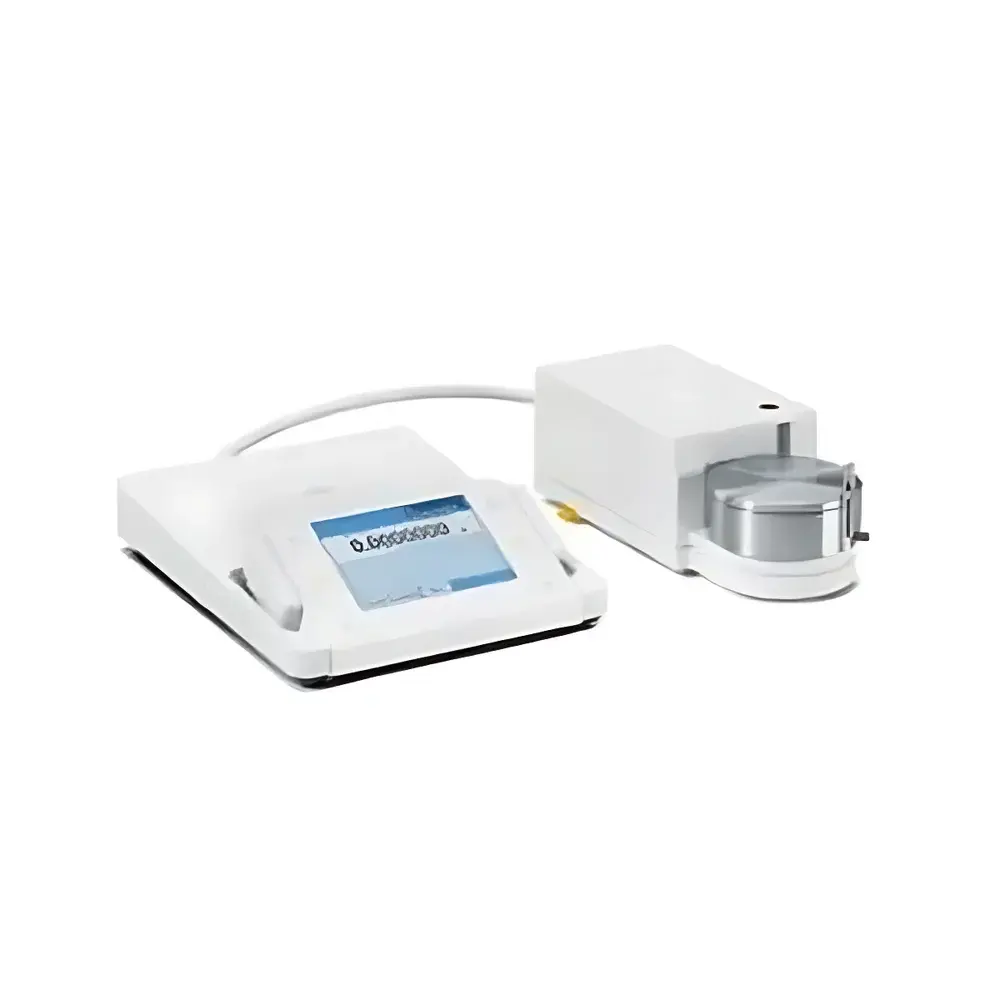
Sartorius Cubis® MSA6.6S-0CE-DF Ultra-Micro Balance
| Brand | Sartorius |
|---|---|
| Origin | Germany |
| Model | Cubis® MSA6.6S-0CE-DF |
| Instrument Type | Ultra-Micro Balance |
| Maximum Capacity | 6.1 g |
| Readability | 0.001 mg |
| Weighing Range | 5–20 g |
| Calibration | Internal, isoCAL |
| Compliance | ISO/IEC 17025, USP <41>, <1251>, GLP/GMP-ready |
Overview
The Sartorius Cubis® MSA6.6S-0CE-DF is an ultra-micro balance engineered for laboratories requiring sub-milligram precision in regulated and high-value applications. Operating on electromagnetic force compensation (EMFC) technology, it delivers traceable, temperature-stable measurements with a readability of 0.001 mg (1 µg) and a maximum capacity of 6.1 g—optimized for critical mass determinations in pharmaceutical development, reference standard preparation, catalyst dosing, and nanomaterial formulation. Its monolithic weighing cell design minimizes mechanical hysteresis and thermal drift, while the integrated draft shield with electrostatic discharge (ESD)-safe materials ensures stability during low-mass measurements under ambient lab conditions. Unlike conventional microbalances constrained by fixed firmware or rigid interface logic, the Cubis® platform is architected as a modular measurement node—designed from inception to serve not only as a mass sensor but as a programmable, audit-compliant endpoint within automated laboratory workflows.
Key Features
- isoCAL Temperature-Compensated Internal Calibration: Fully automatic recalibration triggered by user-defined time intervals or temperature thresholds (±0.5 °C), with full traceability to internal reference masses and real-time logging of calibration events.
- Q-Level Active Leveling System: Motorized, self-detecting leveling mechanism that autonomously verifies horizontal alignment, executes correction, and records the final tilt angle—eliminating manual bubble-level dependency and reducing operator-induced error in safety cabinets or vibration-prone environments.
- Three-Display Architecture: Optional integration of touchscreen control unit, remote display module, or integrated display—each supporting identical functional depth without performance compromise, enabling ergonomic placement in fume hoods, isolators, or cleanroom pass-throughs.
- Q-Guide Guided Workflow Interface: Context-aware, task-driven UI that dynamically surfaces only relevant parameters and prompts based on the selected SOP—reducing training time, minimizing keystroke errors, and enforcing procedural consistency across multi-user environments.
- Q-Apps Application Framework: Secure, reconfigurable software modules embedded directly into the balance OS—supporting validated workflows such as USP <41> minimum weight assessment, pipette calibration verification, gravimetric dispensing, and multi-step formulation protocols—all executed without external PC or middleware.
Sample Compatibility & Compliance
The MSA6.6S-0CE-DF accommodates a broad spectrum of sample forms—including powders, crystals, lyophilized APIs, metallic nanoparticles, and volatile organics—via configurable draft shield configurations (standard, high-side, or fully enclosed). Its stainless-steel pan support and corrosion-resistant housing meet ISO 14644-1 Class 5 cleanroom compatibility requirements. All firmware and Q-App execution logs comply with FDA 21 CFR Part 11 for electronic records and signatures, including full audit trail capture (user ID, timestamp, action, before/after values), role-based access control, and immutable data export in CSV or PDF/A-2 format. The system supports IQ/OQ documentation packages aligned with ASTM E2656 and EU Annex 11 validation principles.
Software & Data Management
Data integrity is enforced at the firmware layer: all measurements, calibrations, and Q-App executions are timestamped, digitally signed, and stored locally in encrypted non-volatile memory. The balance supports direct Ethernet/IP and RS-232 connectivity for seamless integration into LIMS, MES, or ELN platforms via Sartorius’ standardized LabX® driver protocol (OPC UA-compatible). No proprietary client software is required for basic data transfer; raw output conforms to ASTM E1965-18 structured text format. For advanced analytics, optional LabX® Connect licenses enable real-time statistical process monitoring (SPC), trend analysis, and automated report generation with customizable templates compliant with ISO/IEC 17025 clause 7.7.
Applications
- Pharmaceutical QC: Gravimetric assay of reference standards per USP <1251>, residual solvent quantification, and blend uniformity testing.
- Materials Science: Precise dosing of catalyst precursors (<1 mg) for CVD/PVD process development and battery electrode slurry formulation.
- Academic Research: Isotope ratio mass spectrometry (IRMS) sample loading, single-crystal growth charge preparation, and microgravimetric sorption studies.
- Biotechnology: Lyophilized monoclonal antibody vial fill verification, enzyme activity assay substrate weighing, and CRISPR guide RNA complex stoichiometry control.
- Regulatory Compliance: Full audit trail generation for GLP studies, GMP batch release documentation, and FDA inspection readiness.
FAQ
What is the difference between “readability” and “minimum weighable amount” for this balance?
Readability is 0.001 mg—the smallest digit displayed. Minimum weighable amount (MWA) depends on repeatability and required uncertainty; per USP <41>, it is typically ≥100× readability (i.e., ≥0.1 mg) under controlled conditions.
Can Q-Apps be modified or validated internally by the user?
Yes—Q-Apps are deployed as signed, version-controlled packages. Users with administrator privileges may import custom Q-Apps developed via Sartorius’ Q-App SDK, subject to local validation per ISO/IEC 17025 clause 5.4.3.
Does the balance support automatic data backup to network storage?
Local storage is primary; scheduled export to SMB/CIFS network shares or FTP servers is supported via LabX® Connect configuration—requiring no third-party scripting.
Is isoCAL compatible with continuous operation in a nitrogen-purged glovebox?
Yes—isoCAL operates independently of ambient humidity and can be configured to trigger only on temperature deviation, making it suitable for inert-atmosphere environments where moisture-sensitive calibration masses must remain isolated.
How is mechanical shock protection implemented?
The EMFC sensor incorporates active damping circuitry and a reinforced suspension mount, achieving ≤0.5% deviation after 1 m drop impact (per IEC 61000-4-2 ESD and IEC 60068-2-27 shock test profiles).