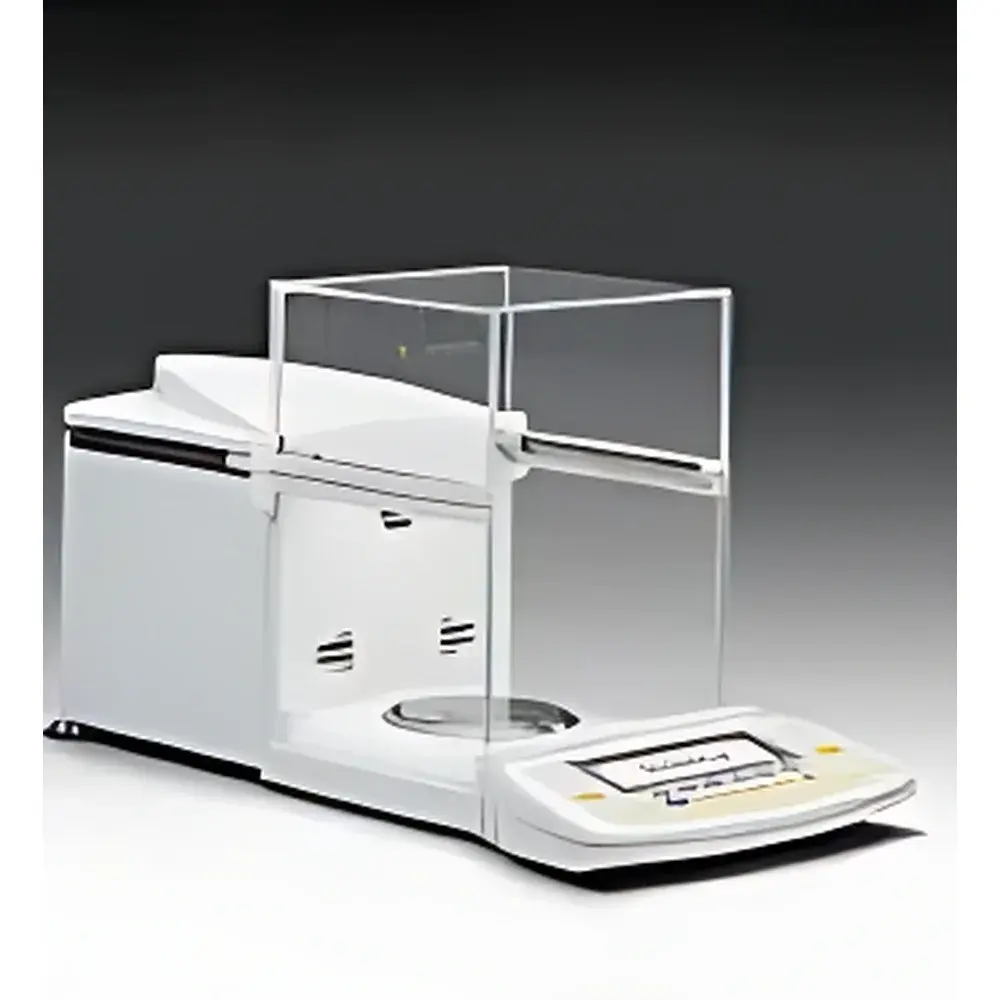
Sartorius GENIUS Series Ultra-Micro and Analytical Balances
| Brand | Sartorius |
|---|---|
| Origin | Germany |
| Manufacturer Type | Authorized Distributor |
| Origin Category | Imported |
| Pricing | Upon Request |
| Weighing Range | 5.1 g to 610 g |
| Readability | 0.001 mg to 0.1 mg |
| Pan Diameter | Ø30 mm to Ø90 mm |
| Sensor Technology | Monolithic Super-Cell |
| Calibration | isoCAL® Fully Automatic Internal Calibration |
| Draft Shield | F.A.S.T. Motorized, Self-Learning Glass Enclosure |
| Electrostatic Control | N.I.C.E. One-Touch Neutralization |
| Display | Backlit Graphical LCD |
| Processor | 40 MHz High-Speed Microcontroller |
| Compliance | ISO/IEC 17025, GLP, GMP, USP <41>, ASTM E898, FDA 21 CFR Part 11 (with optional audit trail software) |
Overview
The Sartorius GENIUS Series represents a class of high-precision ultra-micro and analytical balances engineered for laboratories requiring trace-level mass determination with uncompromising repeatability and regulatory traceability. These instruments operate on electromagnetic force compensation (EMFC) principle — where the mass-induced displacement of a weighing pan is counterbalanced by a precisely regulated current through a coil within a permanent magnetic field. The resulting current is linearly proportional to the applied mass and digitally converted into a stable, temperature-compensated reading. Designed and manufactured in Germany, each GENIUS balance integrates a monolithic super-cell sensor architecture that eliminates mechanical hysteresis and ensures long-term stability under variable environmental loads. The series serves as a foundational metrology tool across pharmaceutical QC labs, academic research facilities, reference material certification bodies, and contract testing organizations where adherence to ISO/IEC 17025 accreditation requirements is mandatory.
Key Features
- Monolithic Super-Cell Sensor: A single-piece, stress-free load cell design delivering exceptional linearity (<0.0005% of full scale), minimal creep (<0.001% FS/30 min), and immunity to lateral force interference.
- isoCAL® Fully Automatic Calibration & Adjustment: Temperature- and time-triggered internal calibration using certified weights; all calibration events are timestamped, logged internally, and exportable via RS-232 or USB for audit compliance.
- F.A.S.T. Motorized Draft Shield: A self-learning, brushless DC motor system that autonomously optimizes opening/closing speed and position based on ambient airflow patterns and user interaction history — reducing settling time by up to 40%.
- N.I.C.E. Electrostatic Neutralization: Integrated ionizing module activated with one button press; generates balanced bipolar air ions to dissipate static charges from samples, containers, and weighing pans without physical contact.
- GLP/GMP-Ready Interface Architecture: Dual isolated serial ports (RS-232 and dedicated printer port), optional Ethernet/Wi-Fi modules, and configurable data output formats (TXT, CSV, Sartorius .sbl) compatible with LIMS and ELN systems.
- 40 MHz MC1 Microprocessor: Enables real-time digital filtering, adaptive damping algorithms, and simultaneous multi-parameter computation (e.g., density, percentage, net/gross/tare) without latency.
Sample Compatibility & Compliance
The GENIUS Series accommodates diverse sample forms — including powders in quartz microcrucibles, volatile solvents in sealed vials, hygroscopic compounds under inert gas purging, and static-prone polymer films — thanks to its electrostatic shielding (anti-static coated glass draft shield), rapid stabilization algorithm, and optional desiccant chamber integration. All models comply with international metrological standards: OIML R 76-1 (2021), ISO 9001:2015, ISO/IEC 17025:2017, and pharmacopeial requirements per USP “Balances” and “Weighing on an Analytical Balance”. isoCAL® event logs meet ALCOA+ data integrity criteria, supporting 21 CFR Part 11 compliance when paired with Sartorius LabX® software featuring electronic signatures and role-based access control.
Software & Data Management
While standalone operation is fully functional, seamless integration with Sartorius LabX® software transforms the GENIUS platform into a networked, auditable measurement node. LabX provides automated method execution, customizable report templates (PDF/Excel), raw data archiving with SHA-256 hash verification, and full electronic audit trail covering user actions, calibration history, and environmental metadata (temperature/humidity from optional sensors). Data export supports CSV, XML, and ASTM E1382-compliant formats for direct ingestion into statistical process control (SPC) tools or enterprise quality management systems (QMS).
Applications
- Pharmaceutical: Active pharmaceutical ingredient (API) assay quantification, reference standard weighing, dissolution tablet mass uniformity testing.
- Materials Science: Nanoparticle mass loading on TEM grids, catalyst dosage in catalytic reaction screening, thin-film thickness calculation via gravimetric deposition.
- Environmental Testing: Filter weight gain analysis for PM2.5/PM10 particulate matter, solvent-extractable residue (SER) determination per EPA Method 1664.
- Academic Research: Isotope ratio mass spectrometry (IRMS) sample preparation, stoichiometric reagent dispensing for synthetic chemistry, microgravimetric corrosion rate studies.
- Forensics & Metrology: Trace evidence weighing (e.g., gunshot residue, fiber fragments), certified reference material (CRM) assignment, uncertainty budgeting per GUM (JCGM 100:2008).
FAQ
What is the difference between ultra-micro and analytical balance classifications per OIML?
Ultra-micro balances (e.g., GENIUS ME5) offer readability ≤0.001 mg and are classified as Class U; analytical balances (e.g., ME235S, ME614S) provide readability ≥0.01 mg and fall under Class I or II depending on verification scale interval.
Can isoCAL® be scheduled independently of temperature drift detection?
Yes — users may configure fixed-interval calibration (e.g., every 2 hours) or manual initiation, in addition to default temperature-triggered mode (±1.5 °C deviation from last calibration temp).
Is the N.I.C.E. ionizer compliant with IEC 61340-5-1 for ESD-sensitive environments?
Yes — it meets discharge decay time <2.0 s per ANSI/ESD S20.20 and produces balanced ion output (±5% offset) verified per IEC 61340-5-1 Annex B.
Does the F.A.S.T. system require periodic recalibration or maintenance?
No — the motorized mechanism uses wear-free magnetic coupling and self-diagnoses positional accuracy during each cycle; no user-serviceable parts are required within 10 years of nominal operation.
How is measurement uncertainty estimated for GENIUS balances?
Sartorius provides type-A (repeatability) and type-B (calibration, resolution, eccentricity, sensitivity) uncertainty components in accordance with EURACHEM/CITAC Guide CG4; expanded uncertainty (k=2) is documented in the factory certificate supplied with each unit.