
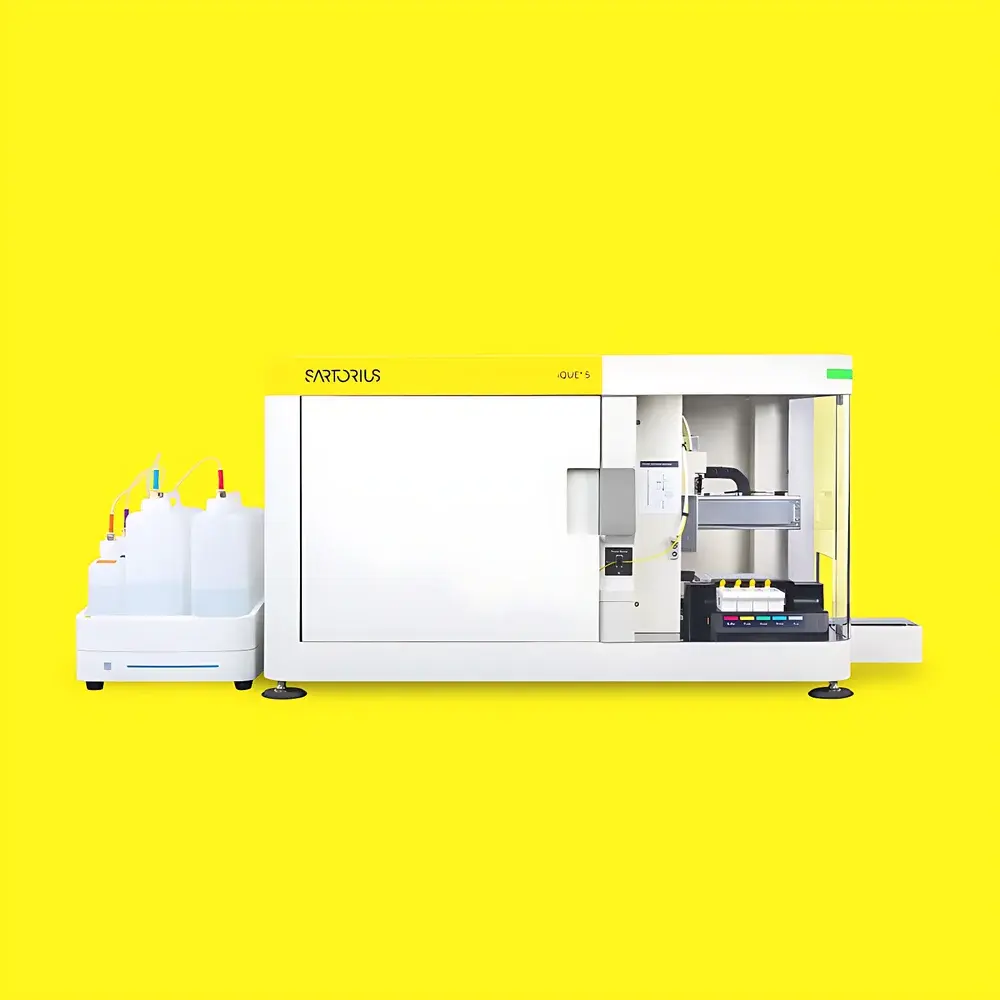
Sartorius iQue® 5 High-Throughput Imaging Flow Cytometer
| Brand | Sartorius |
|---|---|
| Origin | USA |
| Manufacturer Type | Authorized Distributor |
| Origin Category | Imported |
| Model | iQue® 5 |
| Technology Platform | Imaging Flow Cytometry |
| Product Type | Flow Cytometry Analyzer |
| Throughput | 96-well plate in ≤5 min, 384-well plate in ≤20 min |
| Detection Channels | 27 independent parameters with per-channel voltage control |
| Sample Compatibility | Cells, microspheres, yeast, and submicron particles down to 0.2 µm |
| Plate Formats | 96-well and 384-well plates |
| Automation Interface | Compatible with robotic liquid handlers |
| Fluidics Architecture | Patented air-gap sampling with swappable needles/tubing |
| Software Platform | iQue® ForeCyt® v6.x (with audit trail, analysis automation, and GLP-compliant reporting) |
| Optional Accessory | iQue® Qmax mobile fluid management cart |
Overview
The Sartorius iQue® 5 High-Throughput Imaging Flow Cytometer is an engineered solution for quantitative, image-based multiparametric analysis of suspension-based biological samples at microplate scale. Unlike conventional flow cytometers that rely solely on light-scatter and fluorescence intensity, the iQue® 5 integrates high-speed digital microscopy with hydrodynamic focusing to capture spatially resolved, multiplane images (brightfield + up to 6 fluorescence channels per event) while maintaining true flow cytometric statistical rigor. This imaging flow cytometry platform bridges the gap between traditional cytometry throughput and morphological resolution—enabling objective, morphology-informed gating, rare-event detection with visual validation, and phenotypic classification based on texture, shape, and subcellular localization. Designed specifically for early-stage drug discovery, immunoprofiling, and cell therapy QC, the iQue® 5 delivers statistically robust population-level data without requiring manual microscopy review or post-acquisition reanalysis.
Key Features
- 27-parameter detection capability with independent voltage control per photomultiplier tube (PMT), enabling precise compensation tuning across complex multicolor panels.
- Patented air-gap sampling technology minimizes carryover and eliminates clogging risks associated with viscous or particulate-laden samples—critical for primary cell lysates, aggregated biologics, or whole-blood assays.
- Modular fluidics architecture with user-replaceable syringes, tubing, and sampling needles supports rapid maintenance and method transfer across instruments.
- Integrated plate-handling compatibility for both 96-well and 384-well formats, with automatic well-to-well priming and aspiration optimization to maintain laminar flow integrity across all plate types.
- Real-time system health monitoring with proactive alerting: detects pressure deviations, flow-rate anomalies, and optical alignment drift, logging events with timestamped diagnostic metadata.
- Qmax mobile fluid management cart enables unattended operation for >12 hours by providing centralized, temperature-stabilized sheath fluid delivery and waste containment with level-sensing feedback.
Sample Compatibility & Compliance
The iQue® 5 accommodates a broad dynamic range of sample types—including mammalian cells (adherent and suspension), microbial cells (yeast, bacteria), synthetic microspheres (0.2–50 µm), and extracellular vesicles—without hardware modification. Its low-volume aspiration mode (as little as 5 µL/well) preserves precious samples while maintaining signal-to-noise ratio. All validated reagent kits (e.g., iQue® Human Immune Profiling Panels, Apoptosis Assay Kits) are manufactured under ISO 13485-certified conditions and supplied with lot-specific performance verification reports. The platform complies with FDA 21 CFR Part 11 requirements for electronic records and signatures when used with ForeCyt® software configured in audit-trail-enabled mode. Instrument qualification documentation (IQ/OQ/PQ protocols) and risk assessments aligned with ISO 14971 are available for GxP-regulated environments.
Software & Data Management
ForeCyt® software (v6.4+) serves as the unified interface for experimental design, acquisition control, automated analysis, and report generation. It features template-driven workflow creation—allowing non-expert users to execute standardized assays via drag-and-drop gating strategies and preconfigured compensation matrices. Batch processing supports parallel analysis of hundreds of wells with consistent parameter application and inter-plate normalization. Advanced visualization includes t-SNE and UMAP projections, heatmaps of median fluorescence intensity (MFI) across conditions, and overlay-capable image galleries for morphological comparison. All raw data (FCS 3.1 + proprietary .iQF image metadata) are stored in vendor-neutral formats; export options include CSV, PDF, and structured JSON for integration into LIMS or ELN systems. Audit trails record every user action—including gate edits, parameter changes, and report exports—with immutable timestamps and operator ID linkage.
Applications
- High-content immunophenotyping: simultaneous quantification of surface marker expression, intracellular cytokine production, and nuclear translocation in primary PBMCs across dose-response matrices.
- Cell-based assay development: kinetic monitoring of apoptosis, phagocytosis, or cytotoxicity using morphology-validated event classification—not just fluorescence intensity thresholds.
- Viral vector characterization: enumeration and purity assessment of lentiviral or AAV particles via co-staining for capsid protein and genomic RNA, with image-based confirmation of intactness.
- Stem cell differentiation QC: tracking morphological heterogeneity during mesenchymal or neural progenitor maturation using texture-based clustering algorithms embedded in ForeCyt®.
- Antibody screening workflows: rapid ranking of hybridoma supernatants or scFv libraries based on binding affinity, internalization kinetics, and epitope binning—all within a single plate run.
FAQ
What regulatory standards does the iQue® 5 support for GMP/GLP environments?
The system meets requirements for computerized system validation (CSV) under Annex 11 and 21 CFR Part 11 when deployed with ForeCyt® in locked-down configuration, including role-based access control, electronic signatures, and full audit trail functionality.
Can the iQue® 5 be integrated into existing robotic automation platforms?
Yes—it features standard RS-232 and Ethernet interfaces with documented API commands for bidirectional communication with Hamilton, Tecan, and Beckman Coulter robotic arms, supporting fully walk-away plate loading and result handoff.
Is calibration traceable to NIST standards?
Fluorescence calibration uses Sartorius Traceable™ microspheres calibrated against NIST SRM 193X series; daily QC checks are performed using iQue® QC Beads with certificate-of-analysis traceability.
How is data security managed during remote instrument monitoring?
All remote connections require TLS 1.2+ encrypted tunnels; no raw data is transmitted externally—only anonymized diagnostic logs and status metrics are shared via secure Sartorius Cloud endpoints.
Does the platform support custom assay development beyond prequalified kits?
Yes—users may define novel markers, create custom image analysis algorithms using Python scripting hooks in ForeCyt®, and validate new protocols under internal SOPs with full version-controlled documentation archiving.





