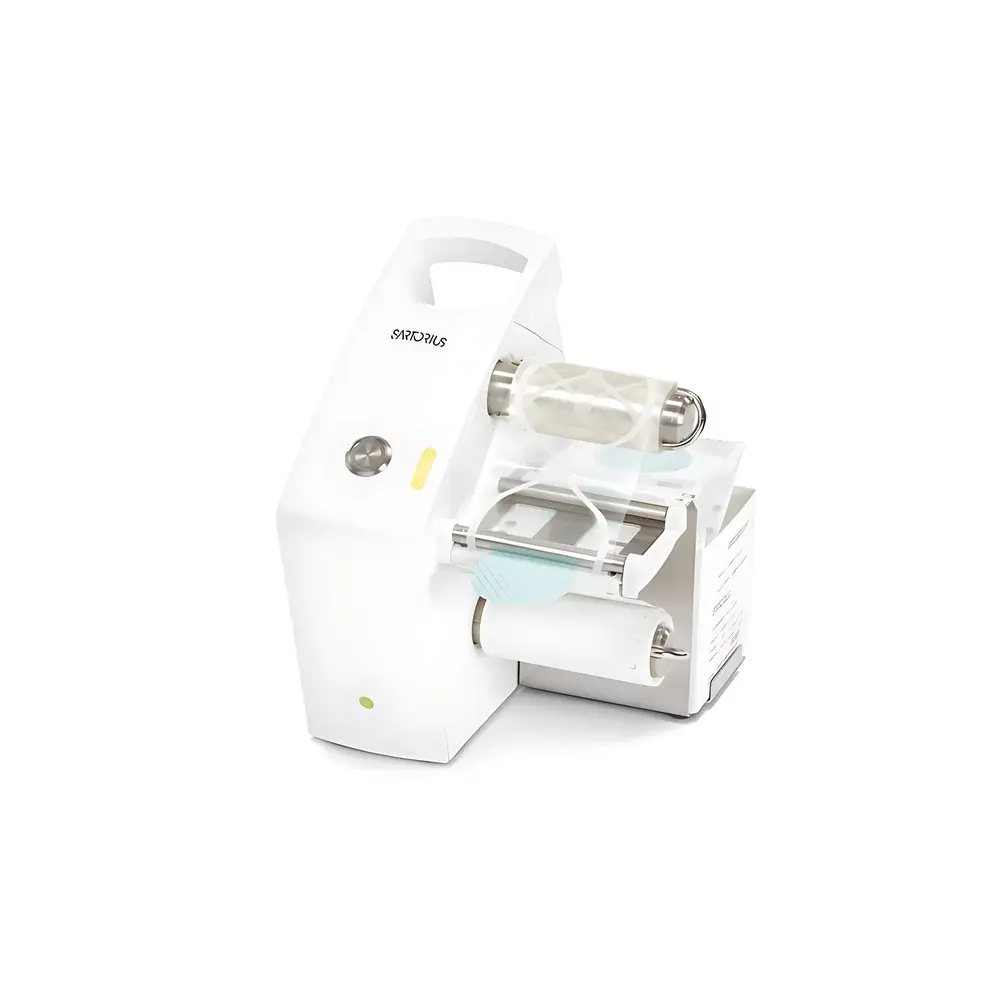
Sartorius Microsart® E-motion Automated Filter Membrane Dispenser
| Brand | Sartorius |
|---|---|
| Origin | Germany |
| Model | 16713-BO |
| Dimensions (L × H × W) | 233 × 172 × 230 mm |
| Weight | 2.6 kg |
| Power Options | AC adapter or built-in rechargeable battery |
| Membrane Feed Mechanism | Motor-driven sprocket roller system |
| Activation Modes | Touch button, infrared optical sensor (hands-free), foot switch |
| Compatible Membrane Format | Pre-folded sterile strip-packaged filters, 47 mm diameter (standard) |
| Membrane Type Support | Cellulose ester (CE), polyethersulfone (PES), nylon, and other standard microbiological filtration membranes |
| Compliance | Designed for ISO 11737-1, USP <61>, <62>, and EU Ph. Eur. 2.6.12 environments |
Overview
The Sartorius Microsart® E-motion Automated Filter Membrane Dispenser is an engineered solution for high-integrity, contamination-controlled membrane handling in regulated microbiological testing workflows. Unlike manual or semi-automated dispensing methods, the E-motion system eliminates direct human contact with sterile filter membranes—reducing the risk of operator-induced contamination, packaging particulate shedding, and inconsistent membrane positioning. It operates on a precision motor-driven sprocket roller mechanism that advances pre-folded, individually sealed membrane strips from standard sterile packaging formats. The device supports 47 mm diameter membranes commonly used in microbial enumeration (e.g., bacteria, yeasts, molds) per pharmacopoeial methods including USP , , EP 2.6.12, and ISO 11737-1. Its compact footprint and dual power configuration (AC mains or internal Li-ion battery) make it suitable for both fixed cleanroom stations and mobile QC lab deployments.
Key Features
- Three activation modes: touch-sensitive button, hands-free infrared optical sensor, and external foot switch—enabling seamless integration into glovebox, biosafety cabinet, or laminar flow hood workflows.
- Motorized sprocket roller drive ensures consistent, low-slip membrane advancement without wrinkling, stretching, or static-induced misalignment.
- Pre-calibrated feed path accommodates standard sterile strip packaging (e.g., 10–25 filters per pack), minimizing setup time and operator training requirements.
- Compact ergonomic design (233 × 172 × 230 mm) with integrated carry handle; weight optimized at 2.6 kg for portability across controlled environments.
- Dual power architecture: field-replaceable rechargeable battery (up to 8 hours continuous operation) or universal AC adapter—ensuring uninterrupted use during extended batch testing.
- No consumables beyond standard sterile filter strips; maintenance limited to periodic roller cleaning and firmware updates via USB-C interface.
Sample Compatibility & Compliance
The Microsart® E-motion is validated for use with all major 47 mm microbiological filter membranes—including cellulose ester (CE), polyethersulfone (PES), nylon, and mixed ester variants—supplied in folded, blister-sealed, or foil-laminated sterile strip packs. It does not alter membrane integrity or pore structure during dispensing. The system supports full traceability when paired with Sartorius’ Microsart® documentation modules and complies with ALCOA+ data integrity principles. While the dispenser itself is not a measuring instrument, its role in sample preparation aligns with GMP Annex 1 (2022), FDA Guidance for Industry: Sterile Drug Products Produced by Aseptic Processing (2004), and ISO 13485:2016 requirements for equipment used in sterility assurance processes. No calibration certificate is required; however, routine operational qualification (OQ) verification—such as membrane feed accuracy and activation response latency—is recommended per laboratory SOPs.
Software & Data Management
The E-motion unit operates as a standalone electromechanical device with no embedded operating system or network connectivity. All control logic resides in a hardened microcontroller with non-volatile memory storing activation mode settings and last-used configuration. Firmware updates are performed offline via USB-C connection using Sartorius-provided utility software (compatible with Windows 10/11). While the device generates no electronic records itself, its activation events (e.g., foot-switch actuation count, sensor-triggered dispenses) can be logged externally via PLC integration or synchronized with LIMS through optional digital I/O modules (e.g., 24 V TTL signal output). This architecture satisfies FDA 21 CFR Part 11 requirements for audit trail capability when deployed within validated systems.
Applications
- Routine microbial limit testing (MLT) in pharmaceutical, biotech, and medical device manufacturing QC labs.
- Environmental monitoring (EM) filter preparation for ISO 14644-1 classified cleanrooms.
- Water-for-injection (WFI) and purified water bioburden analysis per USP .
- Preparation of filters for subsequent membrane filtration assays (e.g., colony-forming unit enumeration on R2A, TSA, or Sabouraud dextrose agar).
- Supporting rapid method validation studies where membrane handling consistency directly impacts assay reproducibility (RSD ≤ 5% across operators).
FAQ
Does the E-motion require calibration or periodic certification?
No—this is a mechanical dispensing aid, not a metrological instrument. Routine functional checks (e.g., feed accuracy over 10 cycles, sensor response time < 300 ms) are sufficient per laboratory quality procedures.
Can it handle non-standard membrane diameters or custom packaging?
It is designed exclusively for 47 mm filters in OEM-standard folded strip packaging. Deviations require engineering review and are not supported under warranty.
Is the built-in battery replaceable by the user?
Yes—the Li-ion module is accessible via a service panel and may be replaced using Sartorius P/N 16713-BAT without tools.
What safety certifications does the device hold?
CE marked per 2014/30/EU (EMC Directive) and 2014/35/EU (Low Voltage Directive); RoHS 2011/65/EU compliant.
How is cleaning and decontamination performed?
External surfaces accept 70% isopropanol wipes; rollers may be cleaned with lint-free swabs moistened with ethanol. Autoclaving or submersion is strictly prohibited.