
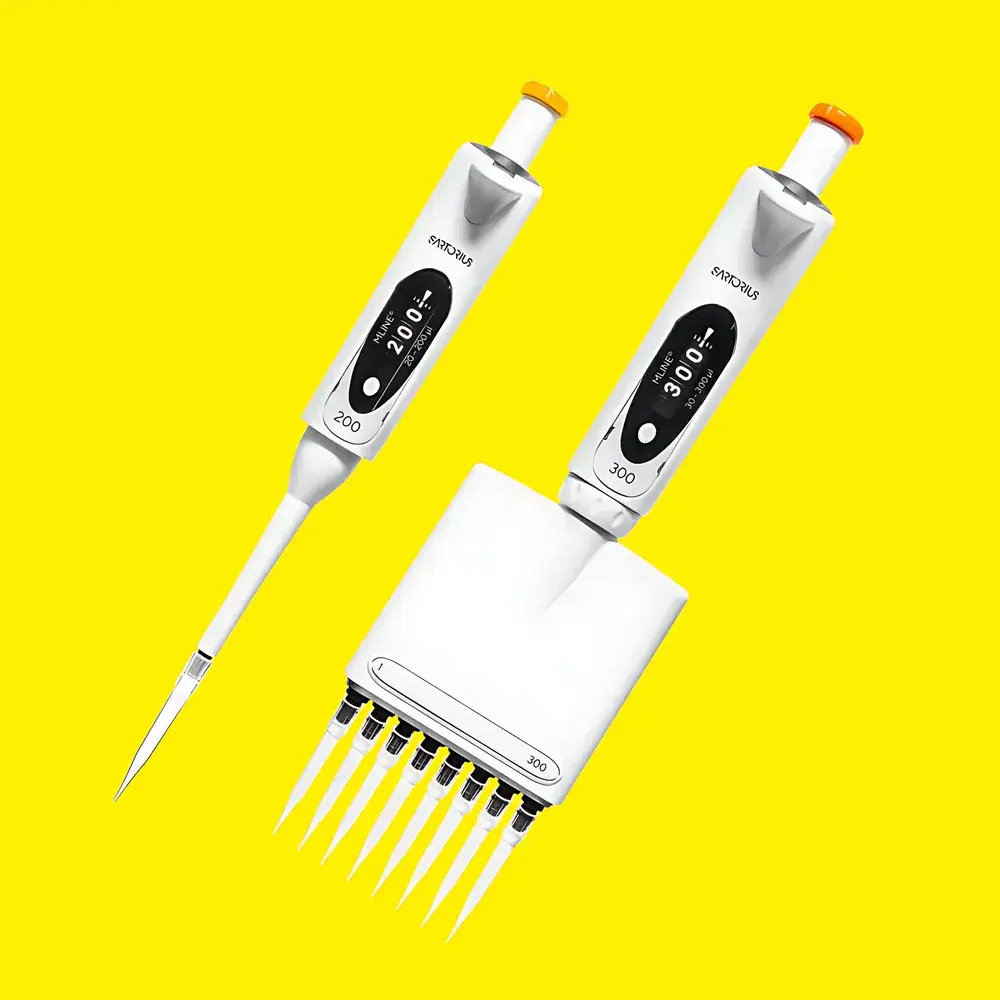
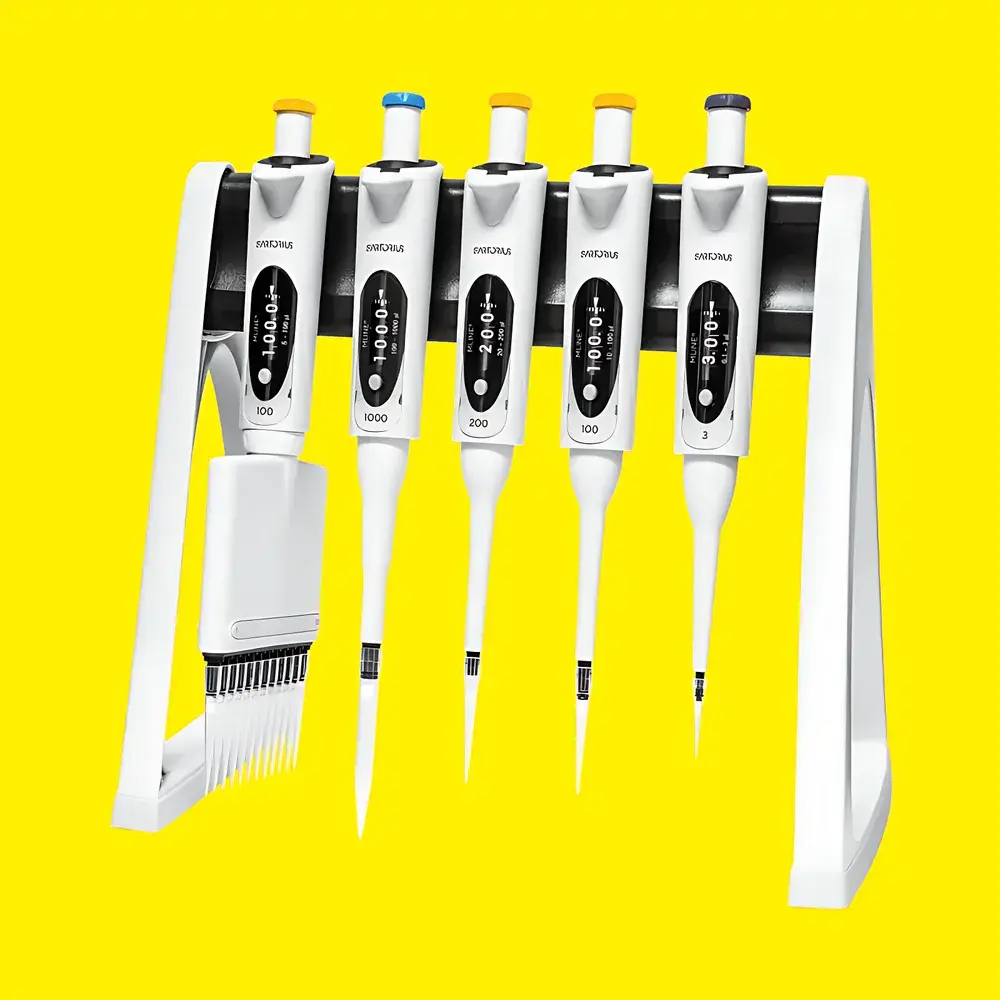
Sartorius Mline® Manual Adjustable-Volume Pipette
| Brand | Sartorius |
|---|---|
| Origin | Finland |
| Instrument Type | Single-Channel Manual Pipette |
| Automation Level | Manual |
| Channel Count | 1 / 8 / 12 |
| Volume Range | 0.1–10,000 µL |
| Maximum Capacity | 10 mL |
| Accuracy | ±0.15%–±10% (per ISO 8655) |
| Sterilization | Full-autoclavable (121°C, 20 min) |
| Tip Ejection Force | Optimized for low hand fatigue |
| Ergonomic Design | Forward-leaning grip angle, lightweight polymer housing, soft-touch plunger |
Overview
The Sartorius Mline® Manual Adjustable-Volume Pipette is an ISO 8655-compliant liquid handling instrument engineered for precision, reproducibility, and operator safety in demanding laboratory environments. Based on positive displacement aspiration and air-cushion delivery principles, the Mline® series delivers consistent volumetric performance across its full range—from ultra-low volumes (0.1 µL) to high-capacity transfers (10 mL). Designed and manufactured in Finland under stringent quality management systems (ISO 13485), each pipette undergoes individual calibration verification and traceable performance validation. Its mechanical architecture eliminates reliance on electronic components or batteries, ensuring long-term stability, minimal drift, and compliance with GLP/GMP workflows where instrument dependency must be reduced to a minimum.
Key Features
- Ergonomic forward-tilt handle geometry reduces wrist extension and ulnar deviation—clinically validated to lower risk of repetitive strain injury (RSI) during extended pipetting sessions.
- Low-force plunger mechanism (≤1.5 N activation force for 1000 µL model) minimizes finger fatigue and improves control during serial dilutions or multi-step assays.
- Integrated aerosol barrier filter (hydrophobic PTFE membrane) prevents sample carryover and cross-contamination between runs without compromising flow dynamics.
- Full autoclavability: entire pipette—including shaft, tip cone, and volume adjustment mechanism—can withstand repeated sterilization cycles at 121°C for 20 minutes per ISO 17665, preserving dimensional integrity and sealing performance.
- Volume lock system prevents accidental setting changes during transport or bench use—critical for regulated applications requiring documented parameter consistency.
- Modular design enables field-serviceable replacement of O-rings, springs, and seals using standard Sartorius service kits (e.g., 725-001-000), extending operational lifetime beyond 100,000 actuations.
Sample Compatibility & Compliance
The Mline® pipette is compatible with universal conical tip formats (including low-retention, filtered, and sterile-certified variants) and performs reliably with aqueous buffers, viscous glycerol solutions (up to 50% v/v), and moderately volatile organic solvents (e.g., ethanol, acetone) when used with appropriate tip selection. All models conform to ISO 8655-2 (volumetric accuracy and precision requirements), ISO 8655-5 (testing procedures), and EU Directive 2014/30/EU (EMC immunity for non-electronic devices). Documentation packages include factory calibration certificates traceable to NIST standards, supporting audit readiness for FDA 21 CFR Part 11–aligned laboratories operating under cGMP or ISO/IEC 17025 frameworks.
Software & Data Management
As a fully manual instrument, the Mline® requires no embedded firmware, drivers, or software integration. However, its standardized volume settings (with 0.1 µL resolution down to 10 µL, and 1 µL increments above 100 µL) are directly translatable into electronic lab notebook (ELN) entries and LIMS-based protocol templates. Each pipette bears a unique alphanumeric serial number engraved on the barrel, enabling asset-level tracking, calibration scheduling, and maintenance history logging in QMS platforms such as LabWare LIMS or Veeva Vault QMS. Optional Sartorius Pipette Calibration Manager (PCM) software supports digital archiving of third-party calibration reports and trend analysis of historical accuracy data.
Applications
- Quantitative PCR (qPCR) setup requiring precise sub-microliter dispensing of master mix and template DNA.
- Cell culture passaging and media supplementation where sterility assurance and ergonomic sustainability are critical over 8-hour shifts.
- Reference material preparation in metrology labs accredited to ISO/IEC 17025, leveraging traceable volume delivery and autoclave validation records.
- QC testing in pharmaceutical manufacturing environments adhering to USP Analytical Instrument Qualification guidelines.
- Academic teaching labs needing robust, serviceable tools that support hands-on training in volumetric technique fundamentals without software dependencies.
FAQ
Is the Mline® pipette suitable for handling corrosive acids or strong bases?
Yes—when equipped with optional chemically resistant tip cones (Sartorius part #725-002-000) and used with polypropylene or FEP-coated tips. Standard stainless steel plunger rods remain stable in pH 2–12 environments; prolonged exposure to concentrated HCl or NaOH is not recommended.
Can I recalibrate the pipette in-house without sending it to a service center?
Yes—volume adjustment is accessible via a recessed hex screw on the upper barrel. Recalibration must be performed using gravimetric methods per ISO 8655-6, with certified analytical balances (≤0.01 mg readability) and temperature-controlled weighing chambers (20 ± 0.5°C). Sartorius provides detailed recalibration SOPs upon request.
What is the recommended recalibration interval for GxP-regulated use?
Annually is standard; however, high-throughput labs (>500 daily dispenses) or those performing critical potency assays should implement semi-annual verification with documented intermediate checks every 30 days.
Does the Mline® support tip ejection with gloved hands?
Yes—the large-diameter ejection lever and tactile feedback ridge allow reliable operation with standard nitrile or latex gloves (thickness ≤0.15 mm), verified per EN 374-2:2014 glove compatibility testing.
Are spare parts and service documentation available globally?
Yes—Sartorius maintains regional service hubs in North America, EMEA, and APAC, with all consumables and repair kits stocked under unified part numbering. Technical manuals, exploded diagrams, and torque specifications are accessible via the Sartorius Service Portal using the pipette’s serial number.



