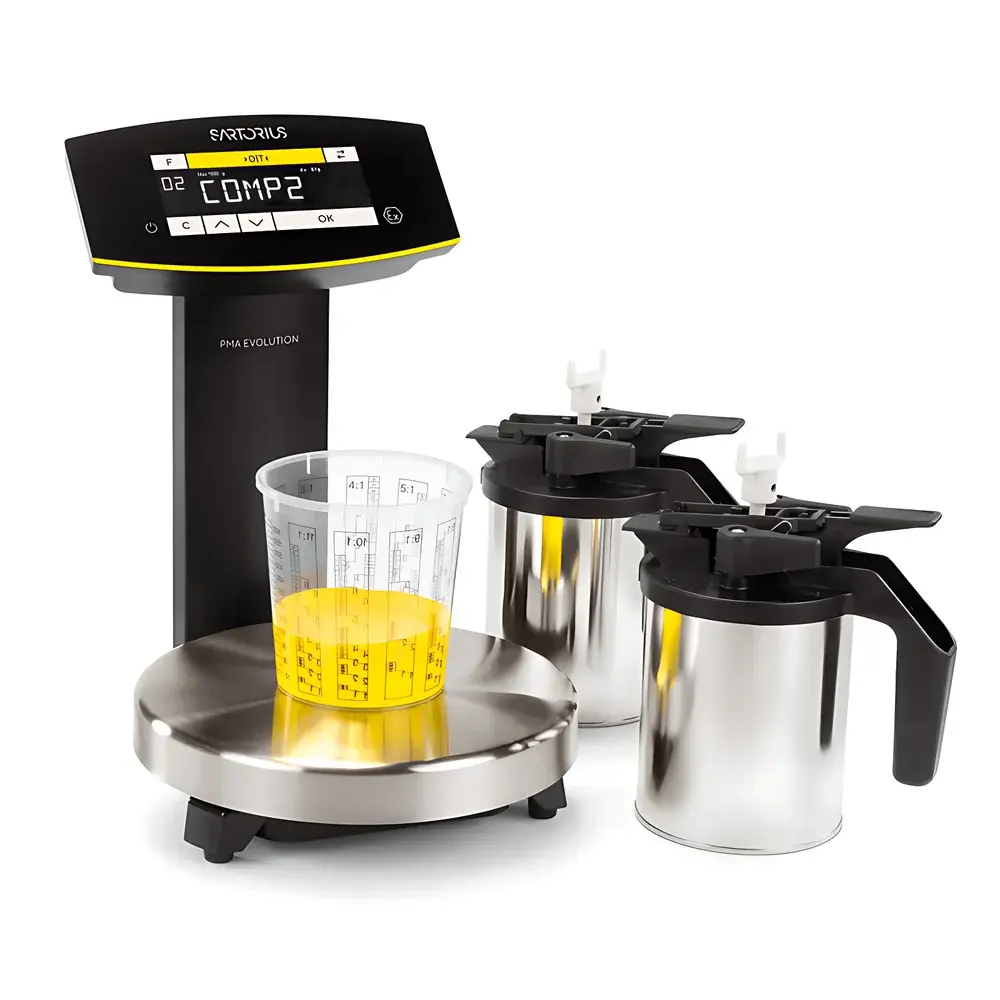
Sartorius PMA.Evolution Explosion-Proof Paint Mixing Scale
| Brand | Sartorius |
|---|---|
| Origin | Germany |
| Model | PMA Evolution |
| Certification | ATEX/IECEx Zone 1 & 2, Class I Div 1/2 (for hazardous areas) |
| Display | High-contrast backlit LCD (black background / white characters) |
| Interface | USB-C (power + data over single cable) |
| Touch Control | Capacitive sensor-based UI |
| Housing Material | Stainless steel base with tempered glass display panel |
| Software Integration | PMA.Management PC software, embedded paint formulation module |
| Compliance | EN 13463-1, EN 60079-0, EN 60079-11, ISO 8502-9 (surface cleanliness verification support), GLP-compliant audit trail (via software) |
| Operating Environment | -10 °C to +40 °C, max. 85% RH non-condensing |
| IP Rating | IP65 (front panel) |
Overview
The Sartorius PMA.Evolution Explosion-Proof Paint Mixing Scale is an intrinsically safe, certified weighing instrument engineered specifically for precise, repeatable, and traceable formulation of solvent-based, high-VOC, or reactive coating systems in classified hazardous environments. Built upon Couette-type load cell architecture with electromagnetic force compensation (EMFC) technology, it delivers stable, drift-compensated mass readings under dynamic workshop conditions—critical where static charge accumulation, solvent vapors, or dust clouds pose ignition risks. Designed for Zone 1/2 (ATEX/IECEx) and Class I Division 1/2 (UL/cUL) locations, the PMA.Evolution integrates mechanical robustness with digital workflow efficiency, enabling compliant paint mixing without compromising on metrological integrity or operational speed.
Key Features
- Intrinsically safe design certified to ATEX Directive 2014/34/EU (II 2G Ex ib IIB T4 Gb) and IECEx Scheme (Ex ib IIB T4 Gb), plus UL/cUL Class I, Division 1, Groups B, C, D; suitable for continuous operation in paint booths, mixing rooms, and solvent-handling zones.
- Tempered glass front panel with capacitive touch interface—resistant to chemical splashes, abrasion, and repeated cleaning with industrial solvents (e.g., xylene, acetone, MEK).
- High-contrast monochrome LCD (black background / white characters) with wide viewing angle (>140°) and adjustable brightness—optimized for readability under overhead lighting, protective eyewear, or gloved operation.
- Single-cable USB-C connectivity providing simultaneous power delivery (5 V DC) and bidirectional data transfer—eliminates separate power adapters and serial cables, reducing installation time and point-of-failure risk.
- Onboard paint formulation module supporting multi-step recipes (up to 99 components), real-time % deviation calculation, tolerance band alerts, and auto-zero stabilization during sequential additions.
- EMFC-based weighing system with automatic temperature and drift compensation—guarantees ≤ ±0.002% repeatability (at 100% capacity) across ambient fluctuations typical in industrial finishing facilities.
Sample Compatibility & Compliance
The PMA.Evolution accommodates standard paint mixing vessels—including stainless steel buckets (up to 30 L), lined pails, and grounded metal containers—without requiring platform modification. Its overload protection (150% capacity) and shock-dampened load cell mount prevent damage from accidental impacts during high-throughput operations. All firmware and embedded applications comply with ISO/IEC 17025:2017 clause 5.9 (traceability of measurement results) and support GLP/GMP documentation requirements via optional PMA.Management software. Calibration is performed using external weights traceable to national standards (e.g., PTB, NIST); internal calibration routines are password-protected and logged with user ID, timestamp, and deviation values per ISO 9001:2015 Annex A.2.
Software & Data Management
PMA.Management is a Windows-based desktop application enabling full configuration, audit trail review, report generation (PDF/CSV), and secure export of formulation records—including operator ID, batch number, environmental conditions (optional via connected hygrometer/thermometer), and pass/fail status per component. The software enforces 21 CFR Part 11 compliance through electronic signatures, role-based access control, and immutable audit logs with SHA-256 hashing. Data synchronization occurs automatically upon USB connection; no network dependency is required. Optional OPC UA integration allows direct linkage to MES/ERP platforms (e.g., SAP QM, Siemens SIMATIC IT) for real-time material consumption tracking and quality gate enforcement.
Applications
- Precision color matching and tinting in automotive OEM and refinish operations.
- Batch-scale formulation of two-component polyurethane, epoxy, and acrylic coatings requiring stoichiometric accuracy.
- Regulatory-compliant mixing of VOC-controlled architectural paints under EU Directive 2004/42/EC.
- Quality assurance workflows verifying adherence to ASTM D4753 (practice for calibrating paint mixing equipment) and ISO 1513 (paint and varnish—sampling).
- Validation of surface preparation agents (e.g., phosphating solutions, etch primers) where concentration tolerances are defined per ISO 8502-9.
FAQ
Is the PMA.Evolution suitable for use in Zone 0 areas?
No. It is certified for Zone 1 and Zone 2 (gas/vapor) and Zone 21/22 (dust) only. Zone 0 requires different protection concepts (e.g., pressurization or encapsulation) not implemented in this model.
Can the scale operate without a connected PC?
Yes. All core paint formulation functions—including recipe execution, tolerance checking, and local data storage—are fully autonomous. The PC is required only for advanced reporting, user management, or firmware updates.
Does it support calibration with internal motorized mechanisms?
No. Internal motorized calibration is not included; calibration relies on certified external weights. This ensures metrological transparency and avoids hidden drift sources associated with automated mechanisms.
What is the maximum recommended vessel weight for stable operation?
The scale supports tare weights up to 90% of rated capacity. For optimal stability during pouring, Sartorius recommends keeping total gross weight (vessel + contents) within ±5% of the selected model’s nominal capacity—verified during factory acceptance testing per OIML R76-1.