
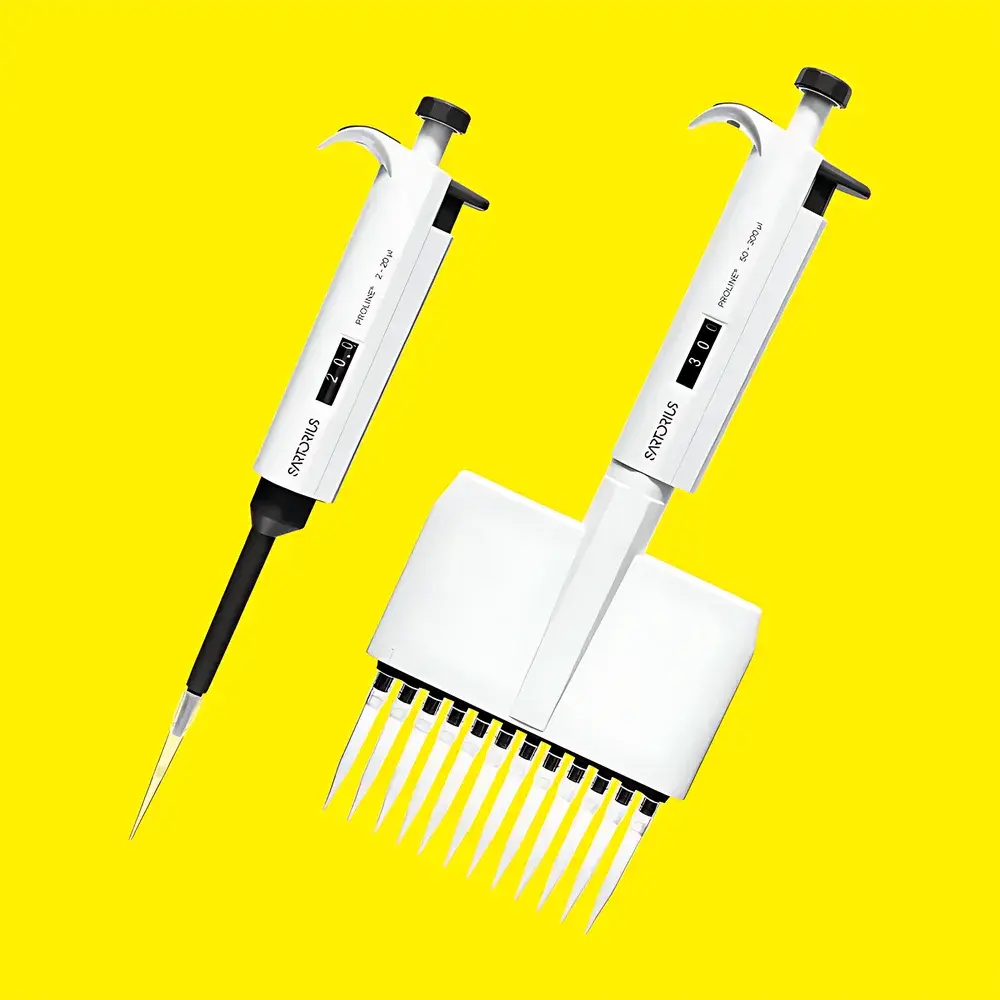
Sartorius Proline Manual Pipette
| Brand | Sartorius |
|---|---|
| Origin | Finland |
| Manufacturer Type | Authorized Distributor |
| Origin Category | Imported |
| Model | Proline |
| Instrument Type | Manual Pipette |
| Automation Level | Manual |
| Channel Configuration | Single, 8-Channel, 12-Channel |
| Volume Range | 0.1–5000 µL |
| Maximum Capacity | 5000 µL |
| Accuracy | ±0.2% to ±12% (volume-dependent, per ISO 8655) |
Overview
The Sartorius Proline Manual Pipette is a precision-engineered, ergonomically optimized liquid handling tool designed for consistent, repeatable volumetric transfer in academic, clinical, and industrial laboratory environments. Built upon the foundational principles of positive displacement and air-cushion aspiration/dispense mechanics, the Proline series delivers traceable accuracy and long-term stability across its full volume range—from ultra-low volumes (0.1 µL) to high-capacity transfers (5000 µL). As Sartorius’ original manual pipette platform—introduced over two decades ago—the Proline remains widely deployed globally due to its robust mechanical architecture, minimal maintenance requirements, and ISO 8655-compliant performance. Its enduring presence in university teaching labs, QC facilities, and R&D workflows reflects its balance of metrological integrity, operational simplicity, and cost efficiency.
Key Features
- Ergonomic finger rest and low actuation force: Reduces hand fatigue and mitigates risk of repetitive strain injury (RSI), especially during high-throughput pipetting sessions.
- Clear, tamper-resistant volume display: Large, dual-scale digital readout enables rapid verification of set volume and fine-tuning—minimizing mis-setting errors in fast-paced environments.
- Tool-free user calibration: Supports on-site adjustment using standard gravimetric methods (e.g., ASTM E542, ISO 8655-6); no special tools or software required—ideal for GLP-compliant labs maintaining internal calibration records.
- Modular, serviceable design: Internally sealed piston mechanism with chemically resistant PTFE seals ensures longevity across aqueous, viscous, and mildly corrosive liquids (e.g., ethanol, dilute acids/bases).
- Multi-channel variants (8 & 12 channels): Enables parallel dispensing into microtiter plates (96-/384-well) with inter-channel volume consistency verified per ISO 8655-4.
Sample Compatibility & Compliance
The Proline pipette accommodates a broad spectrum of liquid classes—including water-based buffers, cell suspensions, glycerol-diluted reagents (up to 40% v/v), and ethanol solutions—without requiring tip pre-wetting or volume correction factors under standard ambient conditions (20–25 °C, 40–60% RH). All models comply with ISO 8655 Parts 1–6 (Pipettes and Calibration) and are supplied with individual factory calibration certificates traceable to national standards (e.g., NIST, MIKES). While not electronically audit-trail enabled, the manual calibration protocol supports documentation for FDA 21 CFR Part 11–aligned quality systems when paired with lab-specific SOPs and logbook entries.
Software & Data Management
As a fully manual instrument, the Proline requires no embedded firmware, drivers, or proprietary software. Volume settings, calibration logs, and maintenance records are maintained externally via laboratory notebooks, LIMS-integrated spreadsheets, or electronic quality management systems (eQMS). Users may generate calibration reports compliant with ISO/IEC 17025 requirements using standard gravimetric data acquisition tools (e.g., METTLER TOLEDO XPR balances, Sartorius Cubis® II). No cloud connectivity or remote diagnostics are supported—ensuring data sovereignty and simplifying IT validation in regulated environments.
Applications
- Undergraduate and graduate teaching laboratories: Introducing fundamental pipetting technique, error analysis, and volumetric metrology concepts.
- QC/QA testing in pharmaceutical manufacturing: Sample preparation for HPLC, dissolution testing, and microbial limit assays where manual control and procedural transparency are prioritized.
- Cell culture and molecular biology workflows: Serial dilution of plasmid DNA, enzyme stock preparation, and reagent aliquoting under biosafety cabinet constraints.
- Environmental and food safety labs: Standard addition protocols, spiked recovery studies, and reference material dilution where instrument qualification follows ISO/IEC 17025 clause 6.4.
FAQ
Is the Proline pipette autoclavable?
No—Proline pipettes are not autoclavable. Sterilization is achieved via external surface disinfection (e.g., 70% ethanol wipe) or use of certified sterile, filter-equipped tips.
Does it support adjustable tip ejection force?
No—tip ejection is standardized at fixed mechanical resistance; users requiring variable ejection (e.g., for low-retention tips) should consider the Sartorius Picus® or Eppendorf Research® plus platforms.
Can I use third-party tips with Proline pipettes?
Yes—Proline conforms to universal tip-fit geometry (ISO 8655-2 Annex B), though optimal accuracy and leak integrity are guaranteed only with Sartorius OptiTip® or CertiTip® consumables.
What is the recommended recalibration interval?
Per ISO 8655-6 and typical lab practice, recalibration is advised every 3–6 months for routine use, or after 10,000 cycles, impact events, or changes in environmental conditions exceeding ±5 °C or ±20% RH.
Are 12-channel Proline models compatible with standard 96-well plates?
Yes—all 12-channel variants align precisely with ANSI/SLAS footprint specifications and accommodate flat-bottom, U-bottom, and V-bottom microplates without adapter plates.



