
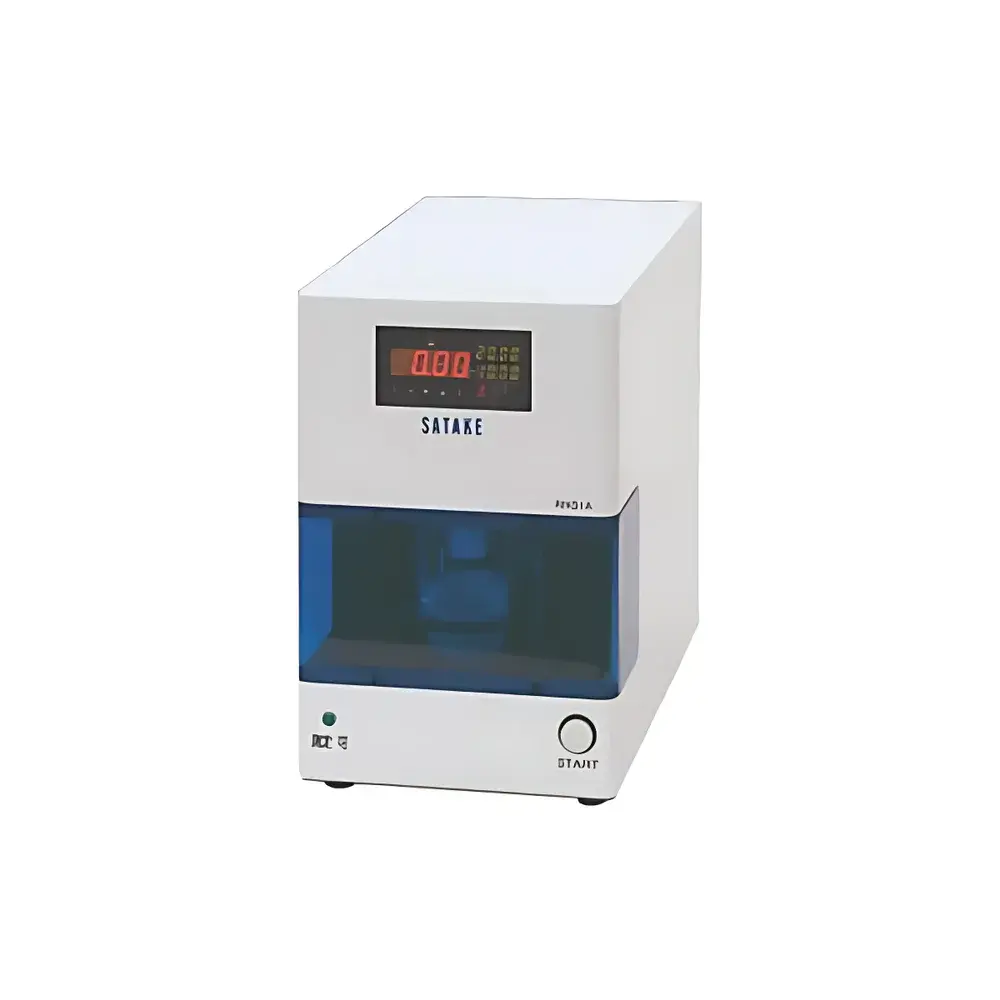
SATAKE RHS1A Rice Hardness and Viscosity Analyzer
| Brand | SATAKE |
|---|---|
| Origin | Japan |
| Model | RHS1A |
| Instrument Type | Benchtop |
| Analysis Time | 10 s per test |
| Sample Mass | 0.2 g (cooked rice sample) |
| Compression Stroke Speed | 0.3 mm/s |
| Force Measurement Range | 0–50 N |
| Resolution | 0.01 N |
| Hardness Accuracy | ±0.2 units |
| Viscosity Accuracy | ±0.2 units |
| Balance Accuracy | ±0.1 units |
| Elasticity Accuracy | ±0.1 units |
| Operating Temperature | 0–40 °C |
| Relative Humidity | 30–80% RH (non-condensing) |
| Power Supply | AC 100 ±10 V, 50/60 Hz, 100 W |
| Dimensions (W×D×H) | 310 × 200 × 343 mm |
| Weight | 12 kg |
Overview
The SATAKE RHS1A Rice Hardness and Viscosity Analyzer is a precision benchtop instrument engineered for objective, quantitative evaluation of the textural properties of cooked rice. It operates on the principle of controlled uniaxial compression testing—applying a calibrated force to a standardized rice sample via a stainless-steel probe, then recording real-time load–displacement response during both downward compression and upward recovery phases. From this force–time curve, four fundamental physical parameters are derived: hardness (peak compressive force), viscosity (area under the loading curve, reflecting resistance to deformation), elasticity (ratio of recovery distance to compression distance), and balance (harmonic ratio between hardness and viscosity). Designed specifically for paddy breeding programs, milling quality control, and ready-to-eat rice product development, the RHS1A delivers repeatable, operator-independent metrics aligned with sensory perception—enabling correlation with human taste panel data in accordance with ISO 5495:2006 (sensory analysis – methodology – paired comparison test) and ASTM E1870-21 (standard guide for sensory evaluation of food products).
Key Features
- Simultaneous quantification of hardness, viscosity, elasticity, and balance in a single 10-second test cycle—no manual repositioning or multi-step protocols required.
- Direct compatibility with sample cups from SATAKE’s NS-1000 Rice Taste Analyzer and FV-1000 Freshness Meter, enabling seamless integration into unified grain quality assessment workflows.
- Motor-driven probe with programmable descent speed (0.3 mm/s) and precise position feedback ensures consistent contact pressure and eliminates inter-operator variability.
- Benchtop footprint (310 × 200 × 343 mm) and low power consumption (100 W) support deployment in QC labs, breeding stations, and pilot-scale processing facilities without dedicated infrastructure.
- Embedded microcontroller with 0.01 N force resolution and ±0.1–±0.2 unit accuracy across all output parameters meets GLP-compliant data integrity requirements for internal method validation.
- Real-time graphical display of force–time curves on integrated LCD interface; optional USB export to Windows-based management software supporting audit trails and electronic signatures per FDA 21 CFR Part 11.
Sample Compatibility & Compliance
The RHS1A accepts standard 0.2 g portions of cooked, cooled rice—prepared per JIS Z 8401:2019 (rules for the rounding of numerical values) and ISO 6636-1:2017 (rice — part 1: determination of cooking quality). It accommodates short-, medium-, and long-grain varieties—including japonica, indica, and glutinous types—without recalibration. All mechanical components contacting samples are food-grade stainless steel (SUS304), compliant with FDA 21 CFR §178.3570 (lubricants for food-processing machinery) and EU Regulation (EC) No 1935/2004. The instrument conforms to IEC 61000-6-3 (EMC emission standards) and IEC 61010-1:2010 (safety requirements for electrical equipment for measurement, control, and laboratory use).
Software & Data Management
Data acquisition and reporting are managed through SATAKE’s unified Grain Quality Suite (v3.2+), compatible with Windows 10/11. The software supports batch-level metadata tagging (e.g., cultivar ID, harvest year, cooking protocol), statistical process control (SPC) charting, and export to CSV, PDF, or LIMS-ready XML formats. Audit trail functionality logs user actions, parameter changes, and calibration events with timestamps and operator IDs—fully traceable for ISO/IEC 17025:2017 accreditation or GMP-aligned internal audits. Raw force–time datasets retain full temporal resolution (1 kHz sampling), permitting post-hoc reanalysis using custom algorithms.
Applications
- Rice breeding programs: High-throughput screening of progeny lines for texture stability across diverse genotypes and environmental conditions.
- Milling QA/QC: Verification of post-polishing consistency in commercial rice mills—correlating instrumental hardness with head rice yield and breakage susceptibility.
- Ready-to-eat (RTE) rice production: Monitoring texture drift during refrigerated or ambient storage to validate shelf-life claims and optimize packaging barrier specifications.
- Food service R&D: Benchmarking texture profiles of parboiled, frozen, or retort-packed rice against fresh-cooked references for menu standardization.
- Academic research: Supporting mechanistic studies on starch retrogradation kinetics, amylose–amylopectin interactions, and hydrothermal treatment effects on gelatinization hysteresis.
FAQ
What sample preparation protocol is required prior to testing?
Standardized cooking must follow JIS Z 8401 guidelines: 10 g milled rice + 15 mL distilled water, steamed at 100 °C for 12 min, rested 10 min, then cooled to 25 ± 2 °C before loading.
Can the RHS1A be used for non-rice cereal products?
No—the probe geometry, force range, and algorithmic models are validated exclusively for cooked rice matrices; application to barley, quinoa, or pasta requires method revalidation and is not supported by SATAKE.
Is routine calibration required, and what standards are used?
Annual verification with NIST-traceable dead-weight calibration kits (0–50 N range) is recommended; built-in zero-point auto-calibration occurs at startup.
Does the system support multi-language UI beyond English and Japanese?
The embedded interface supports English and Japanese only; full software localization (e.g., Spanish, Vietnamese) is available upon request for enterprise deployments.
How is data security maintained during networked operation?
When connected via Ethernet or USB to a secured corporate network, all data transfers are encrypted using TLS 1.2; local storage uses AES-256 encryption and role-based access control (RBAC) enforced by the Grain Quality Suite.





