
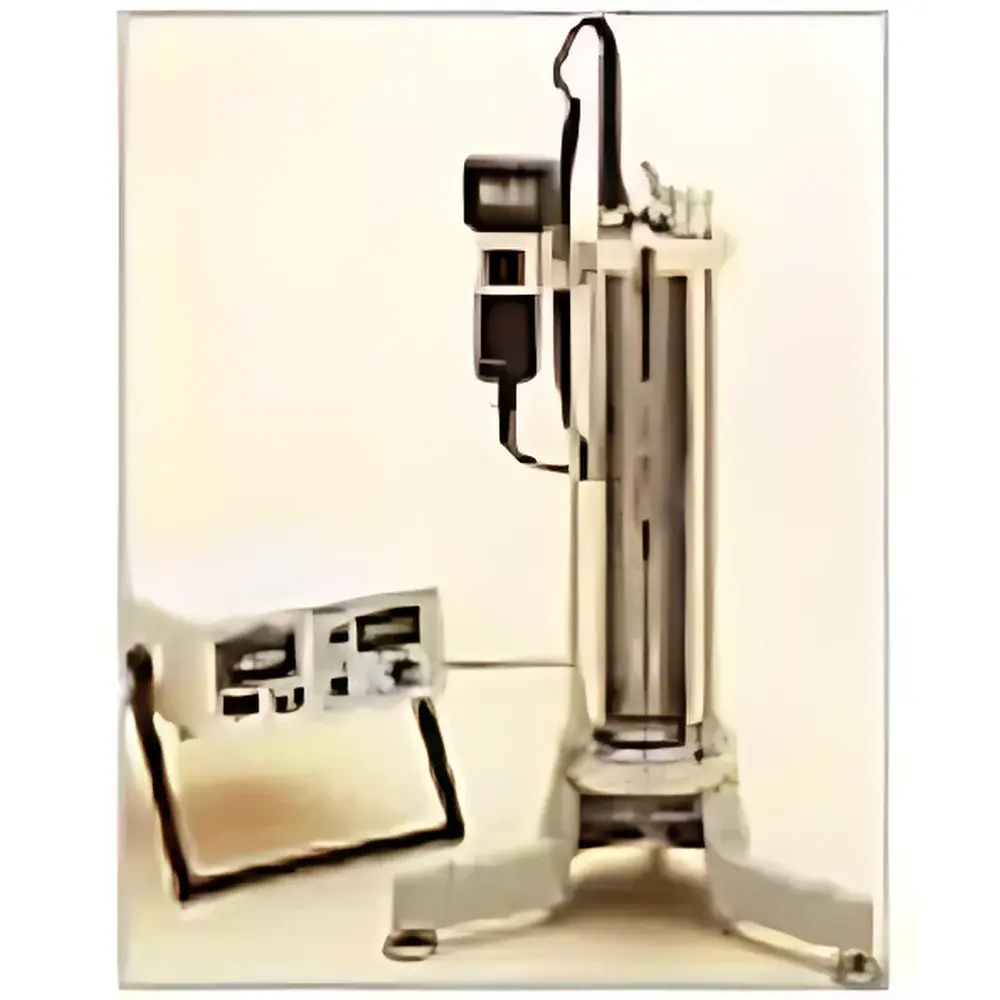
SBS Auto-Falling Needle Viscometer
| Brand | SBS |
|---|---|
| Origin | USA |
| Manufacturer Type | Authorized Distributor |
| Instrument Category | Imported |
| Model | Auto-Falling Needle |
| Instrument Type | Benchtop Fixed-Position Viscometer |
| Operating Environment | Ambient Temperature |
| Viscosity Range | 0.5–1,000,000 cP |
| Measurement Principle | Gravitational Sedimentation of Calibrated Needle in Fluid |
| Shear Rate Range | 10⁻⁴–10³ s⁻¹ |
| Temperature Range | −40 to +150 °C |
| Sample Volume Options | 2.3, 3.6, 7.2, 9.6, 19.2, or 120 cm³ |
| Needle Materials | Borosilicate Glass, Fused Quartz, or Stainless Steel |
| Standard Needle Length | 10.2 cm (compact version: 4.2 cm) |
| Needle Density Options | 1.01, 1.1, 1.5, 2.0, 3.0, 5.0, and 8.0 g/cm³ |
| Timing Resolution | 0.01 s (optional 0.001 s) |
| Interface | RS-232 Serial Port |
| Accuracy & Repeatability | < ±1% |
| Compliance | ASTM D1545, ISO 12058-1, USP <911>, GLP-Compatible Data Logging |
Overview
The SBS Auto-Falling Needle Viscometer is a precision benchtop instrument engineered for absolute viscosity measurement of Newtonian and non-Newtonian fluids via gravitational sedimentation kinetics. Unlike capillary or rotational viscometers—whose accuracy degrades at high viscosity or with opaque, particulate-laden, or thermally unstable samples—this system applies Stokes’ law under controlled geometric and hydrodynamic conditions to derive dynamic viscosity directly from the terminal velocity of a calibrated needle falling through the test fluid. The instrument eliminates reliance on calibration fluids or empirical corrections, delivering traceable, SI-based viscosity values (in centipoise or mPa·s) across six decades of range (0.5–1,000,000 cP), with shear rates spanning 10⁻⁴–10³ s⁻¹. Its modular needle set—available in seven densities (1.01–8.0 g/cm³), multiple lengths (4.2 cm and 10.2 cm), and material options (borosilicate glass, fused quartz, stainless steel)—enables method-specific shear profiling without sample replacement. Designed for laboratory environments operating between −40 °C and +150 °C, it supports both routine QC and advanced rheological characterization in compliance with ASTM D1545 (standard test method for viscosity of transparent liquids by falling needle viscometer) and ISO 12058-1 (plastics — determination of viscosity of thermoplastics by falling needle method).
Key Features
- True absolute viscosity measurement—no calibration fluids or instrument-specific constants required
- Automated timing resolution down to 0.01 s (upgradeable to 0.001 s) with optical detection and microprocessor-controlled event capture
- Multi-density needle library enabling variable shear rate application within a single sample aliquot
- Compact footprint (23 × 9.5 × 21 cm) and ambient-temperature operation, with optional Peltier or circulating bath integration for temperature control
- RS-232 serial interface for direct connection to LIMS or lab PCs; ASCII-formatted output compatible with Excel, MATLAB, and LabVIEW
- Support for ultra-low volume testing (as little as 2.3 cm³), minimizing reagent consumption and waste generation
- Chemically inert needle materials (quartz, borosilicate, passivated stainless steel) suitable for aggressive solvents, acids, and polymer melts
- Self-contained mechanical design requiring no external vacuum, gas supply, or high-voltage components
Sample Compatibility & Compliance
The Auto-Falling Needle Viscometer accommodates optically opaque, highly viscous, volatile, or thermally sensitive fluids—including lubricants, bitumens, epoxy resins, silicone gels, molten polymers, and biological suspensions—that challenge conventional rotational or capillary systems. Its gravity-driven principle avoids wall-slip artifacts, yield stress interference, and edge effects common in cone-and-plate or concentric cylinder geometries. All measurements adhere to ASTM D1545 for transparent liquids and ISO 12058-1 for thermoplastic melts. When paired with validated SOPs and audit-trail-enabled software, the system meets FDA 21 CFR Part 11 requirements for electronic records and signatures. Full GLP/GMP documentation support—including instrument qualification (IQ/OQ/PQ), calibration logs, and raw timing data export—is available upon request.
Software & Data Management
Standard firmware includes real-time display of fall time, calculated viscosity, shear rate, and temperature (when equipped with optional probe). Optional PC-based software provides automated report generation compliant with ISO/IEC 17025 templates, statistical process control (SPC) charts, batch trending, and deviation alerts. All data files are timestamped, user-ID tagged, and stored in immutable binary + CSV dual format. Audit trail functionality records every parameter change, measurement initiation, and export action—meeting regulatory expectations for traceability in pharmaceutical, aerospace, and petrochemical QA/QC environments.
Applications
- Quality control of industrial lubricants (e.g., gear oils, hydraulic fluids) per OEM specifications (BASF, BP, Shell, ExxonMobil)
- Rheological screening of uncured elastomers and thermoset precursors during formulation development (Bayer, Dow, PPG)
- Viscosity-temperature profiling of aerospace-grade thermal fluids under cryogenic and elevated-temperature conditions (NASA, GE Aviation)
- Density-viscosity correlation studies for liquid-liquid phase systems and solvent blends (3M, DuPont, Alcoa)
- Thermal expansion coefficient derivation via sequential density/viscosity mapping across controlled temperature ramps
- Settling behavior quantification in colloidal dispersions and pigment suspensions (PPG, ELF, IBM)
FAQ
How does the falling needle method differ from falling ball viscometry?
Unlike classical falling ball viscometers—which assume rigid spherical geometry and laminar flow around a sphere—the SBS needle geometry minimizes end effects and enables stable orientation in non-Newtonian media, yielding more reliable shear-rate-resolved data across broad viscosity ranges.
Can this instrument measure yield stress?
No. As a gravity-driven steady-state method, it measures apparent viscosity at defined shear rates. Yield stress determination requires controlled-stress ramp or oscillatory testing, typically performed on rotational rheometers.
Is cleaning required between samples?
Yes. While needle exchange is rapid, thorough cleaning with appropriate solvents is mandatory to prevent cross-contamination—especially when switching between polar/non-polar or high/low volatility fluids. A dedicated ultrasonic cleaning station is recommended for quartz and stainless steel needles.
What validation documentation is provided?
Each unit ships with factory calibration certificate traceable to NIST standards, including verification of timing accuracy, needle dimensional metrology, and density certification. IQ/OQ protocols and PQ templates are available under NDA.
Related Products



