
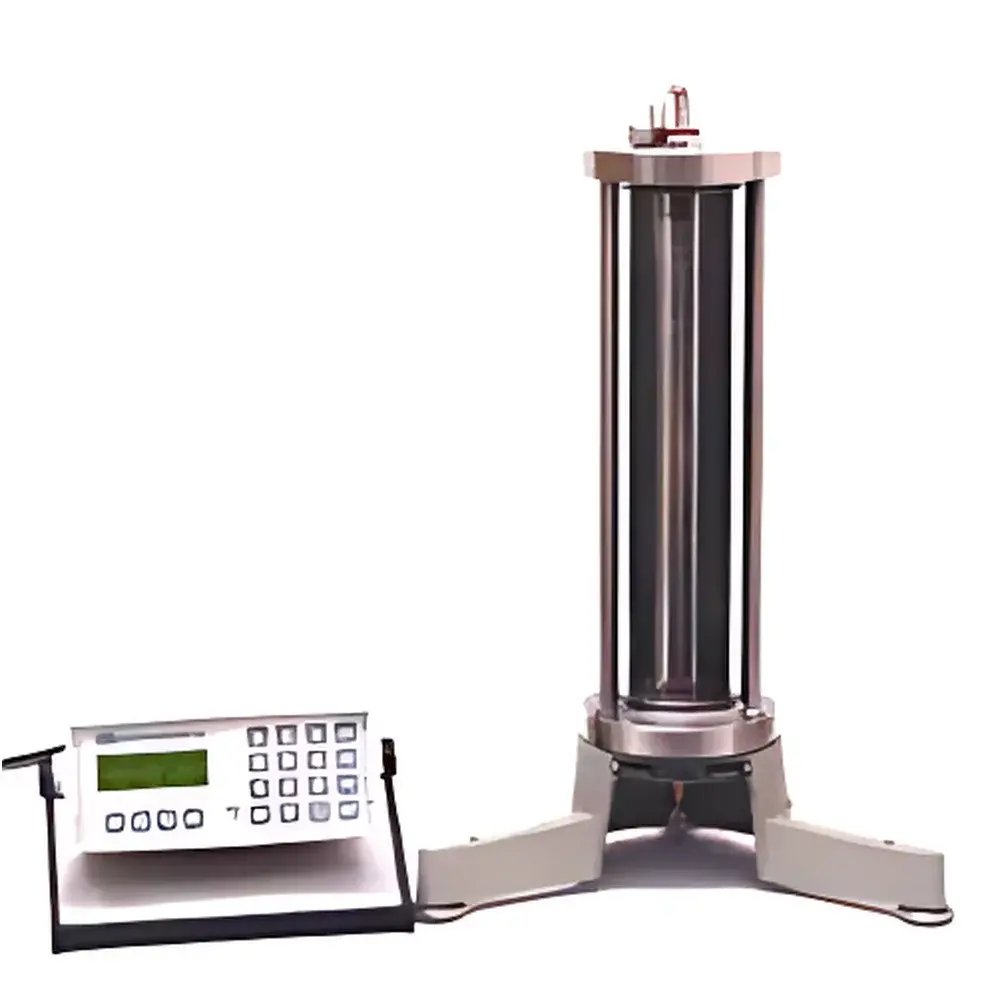
SBS FNV-200 / CNV-100 Falling & Controlled Needle Viscometer
| Brand | SBS |
|---|---|
| Origin | USA |
| Model | FNV-200 / CNV-100 |
| Viscosity Range (FNV) | 0.5–2.4×10⁶ cP |
| Viscosity Range (CNV) | 0.1–30 cP |
| Shear Rate Range (FNV) | ~10⁻⁴–10⁴ s⁻¹ |
| Temperature Range | −40 to 150 °C |
| Accuracy & Repeatability | <1% |
| Sample Volume (FNV) | ~110 cm³ |
| Sample Volume (CNV) | ~85 cm³ |
| Needle Material | Aluminum, Titanium, Stainless Steel, or Borosilicate Glass |
| Needle Density Range | 1.01–8.0 g/cm³ |
| Instrument Weight | 18.2 kg |
| Dimensions (H×W) | 55 × 36 cm |
| Falling Time Resolution | 0.001 s |
| Interface | RS-232 |
Overview
The SBS FNV-200 Falling Needle Viscometer and CNV-100 Controlled Needle Viscometer are precision instruments engineered for absolute viscosity and density determination of Newtonian and non-Newtonian fluids using the principle of terminal velocity sedimentation in a quiescent medium. Unlike rotational or capillary viscometers, these devices rely on fundamental hydrodynamic principles—specifically Stokes’ law and its extended forms for finite Reynolds numbers and wall effects—to derive dynamic viscosity (η) and fluid density (ρ) from the measured terminal velocity (vt) of a calibrated needle falling under gravity through a cylindrical sample column. The FNV operates in free-fall mode, while the CNV applies controlled downward force via a weighted extension bar system, enabling precise low-viscosity measurements where buoyancy and inertia dominate. Both configurations eliminate the need for instrument-specific calibration standards, as viscosity is computed directly from dimensional geometry, needle density, gravitational acceleration, and kinematic parameters—making them primary-standard-capable tools for metrology-grade laboratories.
Key Features
- Direct absolute viscosity measurement without calibration fluids or empirical correction factors
- Simultaneous determination of dynamic viscosity and fluid density from a single falling-time measurement
- Microprocessor-based console with real-time data acquisition, automatic Hall-effect timing (resolution: 0.001 s), and RS-232 serial interface for external control and data logging
- Thermally stabilized sample chamber supporting temperature-controlled testing from −40 °C to +150 °C with high-stability PID regulation
- Modular needle sets—including aluminum, titanium, stainless steel, and borosilicate glass—with certified densities spanning 1.01–8.0 g/cm³ to accommodate diverse fluid density ranges
- Comprehensive shear rate coverage: ~10⁻⁴ to 10⁴ s⁻¹ (FNV), optimized for yield-stress and thixotropic behavior characterization when coupled with time-resolved velocity profiling
- Small-sample insert kit included with CNV-100 for applications with limited material availability (e.g., biopharmaceutical intermediates or high-value specialty polymers)
- Integrated software suite (optional) for non-Newtonian analysis, including Carreau-Yasuda and Herschel-Bulkley model fitting, thermal expansion coefficient calculation, and relative sedimentation rate comparison across formulations
Sample Compatibility & Compliance
The FNV-200 and CNV-100 are validated for use with opaque, heterogeneous, and thermally sensitive samples that challenge optical or rotational methods—including coal slurries, protein gels, polymer melts, ceramic pastes, and pharmaceutical ointments. Their design inherently avoids wall-slip artifacts and torque saturation issues common in cone-plate or concentric-cylinder rheometers. Instruments comply with ASTM D1092 (Standard Test Method for Apparent Viscosity of Adhesives), ISO 2555 (Plastics—Determination of Apparent Viscosity), and USP (Rheological Analysis of Semisolid Dosage Forms). Data acquisition supports audit trails and electronic signatures per FDA 21 CFR Part 11 when integrated with compliant LIMS or ELN platforms. All mechanical components meet RoHS and CE directives; temperature control modules are UL-listed for laboratory use.
Software & Data Management
The SBS ViscoSuite software provides native support for both FNV and CNV operation modes, featuring automated sequence programming, multi-needle density mapping, and batch-mode reporting compliant with GLP/GMP documentation requirements. Raw falling-time datasets include timestamp, temperature, needle ID, and environmental pressure metadata. Export formats include CSV, XML, and PDF reports with embedded uncertainty propagation calculations based on ISO/IEC Guide 98-3 (GUM). For regulated environments, optional 21 CFR Part 11 add-ons provide role-based access control, electronic signature capture, and immutable audit logs with hash-verified data integrity. The RS-232 interface enables seamless integration with LabVIEW, MATLAB, or custom Python-based automation frameworks for high-throughput QC workflows.
Applications
These viscometers serve critical roles in R&D, quality assurance, and process validation across industries requiring traceable, first-principles rheological data. In coatings and inks, they quantify sag resistance and leveling behavior at rest. In food science, they characterize ketchup, mayonnaise, and dairy products under realistic shelf-life storage conditions. Lubricant formulators use them to assess low-shear viscosity stability in engine oils and greases. Biopharma labs apply the CNV-100 to monitor viscosity shifts during monoclonal antibody concentration steps—where even sub-cP changes impact filtration efficiency and subcutaneous injectability. Additional application domains include petroleum refining (crude oil pour point prediction), battery slurry rheology (anode/cathode paste homogeneity), and additive manufacturing feedstock qualification (metal and ceramic suspensions).
FAQ
How does the falling needle method differ from rotational viscometry?
It eliminates mechanical coupling, bearing friction, and edge effects—relying solely on gravity-driven motion and hydrodynamic drag. This yields absolute viscosity values traceable to SI units without calibration transfer errors.
Can the instrument measure yield stress?
Yes—by analyzing the critical needle density threshold at which motion initiates (static yield) or by performing sequential falling tests at incrementally increasing temperatures to infer structural breakdown points.
Is sample degassing required before testing?
For highly viscous or volatile fluids, vacuum degassing is recommended to prevent bubble-induced velocity fluctuations; however, the method tolerates minor entrained air better than capillary techniques.
What maintenance is required for long-term accuracy?
Annual verification of needle density certification and Hall sensor alignment; no lubrication or torque calibration is needed due to the passive measurement architecture.
Does SBS provide NIST-traceable reference fluids for validation?
Yes—certified silicone oil and mineral oil standards (viscosity range 1–10⁶ cP) with full uncertainty budgets are available under separate order codes for routine performance qualification.






