
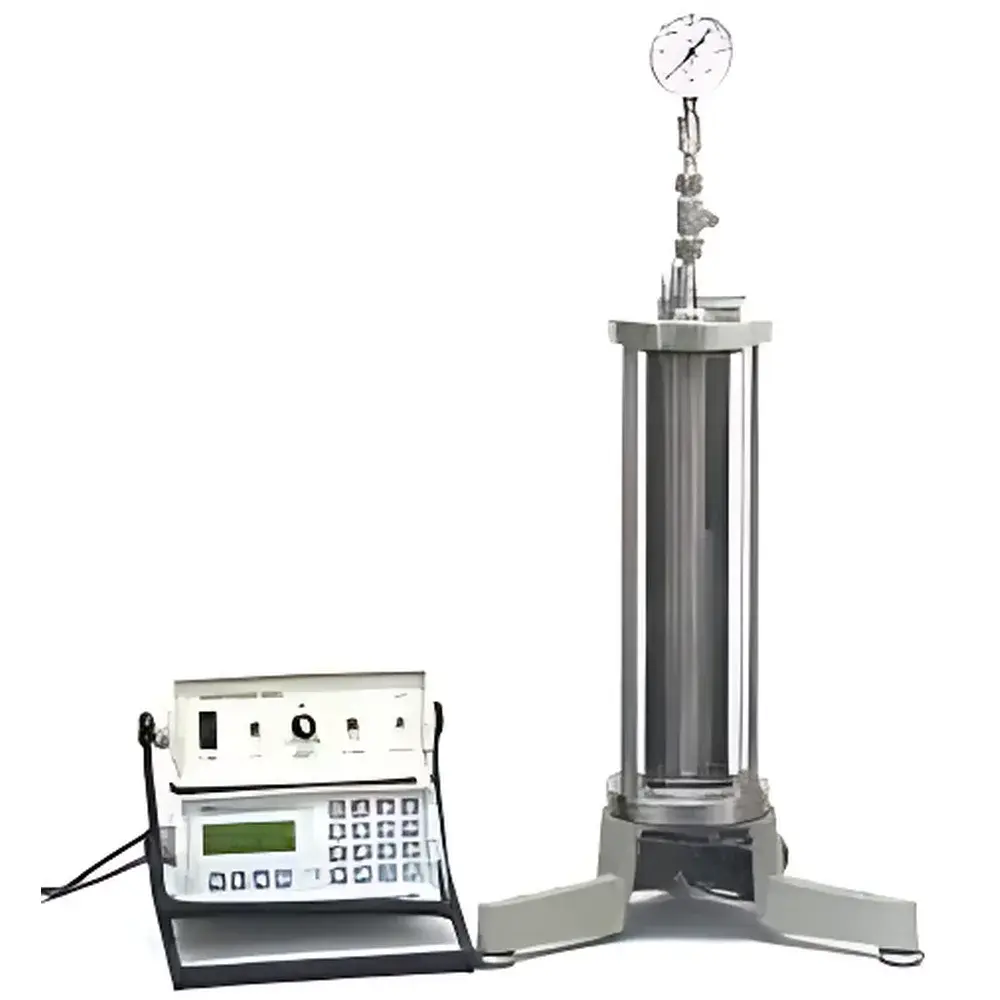
SBS HPHTV-100 High Pressure High Temperature Falling-Needle Viscometer
| Brand | SBS |
|---|---|
| Origin | USA |
| Manufacturer Type | Authorized Distributor |
| Origin Category | Imported |
| Model | HPHTV-100 |
| Viscosity Range | 0.7–10⁶ cP (mPa·s) |
| Temperature Range | 0–100°C (operational), up to 150°C (chamber capability) |
| Pressure Rating | Up to 2000 psi |
| Accuracy & Repeatability | <1% |
| Sample Volume | 4.5 cm³ |
| Needle Materials | Aluminum, Titanium, Stainless Steel |
| Needle Density Range | 6–130 g/cm³ |
| Falling-Time Resolution | 0.001 s |
| Console | Microprocessor-based with RS-232 interface |
| Automatic Needle Handling | Yes |
| Instrument Weight | 7.3 kg (16 lbs) |
Overview
The SBS HPHTV-100 High Pressure High Temperature Falling-Needle Viscometer is a precision instrument engineered for the absolute measurement of dynamic viscosity under controlled elevated pressure and temperature conditions. It operates on the fundamental principle of Stokes’ law for spherical-cap-ended rigid bodies falling under gravity through Newtonian or near-Newtonian fluids within a confined cylindrical geometry. Unlike rotational or capillary viscometers, the HPHTV-100 eliminates the need for calibration standards by deriving viscosity directly from terminal velocity, needle geometry, density differential, and fluid buoyancy—enabling traceable, first-principles-based rheological characterization. Designed for laboratory and process development environments, it supports experimental protocols compliant with ASTM D1092, ISO 3219, and API RP 13B-1 for drilling fluid evaluation, while its pressure-rated chamber accommodates applications aligned with petroleum reservoir simulation, geothermal fluid analysis, and high-pressure polymer processing research.
Key Features
- Validated operational envelope of up to 2000 psi and 150°C—enabling representative testing of downhole fluids, synthetic base oils, and thermally stable formulations
- Falling-needle geometry with hemispherical ends ensures laminar flow regime adherence and minimizes wall effects in standard 4.5 cm³ sample volumes
- Calibration-free absolute viscosity determination via real-time terminal velocity acquisition using dual Hall-effect sensors and an embedded magnet
- Microsecond-resolution timing (0.001 s) guarantees sub-1% repeatability across repeated measurements, verified per ISO/IEC 17025 internal validation protocols
- Interchangeable metal needles (Al, Ti, SS) with densities spanning 6–130 g/cm³ allow optimization for low- and high-density test media—including molten salts, liquid metals, and dense ionic liquids
- Integrated microprocessor console with RS-232 serial output enables direct data logging into LIMS or custom SCADA systems; firmware supports ASCII command protocol for automated script integration
- Motorized needle lift-and-drop mechanism ensures consistent release dynamics and eliminates operator-induced variability during sequential runs
Sample Compatibility & Compliance
The HPHTV-100 accommodates a broad spectrum of Newtonian and weakly non-Newtonian fluids—including hydrocarbon-based drilling muds, silicone oils, glycol-water mixtures, molten polymers, and supercritical CO₂-saturated brines—provided shear-rate dependence remains negligible over the terminal velocity time window (~1–30 s). Its stainless-steel pressure vessel meets ASME BPVC Section VIII Div. 1 design criteria for Class I pressure equipment. All wetted surfaces are electropolished 316SS or compatible alloys, ensuring corrosion resistance per NACE MR0175/ISO 15156 for sour service evaluation. The system supports GLP-compliant operation through audit-trail-enabled firmware logging (timestamped run ID, needle ID, T/P setpoints, raw transit time, calculated η), satisfying FDA 21 CFR Part 11 requirements when paired with validated third-party data acquisition software.
Software & Data Management
The HPHTV-100 console provides native ASCII output via RS-232 at 9600 baud, transmitting structured records containing measured fall time (t), temperature (T), pressure (P), needle density (ρn), fluid density (ρf), and computed viscosity (η) in mPa·s. Optional PC software (SBS ViscoLink v3.x) offers real-time plotting, batch statistical analysis (mean, SD, CV%), outlier detection per Grubbs’ test, and export to CSV, Excel, or PDF report templates pre-formatted for ASTM D1092 submission. Raw sensor timestamps are preserved without interpolation, supporting post-hoc uncertainty propagation per GUM (JCGM 100:2018) for metrological traceability. Firmware updates are delivered via secure HTTPS portal with SHA-256 checksum verification.
Applications
- Downhole fluid rheology for oil & gas wellbore stability modeling (e.g., synthetic-based muds at 120°C/1500 psi)
- Thermal stability assessment of heat-transfer fluids in concentrated solar power (CSP) loop simulations
- Viscosity-temperature-pressure (VTP) equation-of-state parameterization for reservoir fluid PVT studies
- Quality control of high-performance lubricants under extreme operating conditions
- Academic research on non-Newtonian onset thresholds via comparative falling-body vs. rotational data sets
- Regulatory submissions requiring primary-standard-referenced viscosity data (e.g., EPA Method 1664B adjunct testing)
FAQ
Does the HPHTV-100 require calibration with reference oils?
No—it determines absolute viscosity from first principles using measured terminal velocity, geometric constants, and known densities; no calibration fluids are necessary.
Can the system measure non-Newtonian fluids?
It provides reliable results only for fluids exhibiting Newtonian behavior over the shear rate range induced by the needle’s terminal velocity profile (typically <10 s⁻¹); yield stress or shear-thinning behavior must be pre-characterized via complementary methods.
Is the pressure vessel suitable for hydrogen service?
The standard ASME-coded vessel is rated for inert and sour service per NACE MR0175 but requires material certification review and optional hydrogen permeation testing for H₂ partial pressures exceeding 100 psi.
What sample preparation steps are required before loading?
Samples must be degassed under vacuum to eliminate microbubbles, filtered through ≤5 µm mesh if particulates are present, and equilibrated to target T/P for ≥15 minutes prior to needle drop.
How is thermal uniformity ensured across the sample column?
A three-zone PID-controlled heating jacket with axial thermocouple profiling maintains ±0.3°C isothermality over the 65 mm active measurement length, verified per ASTM E740.





