
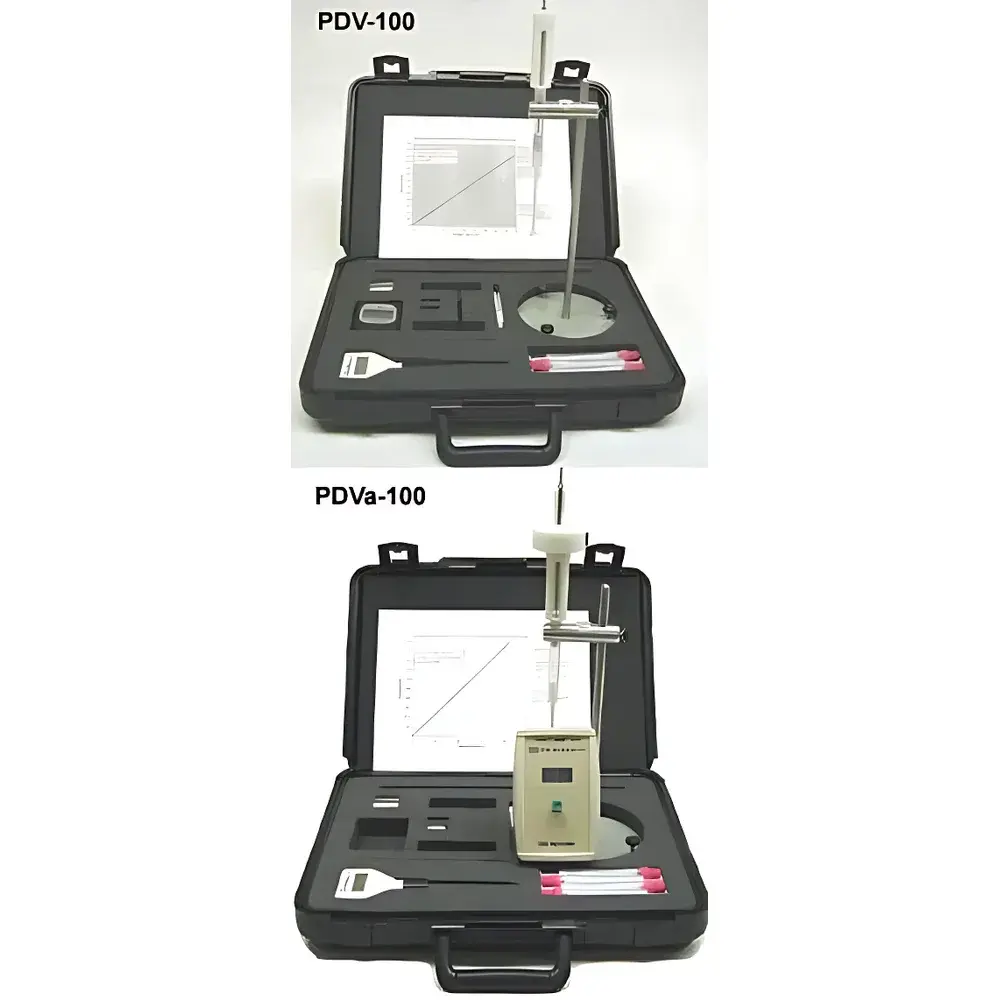
SBS PDVa-100 Portable Disposable Viscometer
| Brand | SBS |
|---|---|
| Origin | USA |
| Model | PDVa-100 |
| Viscosity Range | 0.7–10⁷ cP (mPa·s) |
| Temperature Range | Ambient |
| Accuracy & Repeatability | <1% |
| Sample Volume | ~4.5 cm³ |
| Needle Material | Aluminum, Titanium, or Stainless Steel |
| Needle Density Range | 6–130 g/cm³ |
| Instrument Weight | 2 kg (4.4 lbs) |
| Measurement Principle | Capillary-based falling-needle viscometry with automated timing |
Overview
The SBS PDVa-100 Portable Disposable Viscometer is a field-deployable, gravity-driven rotational viscometer engineered for absolute viscosity measurement of Newtonian and shear-thinning non-Newtonian fluids without calibration dependency. Unlike rotational or vibrational viscometers requiring torque transduction or resonant frequency analysis, the PDVa-100 operates on a modified falling-needle principle—where a precision-machined, density-calibrated metal needle descends under gravity through a fixed vertical column of sample fluid housed in a single-use tube. The time required for the needle to traverse a defined path is directly related to dynamic viscosity via Stokes’ law adaptation for non-spherical geometries and finite boundary effects. This method eliminates zero-point drift, bearing wear, and motor-induced shear artifacts common in benchtop rheometers. Designed for ambient-temperature operation, the instrument delivers laboratory-grade repeatability (<1%) in uncontrolled environments—from refinery sumps and polymer blending lines to pharmaceutical cleanrooms and academic field labs.
Key Features
- True absolute viscosity measurement—no calibration standards, no instrument-specific constants, no user-adjusted parameters
- Fully automated timing resolution to 0.001 second (PDVa-100), eliminating stopwatch-related human error and enabling high-throughput screening
- Disposable polypropylene sample tube (4.5 mL capacity), validated for up to 30 reuses under controlled cleaning protocols; prevents cross-contamination and eliminates solvent rinsing downtime
- Modular needle set—interchangeable aluminum, titanium, and stainless-steel needles covering a density range of 6–130 g/cm³—enables optimal sensitivity across low- to ultra-high-viscosity regimes (0.7–10⁷ cP)
- Compact, battery-operated architecture (2 kg total mass) with integrated support stand and vibration-damped base—designed for stable operation on uneven surfaces, mobile carts, or portable lab benches
- No moving parts beyond the falling needle; no motors, no encoders, no temperature control hardware—maximizing long-term reliability and minimizing maintenance requirements
Sample Compatibility & Compliance
The PDVa-100 accommodates clear to moderately opaque Newtonian liquids (e.g., solvents, mineral oils, glycerol-water mixtures) and pseudoplastic fluids (e.g., xanthan gum solutions, diluted polymer melts, latex dispersions) where shear thinning does not significantly alter needle descent dynamics at low shear rates (5 µm solids loading) that impede needle trajectory. The system complies with ASTM D1200 (Gardner-Holdt bubble tube method principles), ISO 2555 (aqueous polymer solution characterization), and supports GLP-aligned documentation when paired with timestamped CSV export. While not FDA 21 CFR Part 11–validated out-of-the-box, audit trails and electronic records can be generated via external data capture software meeting ALCOA+ criteria.
Software & Data Management
The PDVa-100 includes an embedded microcontroller with USB-C interface for direct connection to Windows/Linux hosts. Firmware v2.3+ supports real-time data streaming and batch export of falling-time measurements, calculated viscosity values (cP and mPa·s), ambient temperature (via onboard thermistor), needle ID, and operator metadata. Export formats include UTF-8 CSV with ISO 8601 timestamps and optional PDF report generation (via companion SBS ViscoLink Desktop application). All raw timing data is stored with 16-bit resolution; no internal averaging or filtering is applied prior to export, preserving traceability for regulatory review. Data integrity is reinforced by cyclic redundancy check (CRC-32) validation per record.
Applications
- On-site quality verification of lubricants, hydraulic fluids, and transformer oils during maintenance rounds
- Rapid screening of formulation consistency in paint, ink, and adhesive manufacturing (batch release support)
- Field assessment of drilling mud rheology in upstream oilfield operations (API RP 13B-1 alignment)
- Educational laboratories—demonstrating fundamental viscoelastic relationships without complex setup
- Pharmaceutical excipient qualification (e.g., methylcellulose, HPMC solutions) under USP guidance for viscosity-dependent dissolution behavior
- Food processing QC for syrups, sauces, and dairy emulsions where thermal history must be preserved (no heating required)
FAQ
Does the PDVa-100 require calibration before use?
No. Viscosity calculation uses pre-characterized needle geometry, density, and tube dimensions—traceable to NIST-certified density standards. Calibration is inherent to the physical design.
Can the same needle be used across all viscosity ranges?
No. Needle selection is viscosity-dependent: low-density aluminum needles for sub-100 cP fluids; high-density stainless-steel needles for >10⁴ cP materials. A selection chart is provided in the operator manual.
Is temperature compensation available?
The instrument measures ambient temperature but does not regulate it. For temperature-sensitive fluids, users must stabilize sample temperature externally (e.g., water bath) and input the measured value manually during analysis.
How is compliance with ISO/IEC 17025 addressed?
While the PDVa-100 itself is not accredited, its measurement uncertainty budget (±0.87% k=2) has been verified per ISO/IEC 17025 Annex A.3 guidelines using reference oils certified by PTB and NPL.
What maintenance is required over a 5-year service life?
Annual verification of needle surface finish (optical inspection), tube dimensional stability (caliper check), and firmware update. No lubrication, alignment, or sensor recalibration is necessary.






