
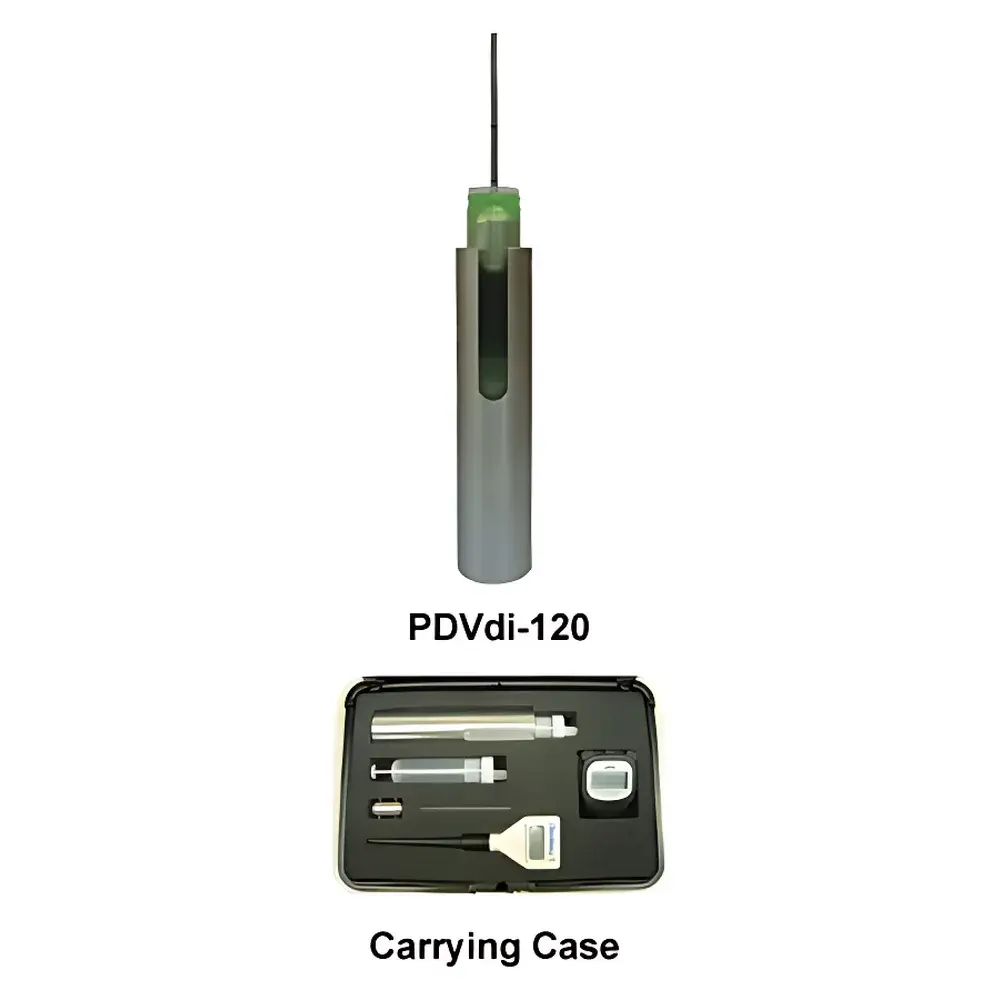
SBS PDVdi-120 Portable Field Viscometer
| Brand | SBS |
|---|---|
| Origin | USA |
| Manufacturer Type | Authorized Distributor |
| Origin Category | Imported |
| Model | PDVdi-120 |
| Price | Upon Request |
| Viscosity Range | 2–10⁶ cP (mPa·s) |
| Temperature Range | Ambient (15–30 °C typical field use) |
| Accuracy & Repeatability | ±2% of reading |
| Sample Volume | ~25 mL |
| Needle Material | Aluminum, Titanium, or Stainless Steel |
| Needle Density | 2.916 g/cm³ |
| Total Weight | 0.38 kg (0.83 lbs) |
| Compliance | ASTM D5478, SAE AIR5704 |
Overview
The SBS PDVdi-120 Portable Field Viscometer is a gravity-driven, falling-needle viscometer engineered for rapid, on-site determination of absolute dynamic viscosity in Newtonian and shear-thinning non-Newtonian fluids. Unlike rotational or capillary-based laboratory instruments requiring power, calibration fluids, or controlled environmental chambers, the PDVdi-120 operates on the principle of Stokes’ law under defined geometric constraints: a precision-machined metal needle of known density and geometry falls freely through a fixed vertical distance within a fluid column contained in a calibrated, reusable syringe. The elapsed time—measured manually with an included stopwatch—is directly related to the fluid’s dynamic viscosity via a validated empirical correlation derived from dimensional analysis and instrument-specific calibration constants. This method eliminates dependence on instrument-specific calibration curves while preserving traceability to SI units through standardized needle geometry, density, and syringe internal diameter. Designed for deployment in oilfields, refineries, maintenance depots, marine engine rooms, and remote QC checkpoints, the PDVdi-120 delivers lab-grade metrological rigor without infrastructure dependency.
Key Features
- True field-portable operation: No external power, no compressed air, no PC interface required—fully functional with stopwatch and ambient lighting.
- Direct absolute viscosity measurement: Requires no prior calibration against reference oils; results are traceable to physical constants (needle density, geometry, gravitational acceleration).
- Multi-point sampling from single aliquot: Up to five repeat measurements possible per 25 mL sample without refilling, enabling statistical assessment of repeatability in situ.
- Minimal operator training: Intuitive mechanical workflow—load syringe, insert needle, release, time fall between engraved marks—reducing human error and inter-operator variability.
- Immediate result generation: Viscosity calculation completed in <10 seconds post-timing; digital thermometer enables real-time temperature annotation for viscosity correction per ISO 3104 or ASTM D445 conventions.
- Low-cost ownership model: Reusable stainless steel syringes and corrosion-resistant needles (Al/Ti/SS options) eliminate consumable costs associated with disposable capillaries or rotor assemblies.
- Ruggedized design: All-metal construction, IP54-rated housing, and shock-absorbing carrying case certified for transport in industrial vehicles and marine environments.
- Non-Newtonian screening capability: Consistent needle fall behavior across shear rates enables qualitative yield stress estimation and flow curve trend identification when paired with temperature-controlled sample conditioning.
Sample Compatibility & Compliance
The PDVdi-120 accommodates transparent to moderately opaque liquids including lubricating oils, hydraulic fluids, diesel fuels, biodiesel blends, transformer oils, glycols, and low-viscosity polymer solutions. It is not suitable for highly aerated, fibrous, or particulate-laden suspensions (>5 µm solids), nor for volatile solvents with evaporation rates exceeding 0.5 mg/min under ambient conditions. Instrument performance conforms to ASTM D5478 “Standard Test Method for Determining Viscosity of Liquids Using a Falling-Needle Viscometer” and SAE AIR5704 “Aerospace Recommended Practice for Field Viscosity Measurement of Lubricants.” Data reporting supports GLP-compliant documentation when used with the provided log sheet template and digital thermometer timestamping. While not inherently 21 CFR Part 11 compliant, audit trails may be established using external electronic lab notebooks (ELN) integrated via manual data entry.
Software & Data Management
The PDVdi-120 operates as a standalone analog-digital hybrid system. No embedded firmware or proprietary software is required. Viscosity calculation uses a linearized form of the modified Stokes equation pre-programmed into the included quick-reference nomograph and Excel-compatible lookup table (supplied digitally upon registration). Users may input measured fall time (in seconds), recorded temperature (°C), and selected needle material density to compute viscosity in cP or mPa·s. Raw timing data, temperature logs, and operator ID fields are captured manually in the bound instruction manual logbook—designed for regulatory inspection readiness. Optional CSV export templates facilitate integration with LIMS platforms for trending, SPC charting, and historical batch comparison.
Applications
- On-the-spot verification of lubricant viscosity grade compliance per ISO VG or SAE J300 specifications during equipment commissioning or preventive maintenance.
- Rapid screening of fuel oil degradation (e.g., thermal cracking, oxidation-induced thickening) aboard vessels or at terminal storage tanks.
- Field validation of hydraulic fluid contamination by water ingress or soot loading—correlated with viscosity drift outside ±5% baseline.
- QC checkpoint testing for incoming raw materials (e.g., resins, surfactant concentrates) where laboratory turnaround exceeds production cycle time.
- Educational demonstration of Newtonian/non-Newtonian rheological behavior using interchangeable needles and temperature-controlled baths (external).
- Regulatory response support: EPA SPCC Plan verification, FAA AC 150/5200-37 compliance checks, and DOT hazmat classification pre-screening.
FAQ
Does the PDVdi-120 require annual recalibration?
No. Calibration is intrinsic to the physical design—needle density, syringe bore diameter, and fall distance are factory-certified and immutable. Users verify system integrity annually using the supplied reference oil (certified ±1% at 40 °C) per ASTM D5478 Annex A1.
Can it measure viscosity at elevated temperatures?
Yes—when used with optional heated sample blocks (not included) that maintain syringe temperature stability within ±0.5 °C; viscosity results must be reported with concurrent digital thermometer readings per ISO 3104 Clause 7.2.
Is the syringe autoclavable?
No. Reusable syringes are cleaned with solvent rinse (e.g., naphtha, isopropanol) and dried with filtered nitrogen; steam sterilization degrades polypropylene seals and alters internal dimensional tolerances.
How does it handle shear-thinning fluids?
The falling-needle geometry imposes a narrow, well-defined shear rate range (~1–50 s⁻¹ depending on viscosity); consistent timing across multiple drops indicates pseudoplastic behavior, while increasing fall time suggests thixotropic recovery—enabling qualitative rheological fingerprinting.
What is the minimum detectable viscosity change?
At 100 cP, the instrument resolves ±2 cP changes (2% of reading), validated per ASTM D5478 repeatability protocol using triplicate measurements on NIST-traceable standard oils.





