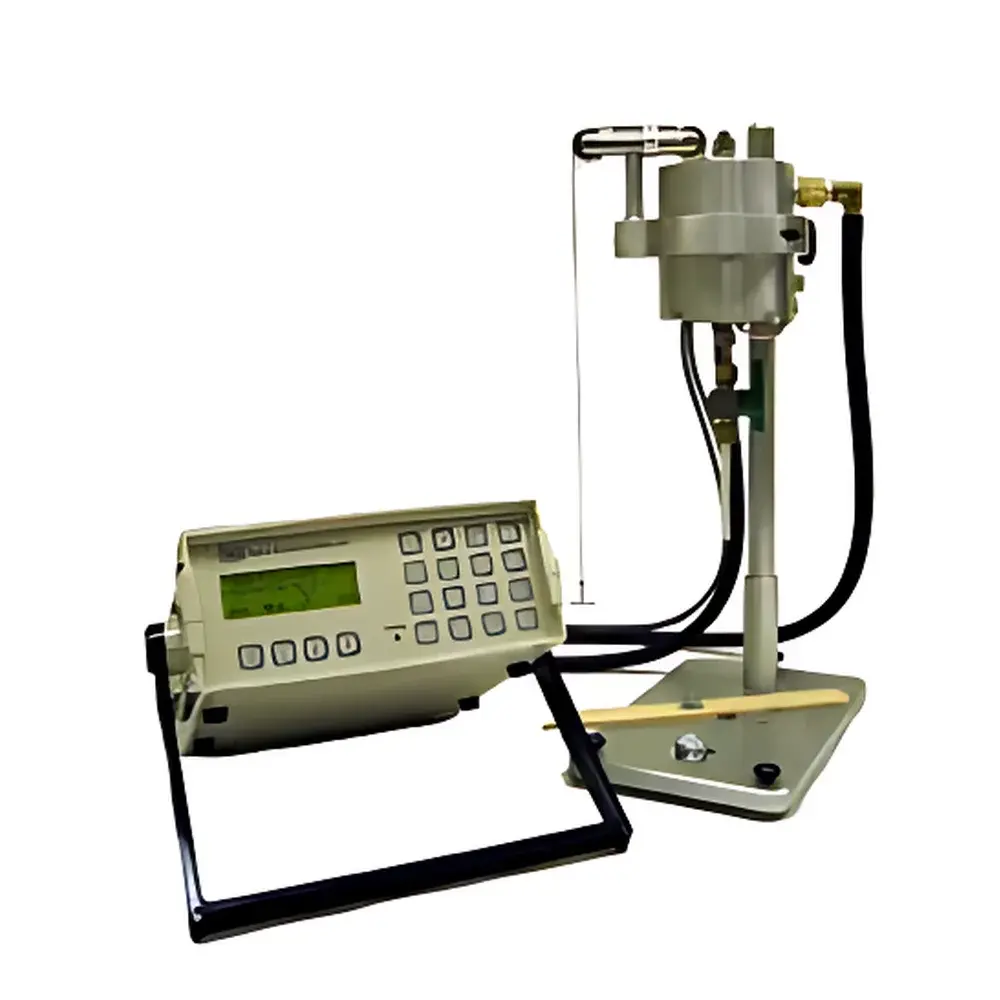
SBS SV-100 Sealed Falling-Needle Viscometer
| Brand | SBS |
|---|---|
| Origin | USA |
| Model | SV-100 |
| Viscosity Range | 0.5–10,000 mPa·s |
| Temperature Range | −40 to +150 °C |
| Accuracy & Repeatability | < ±2% |
| Sample Volume | ≥1.5 cm³ |
| Needle Material | Aluminum, Titanium, or Stainless Steel |
| Needle Density | ~7.0 g/cm³ |
| Operating Pressure | Up to 2,000 psi |
| Compliance | ASTM D5478 |
| Instrument Weight | 7.3 kg |
Overview
The SBS SV-100 Sealed Falling-Needle Viscometer is a precision-engineered instrument designed for absolute viscosity measurement of both Newtonian and non-Newtonian fluids under fully sealed, temperature-controlled, and pressurized conditions. Unlike rotational or capillary viscometers, the SV-100 employs a gravimetric falling-needle principle: a magnetized metal needle of known geometry and density falls freely through a fixed vertical distance within a sealed sample chamber, and its transit time is detected with high temporal resolution using dual Hall-effect sensors. This method yields true absolute viscosity (in mPa·s) without reliance on calibration standards—eliminating systematic drift associated with reference oil aging or sensor hysteresis. The sealed architecture prevents evaporation, oxidation, or compositional change during analysis, making it especially suitable for low-boiling-point hydrocarbons, solvents, monomers, reactive resins, and other volatile or air-sensitive materials commonly encountered in petrochemical R&D, polymer synthesis, and specialty chemical manufacturing.
Key Features
- Falling-needle methodology delivers absolute viscosity values traceable to fundamental physical constants—no calibration required across the full 0.5–10,000 mPa·s range
- Hermetically sealed measurement chamber rated for pressures up to 2,000 psi, enabling viscosity characterization under process-relevant conditions (e.g., downhole fluids, high-pressure reactor effluents)
- Integrated temperature control via circulating water jacket supports precise thermal regulation from −40 °C to +150 °C, compliant with ASTM D5478 thermal stability requirements
- Minimal mechanical disturbance to sample structure—no shear history induced by rotor immersion or capillary entry, preserving thixotropic or fragile microstructures
- Automated timing system with Hall-effect sensors achieves sub-millisecond resolution in fall-time detection, contributing to repeatability better than ±2%
- Interchangeable needles fabricated from aluminum, titanium, or stainless steel allow optimization for density contrast and chemical compatibility
- Built-in data acquisition interface supports direct export of raw transit times and calculated viscosities for integration into LIMS or QA/QC workflows
Sample Compatibility & Compliance
The SV-100 accommodates samples as small as 1.5 cm³—ideal for precious or hazardous materials where bulk handling is impractical. Its inert wetted path (stainless-steel chamber, metal needle, fluoropolymer seals) ensures compatibility with aggressive organic solvents, acidic/basic formulations, and thermally labile compounds. The instrument conforms explicitly to ASTM D5478, “Standard Test Method for Viscosity of Liquids by Falling-Needle Viscometer,” and supports GLP/GMP-aligned operation through configurable audit trails, user access levels, and electronic signature capability when paired with optional SBS-certified software. It is routinely deployed in laboratories subject to FDA 21 CFR Part 11 requirements for electronic records and signatures, particularly in pharmaceutical excipient development and controlled substance formulation studies.
Software & Data Management
SBS provides optional Windows-based control and analysis software that automates test sequencing, temperature ramping, pressure monitoring (when interfaced with external transducers), and non-Newtonian modeling. For shear-thinning or shear-thickening fluids, the software applies time-dependent fall-time regression to compute apparent viscosity at defined effective shear rates—derived from needle geometry, density differential, and fluid displacement dynamics. All raw sensor timestamps, environmental parameters, and calculated results are logged with ISO/IEC 17025-compliant metadata (operator ID, timestamp, instrument serial number, calibration status). Export formats include CSV, XML, and PDF reports with embedded digital signatures for regulatory submission readiness.
Applications
- Viscosity profiling of jet fuels, crude fractions, and synthetic lubricants under simulated reservoir or refining conditions
- Real-time monitoring of epoxy, polyurethane, and acrylate resin cure kinetics without opening the reaction vessel
- Quality control of volatile monomers (e.g., styrene, methyl methacrylate) during distillation and storage
- Rheological screening of battery electrolytes and fluorinated solvents used in Li-ion and solid-state battery development
- Characterization of high-value cosmetic emulsions and fragrance oils where oxidation must be avoided during measurement
- Supporting ASTM D5478 validation studies in contract testing laboratories accredited to ISO/IEC 17025
FAQ
Does the SV-100 require periodic recalibration with standard reference oils?
No—its falling-needle principle is inherently absolute and traceable to mass, length, and time; calibration is not required for routine operation.
Can the instrument measure viscosity at elevated pressures without external pressure vessels?
Yes—the integrated sealed chamber is rated for continuous operation up to 2,000 psi, eliminating the need for auxiliary autoclaves or external pressurization systems.
Is temperature uniformity verified across the sample volume?
Yes—thermal profiling per ASTM D5478 confirms axial and radial gradients remain within ±0.1 °C at steady state when using certified circulators.
How is non-Newtonian behavior quantified?
By conducting sequential measurements at varying temperatures or needle densities, the software computes shear-rate-dependent viscosity curves using established correlations between fall velocity and local shear rate.
What documentation is provided for regulatory audits?
Each unit ships with a Factory Calibration Certificate, ASTM D5478 Conformance Statement, and IQ/OQ protocols compatible with GxP validation frameworks.