
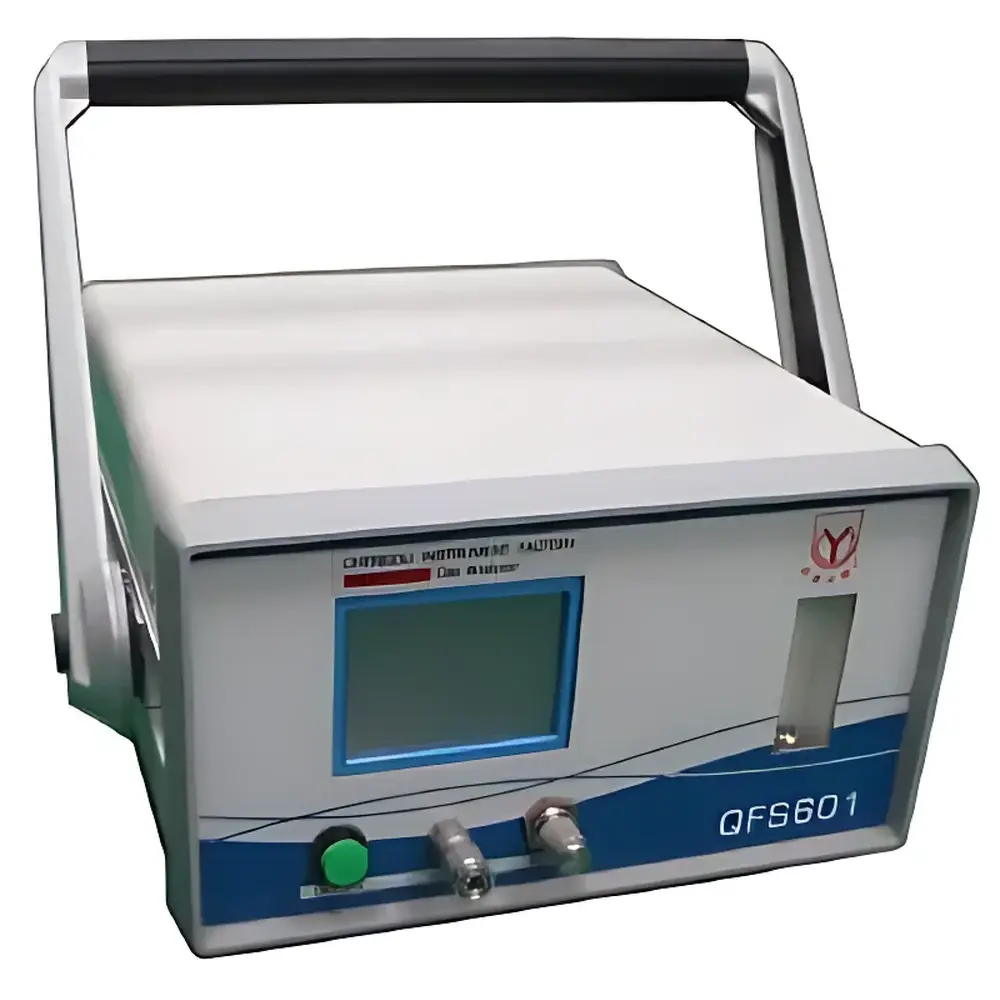
SCChengyi QFS601 Gas Moisture Analyzer (Dew Point Meter)
| Brand | SCChengyi |
|---|---|
| Origin | Sichuan, China |
| Model | QFS601 |
| Measurement Range | -80 to +20 °C dew point (≈ 0.5–23,632 µL/L H₂O) |
| Accuracy | ≤ ±1 °C |
| Response Time | <30 s (63%), <60 s (90%) for rise at DP < -40 °C |
| Output Signals | 4–20 mA, RS232 or USB (user-specified) |
| Power Supply | AC 220 ± 22 V, 50–60 Hz / Internal rechargeable battery (DC) |
| Operating Conditions | Gas Temp < +60 °C, Pressure < 2 MPa, Recommended Flow Rate: 200 mL/min |
| Dimensions | 260 × 170 × 300 mm (W × H × D) |
Overview
The SCChengyi QFS601 Gas Moisture Analyzer is a high-stability, capacitive thin-film dew point meter engineered for continuous and intermittent measurement of water vapor concentration in industrial process gases. Unlike absolute methods such as chilled-mirror hygrometry or tunable diode laser absorption spectroscopy, the QFS601 employs a robust polymer-based capacitive humidity sensor whose dielectric constant varies predictably with ambient water vapor partial pressure. This principle enables rapid, drift-resistant detection across an extended dew point range—from cryogenic levels (-80 °C DP) to near-ambient conditions (+20 °C DP)—while maintaining metrological integrity under real-world gas stream variability. The instrument’s core architecture integrates a precision-engineered gas handling system—including laminar flow control, particulate filtration, and optional hydrophobic pre-filtration—to minimize contamination-induced signal degradation. Its dual-power design (AC mains + internal rechargeable battery) supports both fixed installation in control rooms and portable field deployment in remote or power-limited environments, including turbine enclosures, SF₆-insulated switchgear bays, and syngas purification lines.
Key Features
- Capacitive thin-film sensing element with long-term baseline stability—engineered to mitigate typical drift mechanisms associated with conventional hygroscopic polymers
- Wide operational dew point range: -80 °C to +20 °C DP (equivalent to ~0.5–23,632 µL/L H₂O by volume), suitable for ultra-dry applications (e.g., semiconductor purge gases) and humid process streams (e.g., biogas drying)
- Fast dynamic response: <30 s (63% step response) for dew point increases below -40 °C; <60 s for 90% recovery—optimized for transient moisture events in compressor discharge or dryer outlet monitoring
- Dual-mode operation: Supports both laboratory-grade spot measurements and 24/7 process integration via analog (4–20 mA) and digital (RS232/USB) outputs
- Robust environmental tolerance: Immune to non-condensing oil aerosols, common hydrocarbon vapors, and particulate matter up to ISO Class 5; no catalytic poisoning observed with H₂S, CO, or NH₃ within specified operating limits
- Onboard data logging capability with timestamped storage of dew point, ppmv, and relative humidity equivalents—compliant with basic GLP traceability requirements
Sample Compatibility & Compliance
The QFS601 is validated for use with compressed air, nitrogen, argon, hydrogen, natural gas, SF₆, CO₂, and synthesis gas (syngas). It meets mechanical and electrical safety requirements per IEC 61000-6-2 (immunity) and IEC 61000-6-4 (emissions). While not certified to ATEX or IECEx for hazardous area use, it may be deployed in Zone 2/Class I Division 2 environments when installed with appropriate barrier systems. For regulated industries, the device supports audit-ready data export and user-accessible calibration history logs—facilitating alignment with FDA 21 CFR Part 11 principles where electronic records are retained locally and exported manually. It conforms to ISO 8573-1:2010 Class 2–4 moisture purity specifications for compressed air quality assessment.
Software & Data Management
The analyzer includes embedded firmware supporting configurable display modes (dew point temperature, ppmv, g/m³, %RH) and user-defined alarm thresholds. Data export is performed via USB mass storage mode or RS232 serial protocol using ASCII-formatted CSV files compatible with Excel, LabVIEW, and SCADA historian systems. No proprietary software installation is required. Firmware updates are delivered as signed binary packages via USB stick, ensuring version control and rollback capability. All stored measurements include UTC timestamps, sensor ID, and operator-assigned batch tags—enabling traceability in QA/QC workflows without third-party database dependencies.
Applications
- Power generation: Monitoring moisture in SF₆ circuit breakers and transformer insulating gas to prevent dielectric failure
- Petrochemical refining: Verifying dryness of feedstock gases prior to Fischer–Tropsch or methanol synthesis reactors
- Electronics manufacturing: Ensuring < -70 °C DP in N₂ purge lines for photolithography tool chambers
- Heat treatment atmospheres: Controlling H₂O partial pressure in endothermic gas generators for carburizing furnaces
- Biomethane upgrading: Validating post-adsorption moisture levels before grid injection per EN 16723-1
- On-site commissioning: Rapid verification of dryer performance during plant start-up or maintenance turnarounds
FAQ
What calibration standards are supported?
The QFS601 accepts two-point calibration using certified chilled-mirror reference standards traceable to NIST or NMi. Factory calibration certificates include uncertainty budgets per ISO/IEC 17025 guidelines.
Can the sensor be cleaned in situ?
No physical cleaning is required. The hydrophobic inlet filter and laminar flow path minimize fouling; periodic replacement of the 0.1 µm particulate filter (part #QFS-FIL-01) every 6 months is recommended under dusty conditions.
Is pressure compensation automatic?
Yes—the instrument applies real-time pressure correction using an integrated piezoresistive transducer (range: 0–2 MPa), ensuring accurate ppmv calculation across variable line pressures.
Does it support Modbus RTU communication?
Not natively; however, the RS232 interface can be bridged to Modbus RTU via external protocol converters compliant with IEEE 1157.
What is the expected service life of the sensing element?
Under normal operating conditions (no exposure to liquid water, condensables, or strong oxidizers), the thin-film sensor maintains metrological performance for ≥36 months—verified through accelerated aging tests per IEC 60751 Annex D.
Related Products






