
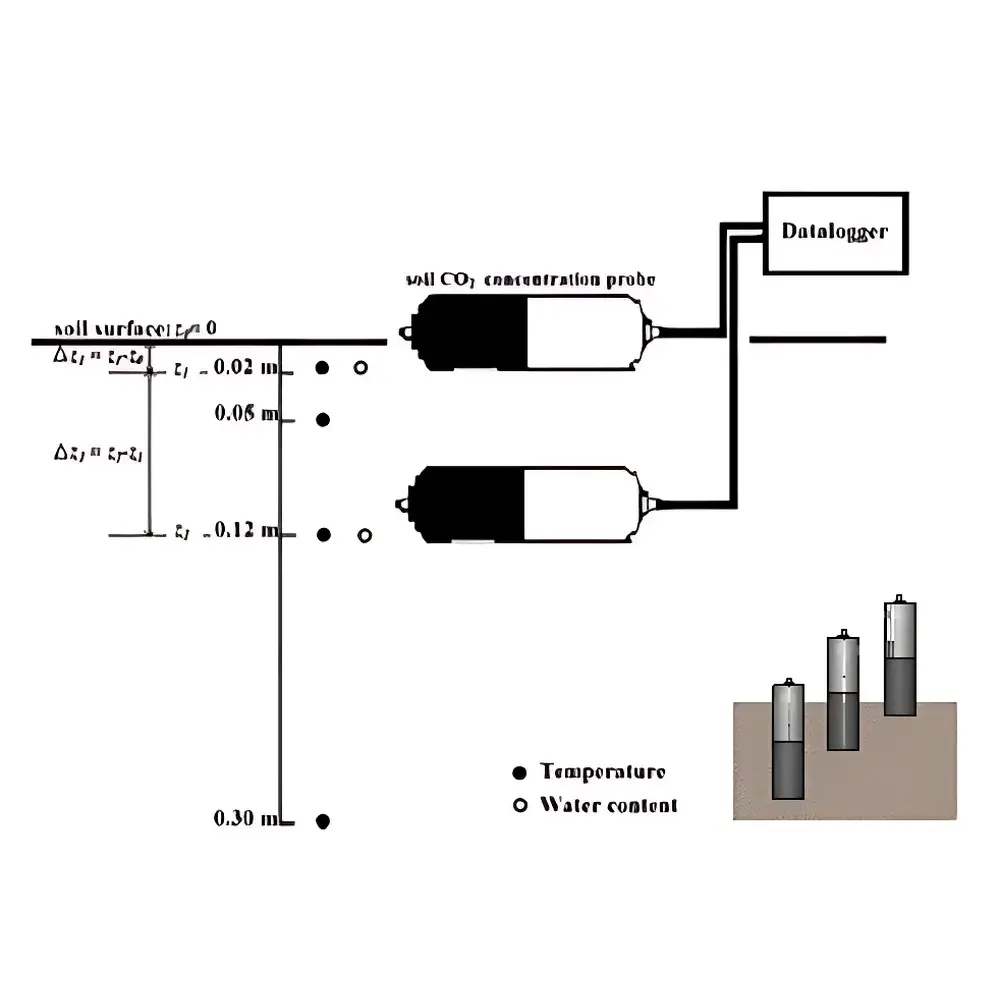
SCG-N Soil Profile CO₂ Gradient Monitoring System
| Brand | — |
|---|---|
| Origin | Beijing, China |
| Manufacturer Type | Authorized Distributor |
| Product Category | Domestic |
| Model | SCG-N |
| Price Range | USD 14,000–42,000 (FOB) |
| Instrument Type | Soil Moisture / Water Potential Analyzer |
| CO₂ Measurement Principle | NDIR (Non-Dispersive Infrared), Single-Beam Dual-Wavelength |
| Standard Depth Layers | 3 |
| Data Logger | 16-Channel (expandable to 32) |
| Power Supply | Rechargeable Li-ion Battery or Solar Panel |
| Wireless Connectivity | 4G LTE Full-Band Module (backward-compatible with EDGE/GPRS) |
| Compliance | Designed for GLP-aligned field research |
Overview
The SCG-N Soil Profile CO₂ Gradient Monitoring System is an integrated, in-situ field instrument engineered for high-temporal-resolution quantification of vertical CO₂ flux dynamics across soil horizons. It operates on the foundational principle of Fick’s First Law of Diffusion, enabling calculation of soil CO₂ efflux (μmol CO₂ m⁻² s⁻¹) from measured concentration gradients (dC/dx) and depth-resolved estimates of the CO₂ diffusion coefficient (D), which is empirically parameterized using concurrent soil temperature, volumetric water content (VWC), and porosity data. Unlike surface-flux-only methods such as closed-chamber or eddy covariance, the SCG-N captures subsurface production zones—critical for distinguishing root respiration, microbial decomposition, and abiotic carbonate dissolution contributions. Its design supports long-term deployment in heterogeneous ecosystems including forests, grasslands, agricultural fields, and permafrost-affected soils, where diurnal and seasonal shifts in moisture, thermal regime, and biological activity drive non-linear CO₂ generation profiles.
Key Features
- In-situ, non-destructive profiling: Simultaneous measurement of CO₂ concentration at up to three standard depths (customizable to ≥5 layers via 32-channel logger expansion)
- Multi-parameter co-location: Integrated Vaisala meteorological sensors (air temperature, relative humidity, barometric pressure, precipitation, wind speed/direction) ensure environmental context synchronization
- NDIR-based CO₂ sensing: Dual-wavelength single-beam infrared detection with selectable ranges (0–5000 ppm, 0–7000 ppm, 0–10,000 ppm, or 0–20,000 ppm); ±1.5% full-scale accuracy; 30-second response time
- Soil physical property integration: Onboard soil moisture (0–60% VWC, ±3% factory-calibrated), temperature (−40°C to +80°C, ±0.2°C), and dielectric permittivity (1–80, 0.01 resolution) sensors enable real-time D-coefficient modeling
- Optional O₂ profiling: Fluorescence-based fiber-optic O₂ modules (0–50% O₂, <0.4% accuracy, 5-second response, zero oxygen consumption)
- Configurable surface interface: ACE-type transparent or opaque soil respiration chambers (closed/open modes) for net ecosystem exchange (NEE) or autotrophic/heterotrophic partitioning
- Robust data architecture: 16-channel datalogger (220,000 timestamped records, 16-bit resolution, programmable sampling interval from 3 sec to 4 hr); optional 8 GB MicroSD card and cloud backup
Sample Compatibility & Compliance
The SCG-N is validated for use in mineral soils (sandy loam to clay), organic-rich peats, volcanic ash substrates, and saline-affected profiles (up to 8 dS/m EC). Sensor housings are IP68-rated and chemically inert to common soil solutes. While not a certified emissions-monitoring device under EPA 40 CFR Part 60, its measurement traceability aligns with ISO/IEC 17025 principles for environmental testing laboratories. Data acquisition workflows support audit-ready metadata tagging (time zone, GPS coordinates, sensor calibration dates), satisfying GLP documentation requirements for carbon cycle research funded by NSF, EU Horizon, or national ecological observatory networks. All firmware and software comply with IEC 61508 functional safety standards for embedded systems operating in remote environments.
Software & Data Management
The system ships with proprietary desktop software compatible with Windows 10/11 and macOS 12+. It enables direct USB or wireless download of raw and processed datasets, supports batch calibration correction (e.g., temperature drift compensation for NDIR units), and exports time-series in CSV, NetCDF4, and CF-compliant formats. Built-in statistical tools compute hourly/daily means, min/max envelopes, cross-parameter correlations (e.g., CO₂ gradient vs. soil VWC), and diffusion flux integrals using user-defined D models (e.g., Millington-Quirk or Penman formulations). The software generates publication-ready plots—including layered CO₂ concentration heatmaps, cumulative flux curves, and meteorological overlay panels—and exports vector graphics (SVG/PDF). Cloud sync (optional subscription) provides role-based access control, versioned backups, and API endpoints for integration with FluxNet, AmeriFlux, or ICOS data portals.
Applications
- Quantifying depth-specific contributions to total soil respiration in climate change experiments (e.g., warming, drought, CO₂ enrichment)
- Validating biogeochemical models (e.g., CENTURY, DAYCENT, RothC) by constraining subsurface CO₂ production rates
- Assessing carbon sequestration potential in restored grasslands and afforested sites
- Monitoring CO₂ inversion events (atmosphere-to-soil flux) during post-rainfall rewetting in arid ecosystems
- Linking root-zone O₂ depletion with anaerobic C mineralization pathways in flooded rice paddies or wetland soils
- Supporting UNFCCC Article 5 reporting on land-use change and forestry (LULUCF) through standardized soil carbon stock change estimation
FAQ
How does the SCG-N differ from conventional chamber-based soil respiration systems?
It measures vertical CO₂ concentration gradients *within* the soil matrix rather than inferring flux from surface accumulation, thereby resolving subsurface production hotspots and avoiding chamber-induced pressure artifacts or root exclusion bias.
Can the system operate autonomously for over one year without maintenance?
Yes—when paired with a 20W solar panel and deep-cycle lithium battery, the SCG-N achieves >12 months of continuous operation in mid-latitude temperate zones; power budgeting tools are included in the software.
Is sensor recalibration required in the field?
NDIR CO₂ sensors include automatic zero-reference cycles; soil moisture and temperature sensors are factory-calibrated with documented uncertainty budgets—field recalibration is optional but recommended annually using traceable reference standards.
Does the system support third-party data ingestion (e.g., from nearby eddy covariance towers)?
Yes—the software accepts external time-series inputs via CSV import and allows synchronized multi-source visualization and regression analysis against SCG-N-derived flux estimates.
What level of technical support is provided for academic users?
Comprehensive documentation (including SOPs for installation, QA/QC protocols, and uncertainty propagation guidelines) is supplied; remote configuration assistance and data interpretation workshops are available upon request.







