
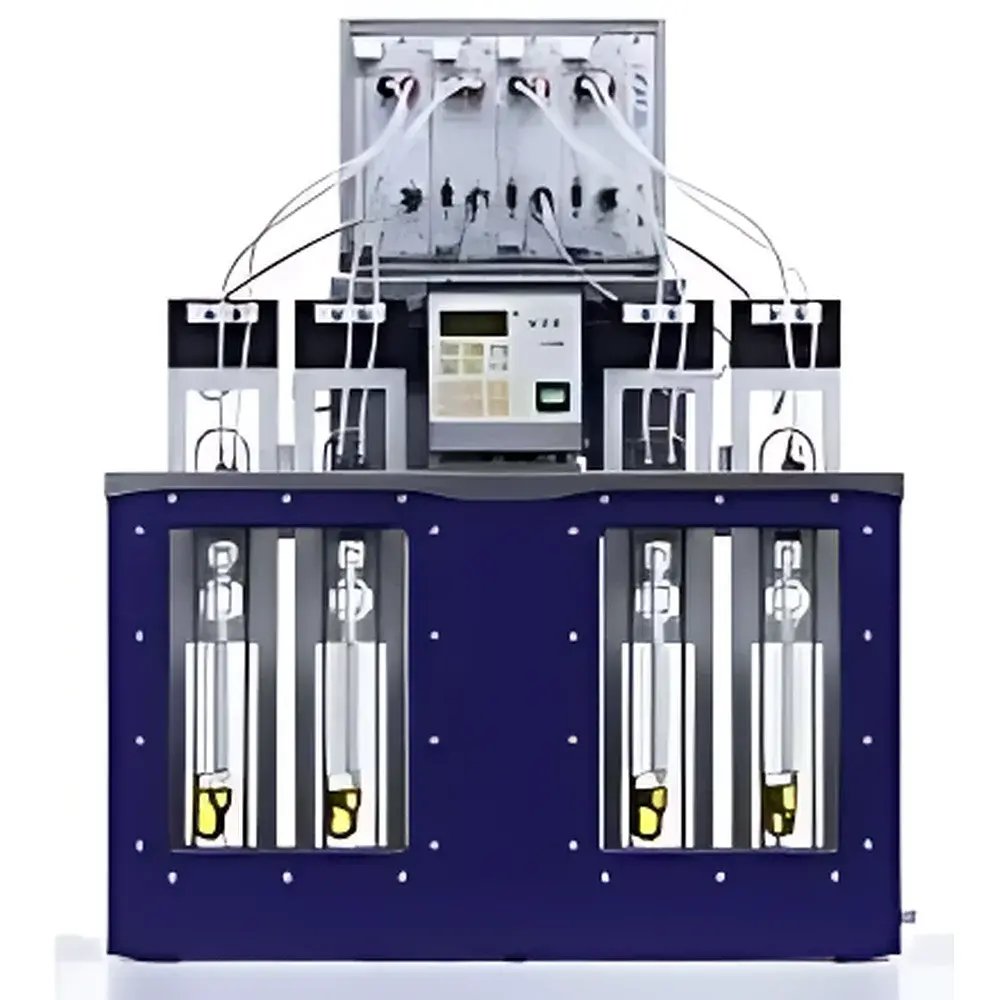
SCHOTT AVS370 Automated Capillary Viscometer
| Brand | SCHOTT |
|---|---|
| Origin | Germany |
| Model | AVS370 |
| Measurement Principle | Capillary Flow (Ubbelohde & Ostwald-type) |
| Time Range | 0.01–9999.99 s (resolution: 0.01 s) |
| Kinematic Viscosity Range | 0.35–1800 mm²/s (positive pressure mode) / 0.35–5000 mm²/s (vacuum mode) |
| Timer Accuracy | ±0.01% |
| Temperature Equilibration Time Setting | 0–20 min (in 1-min increments) |
| Replicate Runs | 1–10 per sample |
| Interface | RS-232C |
| Power Supply | 115/230 VAC, 50/60 Hz, 30 W |
| Housing | Anodized aluminum |
| Dimensions (W×H×D) | 225 × 205 × 320 mm |
| Weight | 5.4 kg |
| Compatible Viscometers | DIN Ubbelohde, ASTM Ubbelohde, DIN Micro Ubbelohde, Micro Ostwald, Cannon-Fenske Routine, TC-Ubbelohde, TC-Micro Ubbelohde |
Overview
The SCHOTT AVS370 is a fully automated capillary viscometer engineered for high-precision kinematic viscosity determination in accordance with ISO 3104, ASTM D445, and DIN 51562 standards. It operates on the fundamental principle of Poiseuille flow through calibrated glass capillaries—measuring the efflux time of a fixed volume of liquid under controlled hydrostatic or vacuum-driven pressure. Unlike rotational or vibrational methods, capillary viscometry delivers traceable, primary-standard-level accuracy for Newtonian and near-Newtonian fluids, making it the reference method for quality control laboratories in petrochemicals, pharmaceuticals, lubricants, and polymer solutions. The AVS370 uniquely integrates dual-mode fluid propulsion—positive-pressure and vacuum-driven—enabling seamless adaptation to both low-viscosity volatile solvents and higher-viscosity oils without hardware modification.
Key Features
- Dual-mode capillary drive system: Switch between positive-pressure and vacuum aspiration via software command—no manual valve reconfiguration required.
- Hybrid sensing architecture: Combines optical beam interruption detection (for precise meniscus transit timing) with thermal conductivity-based flow monitoring to verify stable laminar flow conditions prior to data capture.
- Modular scalability: Standard configuration includes one ViscoPump II module; up to four pumps can be housed in a 19-inch rack-mount chassis for parallel multi-sample analysis.
- Thermal equilibration control: Programmable pre-run temperature stabilization period (0–20 minutes), ensuring sample thermal homogeneity before measurement initiation—critical for temperature-sensitive materials such as biodiesel or silicone oils.
- RS-232C serial interface for direct integration into LIMS or QC data management platforms, supporting ASCII-based command protocols for automated batch sequencing.
- Anodized aluminum enclosure provides EMI shielding, mechanical stability, and resistance to laboratory chemical exposure—designed for continuous operation in regulated environments.
Sample Compatibility & Compliance
The AVS370 supports a comprehensive range of standardized capillary viscometers, including DIN Ubbelohde, ASTM Ubbelohde, DIN Micro Ubbelohde, Micro Ostwald, Cannon-Fenske Routine, and temperature-compensated (TC) variants. This broad compatibility ensures adherence to method-specific geometry requirements across international pharmacopoeias (e.g., USP , EP 2.2.33) and industrial specifications (e.g., ISO 3104 for petroleum products). All measurements comply with GLP documentation requirements: timestamped raw efflux times, pump pressure/vacuum logs, and thermal stabilization records are embedded in each data export. The instrument’s timer accuracy of ±0.01% meets the repeatability thresholds defined in ASTM D445 Annex A1 for Class 1 viscometers.
Software & Data Management
WinVisco370 v3.x is supplied standard with each AVS370 unit. The software enables concurrent control of up to two AVS370 instruments and eight ViscoPump II modules—supporting independent parameter sets per channel (e.g., different capillary constants, temperature setpoints, or replicate counts). It generates audit-trail-enabled reports compliant with FDA 21 CFR Part 11 requirements, including electronic signatures, user access levels, and immutable change logs. Data exports include CSV, PDF, and XML formats compatible with enterprise analytics tools. Calibration verification routines are built-in, allowing periodic validation against NIST-traceable reference oils (e.g., Cannon Standard Viscosity Oils) with automatic drift correction mapping.
Applications
- Petrochemical QA/QC: Kinematic viscosity grading of base oils, diesel fuels, and aviation turbine fuels per ASTM D445 and IP 71.
- Pharmaceutical excipient characterization: Viscosity profiling of polysorbates, PEGs, and cellulose derivatives under GMP-compliant workflows.
- Chemical manufacturing: Batch release testing of solvents, monomers, and synthetic esters where ISO 3104 compliance is contractually mandated.
- Academic rheology labs: Teaching capillary flow principles and validating theoretical Hagen-Poiseuille correlations with real-world fluid datasets.
- Research on temperature-dependent viscosity: Programmable thermal soak intervals enable Arrhenius modeling across 20–100 °C ranges using external bath integration.
FAQ
Does the AVS370 require external temperature baths?
Yes—the AVS370 is a viscometer controller only; it must be paired with a certified thermostatic bath (e.g., Julabo F25 or similar) meeting ASTM D445 temperature uniformity requirements (±0.02 °C).
Can WinVisco370 export data directly to LabWare LIMS?
Yes—via configurable ASCII output templates and optional OPC UA gateway add-on for real-time data streaming.
Is calibration traceable to national standards?
All factory calibrations are performed using NIST-traceable reference oils, with full calibration certificates provided per unit.
What maintenance is required for the ViscoPump II modules?
Pump diaphragms and seals are rated for ≥10,000 cycles; routine inspection every 6 months is recommended for GxP environments.
Does the system support 21 CFR Part 11-compliant electronic signatures?
Yes—WinVisco370 implements role-based authentication, biometric or token-assisted signing, and encrypted audit trail storage meeting Part 11 Subpart B requirements.
Related Products



