
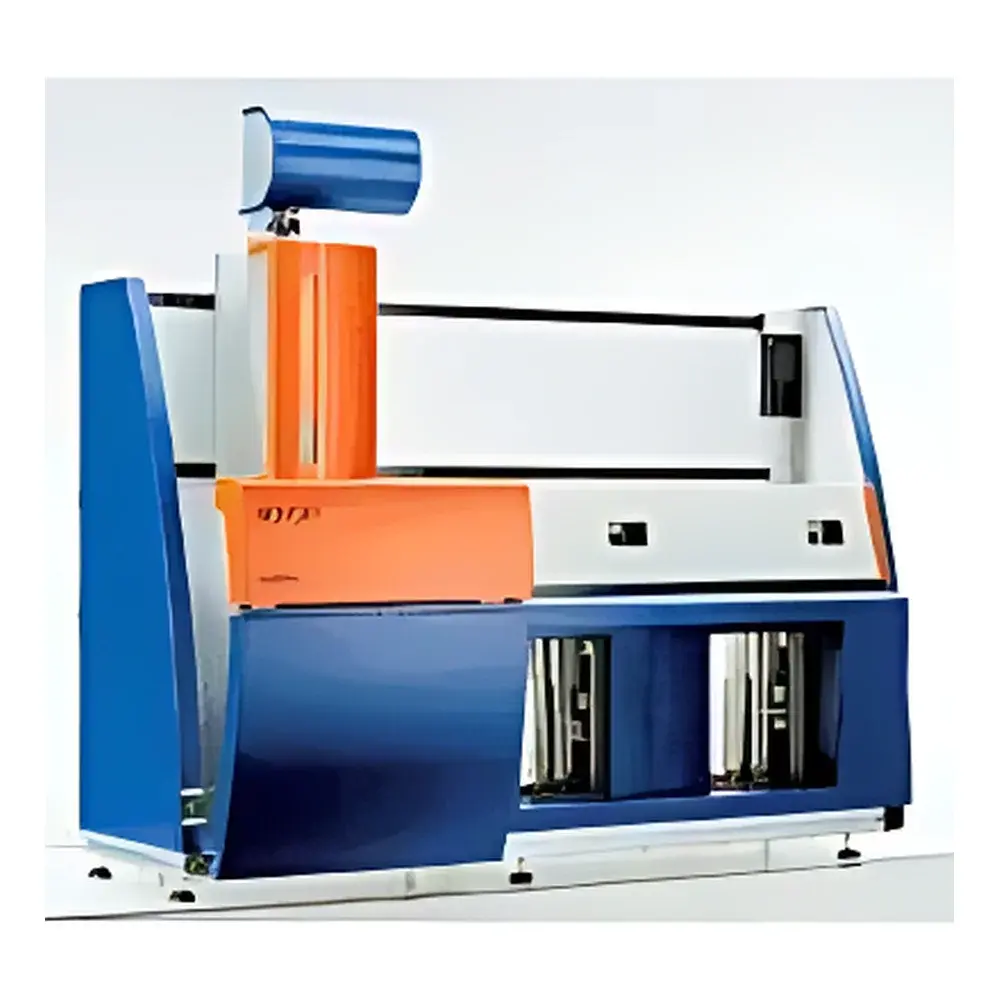
Schott AVSPro Fully Automated Kinematic Viscometer
| Brand | SCHOTT |
|---|---|
| Origin | Germany |
| Model | AVSPro |
| Measurement Principle | Capillary Flow (ASTM D445, ISO 3104, IP 71) |
| Kinematic Viscosity Range | 0.35–1200 mm²/s at ambient temperature |
| Accuracy | ±0.01% of reading + ±1 digit |
| Replicate Runs | 1–99 per sample |
| Temperature Equilibration Time | 0–99 min |
| Detection Methods | Dual-mode — Opto-electronic (for transparent/clear liquids) and Thermal Conductivity (TC) sensing (for opaque, dark, or highly viscous samples) |
| Sample Handling | Fully automated liquid handling with programmable injection sequence |
| Interface | RS-232/USB for PC integration |
| Compliance | Designed to meet ASTM D445, ISO 3104, ISO 17025 requirements for accredited viscosity testing laboratories |
Overview
The Schott AVSPro Fully Automated Kinematic Viscometer is an engineered solution for high-precision kinematic viscosity determination in research, quality control, and regulatory-compliant laboratories. Based on the universally accepted capillary flow principle—governed by Poiseuille’s law—the AVSPro delivers traceable, reproducible measurements aligned with international standards including ASTM D445, ISO 3104, and IP 71. Unlike rotational or vibrational viscometers, capillary-based systems provide primary-standard-level accuracy for Newtonian and near-Newtonian fluids, with typical measurement uncertainty below ±0.01% of reading. The AVSPro integrates two independent detection modalities—opto-electronic timing for optically clear samples and thermal conductivity (TC) sensing for opaque, colored, or highly viscous media—eliminating manual method switching and enabling unattended analysis across diverse sample matrices without compromise in metrological integrity.
Key Features
- Fully automated capillary viscometry platform with integrated sample dispensing, rinsing, and drying cycles
- Dual-sensor architecture: opto-electronic photogate detection for transparent liquids and thermal conductivity-based timing for black oils, bitumens, polymer melts, and turbid suspensions
- Programmable run sequence: users define injection order across up to 99 samples per batch, supporting heterogeneous test protocols
- Precise thermal equilibration control with adjustable dwell time (0–99 minutes) prior to viscosity measurement
- Modular design compliant with ISO 17025 laboratory accreditation requirements, including audit-trail enabled firmware and user-access-level permissions
- RS-232 and USB interfaces for bidirectional communication with host PCs; supports scripting via ASCII command protocol for integration into automated QC workflows
Sample Compatibility & Compliance
The AVSPro accommodates a broad spectrum of industrial and scientific samples—including petroleum distillates, lubricants, biodiesel blends, silicone oils, glycerol-water mixtures, and low-concentration polymer solutions—without requiring dilution or pre-filtration in most cases. Its TC sensor enables reliable timing in samples where optical obscuration prevents photogate operation (e.g., crude oil, asphaltene-containing fractions, carbon-black dispersions). All measurement routines adhere to the repeatability and reproducibility criteria defined in ASTM D445 (≤0.35% RSD for duplicate tests) and ISO 3104 (±0.5% for inter-laboratory precision). Instrument validation includes built-in reference fluid checks and calibration traceability to NIST-traceable certified viscosity standards.
Software & Data Management
The AVSPro operates under Schott’s ViscoControl software suite, which provides full GLP/GMP-aligned data governance. Each measurement record contains timestamped metadata: ambient pressure, bath temperature stability profile, capillary ID, sample ID, detection mode used, raw efflux time, calculated kinematic viscosity, and statistical summary across replicates. Audit trails log all user actions—including method edits, calibration events, and result overrides—with immutable timestamps and operator IDs. Export formats include CSV, PDF reports (with digital signature support), and XML for LIMS ingestion. Software complies with FDA 21 CFR Part 11 requirements when deployed with electronic signature configuration and role-based access control.
Applications
- Refinery QC: routine verification of diesel, jet fuel, and base oil kinematic viscosity per ASTM D445
- Pharmaceutical excipient characterization: viscosity profiling of propylene glycol, PEGs, and castor oil derivatives under USP guidance
- Automotive fluid certification: SAE J300 compliance testing for engine oils and transmission fluids
- Academic rheology studies: benchmarking Newtonian behavior prior to complex fluid analysis using rotational rheometers
- Biopolymer processing: monitoring viscosity drift during enzymatic hydrolysis or thermal degradation of starch/xanthan solutions
- Renewable fuels development: stability assessment of FAME and HVO blends across seasonal temperature ranges
FAQ
What standards does the AVSPro comply with?
ASTM D445, ISO 3104, ISO 17025, IP 71, and DIN 51562—fully documented in the instrument’s Type Approval Certificate and Validation Protocol.
Can the AVSPro measure non-Newtonian fluids?
It is optimized for Newtonian and low-shear-rate pseudo-Newtonian liquids; for shear-dependent behavior, pairing with a rotational rheometer (e.g., Brookfield DVNext or Anton Paar MCR series) is recommended.
Is thermal calibration required before each test series?
No—temperature stability is continuously monitored via Pt100 sensors in the thermostatic bath; calibration is performed annually per ISO/IEC 17025 requirements.
How is data integrity ensured during long unattended runs?
All raw timing data, environmental logs, and operator inputs are written to non-volatile memory in real time; power-loss recovery resumes from last valid measurement point.
Does the system support multi-capillary configurations?
Yes—up to four independently controlled Ubbelohde or Cannon-Fenske capillaries can be mounted simultaneously for parallel testing or redundancy validation.



