
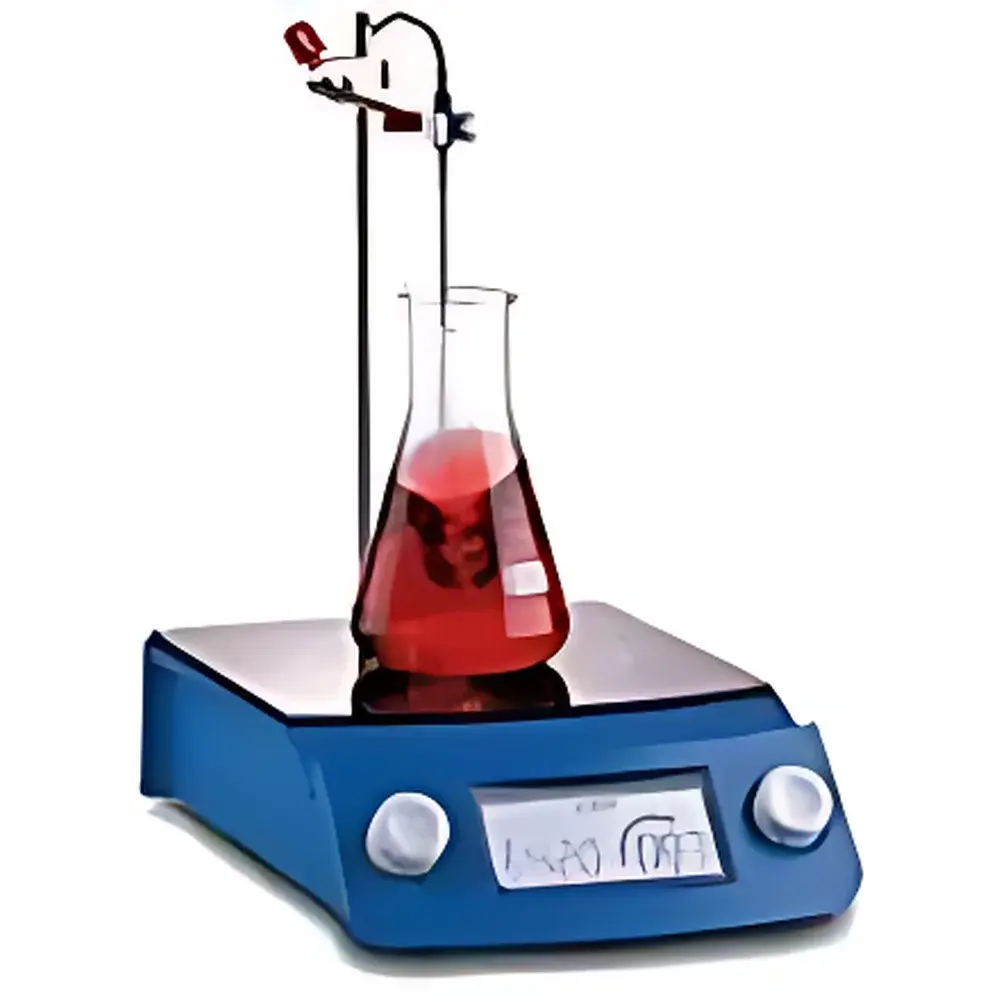
SCHOTT SLR Infrared Heating Magnetic Stirrer
| Brand | SCHOTT |
|---|---|
| Origin | Germany |
| Model | SLR |
| Instrument Type | Magnetic Stirrer |
| Heating Method | Infrared |
| Max. Stirring Volume | 10 L (H₂O) |
| Stirring Speed Range | 100–1100 rpm (adjustable in 10 rpm increments) |
| Heating Plate Material | Ceramic Glass |
| Max. Heating Temperature | ~550 °C |
| Heating Power | 0.9 kW |
| Plate Dimensions (L×W) | 235 × 235 mm |
| Heating Zone Diameter | Φ155 mm |
| Dimensions (W×H×L) | 370 × 240 × 85 mm |
| Weight | ~3.8 kg |
| Max. Load Capacity | 25 kg |
| Temperature Control Accuracy | ±2–5 °C |
| External Temperature Sensor Support | Pt1000 (optional) |
| Temp. Setting/Display Resolution | 1 °C |
| IP Rating | IP20 |
| Operating Ambient | 10–40 °C, ≤85% RH |
| Power Supply | 115/230 V, 50/60 Hz |
| Safety Features | Overtemperature auto-shutdown, residual heat warning, thermal shock resistance up to 700 °C |
Overview
The SCHOTT SLR Infrared Heating Magnetic Stirrer is an engineered solution for laboratories requiring precise, simultaneous thermal control and mechanical agitation of liquid samples. Unlike conventional resistive-heating hotplates, the SLR employs infrared radiation technology to deliver rapid, uniform energy transfer directly to the vessel bottom—minimizing thermal lag and improving response time during temperature ramping or maintenance. Its magnetic stirring mechanism operates on the principle of rotating magnetic fields generated beneath the ceramic glass surface, inducing torque on PTFE- or glass-coated stir bars without mechanical contact. Designed for reproducible heating-stirring workflows in analytical chemistry, pharmaceutical formulation, polymer synthesis, and quality control environments, the SLR meets functional requirements aligned with ISO/IEC 17025-compliant laboratory practices—particularly where traceability, stability, and operator safety are critical.
Key Features
- Infrared heating system enabling faster thermal response and improved energy efficiency compared to coil-based hotplates
- 24-step power regulation with dual rotary encoders for independent, tactile adjustment of heating intensity and stirring speed
- Large backlit LCD display showing both numeric setpoints and real-time graphical trend indicators for temperature and rpm
- Ceramic glass heating surface (Φ155 mm active zone) offering chemical inertness, scratch resistance, and thermal shock tolerance up to 700 °C
- Stirring speed range from 100 to 1100 rpm, adjustable in precise 10 rpm increments; stable low-speed operation ensures gentle mixing of sensitive suspensions or viscous media
- Integrated safety architecture including overtemperature cut-off, residual heat warning (via icon and audible signal), and automatic shutdown upon sensor failure or open-circuit conditions
- Optically bonded capacitive touch controls—seamless, cleanable, and resistant to solvent exposure or accidental spills
- Enclosure design with zero crevices and sloped edges prevents accumulation of liquids or particulates, supporting GLP-aligned housekeeping protocols
Sample Compatibility & Compliance
The SLR accommodates standard laboratory glassware—including round-bottom flasks (up to 20 L capacity with appropriate stir bar geometry), beakers, and crystallization dishes—provided base diameters fall within the 155 mm heating zone. Compatibility extends to borosilicate glass, PTFE-lined vessels, and certain high-temp ceramics. When paired with an optional external Pt1000 temperature probe and support stand, the unit supports closed-loop temperature regulation between 35 °C and 200 °C, with 5-second alternating display of actual and setpoint values—enabling compliance with USP , ASTM E2912, and internal SOPs governing thermal validation. The device conforms to IEC 61010-1 for electrical safety and carries CE marking per EU Directive 2014/30/EU (EMC) and 2014/35/EU (LVD). Its IP20 rating indicates protection against solid objects ≥12.5 mm; ambient operation is restricted to non-condensing environments (10–40 °C, ≤85% RH).
Software & Data Management
The SLR operates as a standalone instrument without proprietary software dependency. All operational parameters—including speed, power level, and (when equipped) temperature setpoints—are stored locally and retained after power cycling. While no USB or Ethernet interface is provided, the unit supports manual documentation via timestamped logbooks compliant with FDA 21 CFR Part 11 Annex 11 principles when used in conjunction with validated electronic lab notebooks (ELNs). Optional Pt1000 integration allows analog output signals suitable for connection to external data acquisition systems (e.g., LabVIEW-compatible DAQ modules) for continuous monitoring and audit-trail generation.
Applications
- Controlled dissolution testing in pharmaceutical QC labs (e.g., USP Apparatus II simulation)
- Polymerization initiation under defined thermal profiles with concurrent homogenization
- Standardization of calibration standards requiring matrix stabilization at elevated temperatures
- Preparation of homogeneous catalyst slurries for heterogeneous reaction screening
- Heating-stirring sequences in environmental sample digestion protocols (e.g., EPA Method 3050B)
- Long-duration stability studies involving aqueous or organic solvents where thermal drift must remain below ±3 °C
FAQ
Is the SLR compatible with temperature probes other than Pt1000?
No—the external sensor interface is specifically designed for Pt1000 RTDs meeting DIN EN 60751 Class A tolerances.
Can the SLR be used under a fume hood?
Yes, provided ambient temperature remains within 10–40 °C and relative humidity does not exceed 85% RH; airflow must not impinge directly on the ceramic surface during operation.
What is the maximum recommended viscosity for effective stirring?
Optimal performance is achieved with aqueous solutions up to ~500 mPa·s; for higher viscosities, use larger-diameter stir bars and reduce speed incrementally while monitoring torque stability.
Does the unit support programmable ramp-hold temperature profiles?
No—temperature programming requires external controllers; the SLR provides only manual setpoint adjustment and real-time feedback.
Is calibration certificate included with purchase?
Factory calibration data is supplied; full metrological certification (e.g., DAkkS or UKAS) is available as a chargeable service upon request.



