
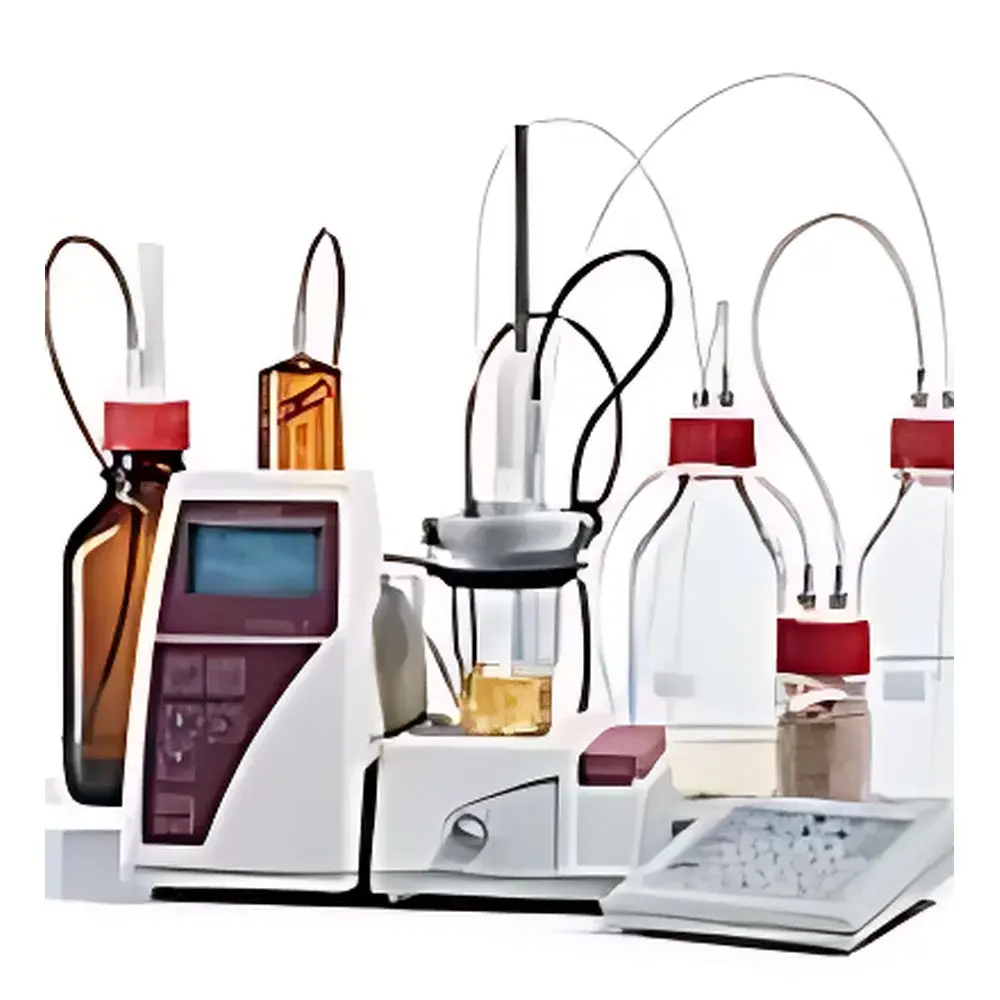
SCHOTT TitroLine KF Karl Fischer Moisture Analyzer
| Brand | SCHOTT |
|---|---|
| Origin | Germany |
| Instrument Type | Volumetric Karl Fischer Titrator |
| Titration Burette Capacity | 20 mL (DURAN® borosilicate glass, Class 3, UV-protected jacket) |
| Valve System | PTFE/ECTFE three-way safety valve |
| Tubing | UV-resistant FEP tubing with PTFE check valves |
| Dispensing Accuracy | ±0.03–0.07% (burette), ±0.1–0.2% (system) |
| Display | Backlit LCD (69 × 39 mm, 64 × 128 characters), auto-adjusting brightness |
| Electrode | Dual platinum electrode, polarizing voltage adjustable from 5–200 mV (default 100 mV) |
| Current Measurement Range | 0–99.9 µA, resolution 0.1 µA |
| Interfaces | Dual RS-232 ports (PC/printer + balance/expansion) |
| Calibration Modes | Pure water, certified standard, sodium tartrate dihydrate (with solvent/gas blank correction) |
| Reporting | On-screen results + printable reports (Basic, Standard, GLP-compliant) |
| Calculation Units | ppm, mg, mg/L, mg/pc |
| Stirring Speed | 50–1000 rpm |
| Power Supply | AC 230 V, 50/60 Hz, 30 VA |
| Dimensions (W × H × D) | 310 × 265 × 205 mm (including titration unit) |
| Weight | 3.2 kg |
| Compliance | DIN 12650 Part 5, EN ISO 8655-3 |
| Qualification Support | DQ/IQ/OQ/PQ documentation available on request |
Overview
The SCHOTT TitroLine KF is a precision-engineered volumetric Karl Fischer titrator designed for accurate, trace-level moisture determination in solid, liquid, and gaseous samples across regulated and research-intensive environments. Based on the electrochemical iodometric principle defined in ASTM E203 and ISO 760, the system quantifies water via stoichiometric reaction with iodine generated in situ during coulometric or volumetric titration — in this case, volumetric mode using standardized KF reagent. Its modular architecture integrates a high-stability 20 mL glass burette (DURAN® borosilicate, Class 3), UV-shielded fluidic pathways, and dual platinum indicator electrodes with programmable polarization voltage — enabling robust endpoint detection even in low-conductivity or viscous matrices. The instrument is calibrated and validated in accordance with DIN 12650 Part 5 and EN ISO 8655-3, ensuring metrological traceability to national standards. Designed for seamless integration into quality control laboratories operating under GMP, GLP, or FDA 21 CFR Part 11 frameworks, the TitroLine KF supports full audit trail generation, user access control, and electronic signature readiness when paired with compliant software.
Key Features
- Volumetric KF titration platform optimized for reproducibility in routine QC and release testing
- Pre-assembled, plug-and-play configuration — all core components (burette, electrode, stirrer, pump modules, and interface cables) shipped in a single package; operational within 10 minutes of unboxing
- Intuitive dialogue-driven user interface with context-sensitive prompts displayed on a large backlit LCD (64 × 128 characters), eliminating reliance on manuals for daily operation
- Dual RS-232 interfaces enable simultaneous connection to analytical balances (for sample weight import), printers (GLP-compliant reporting), and optional accessories such as oven couplers for loss-on-drying correlation or automated sample changers
- Integrated solvent handling system: DC-powered peristaltic pumps manage automatic reagent aspiration and waste expulsion, maintaining closed-system integrity and minimizing operator exposure
- Adjustable stirring speed (50–1000 rpm) ensures homogeneous mixing without emulsion formation or electrode fouling — critical for heterogeneous solids like polymers or pharmaceutical tablets
- Three-tier calibration strategy: primary (pure water), secondary (certified KF standard), and tertiary (sodium tartrate dihydrate), each supporting solvent and ambient moisture blank subtraction
Sample Compatibility & Compliance
The TitroLine KF accommodates diverse sample types — including hygroscopic powders (e.g., excipients, catalysts), viscous oils (lubricants, biodiesel), solvents (acetonitrile, methanol), and thermally labile materials (via optional oven coupling). Its fluidic design minimizes carryover and memory effects, while FEP tubing and PTFE/ECTFE valves resist chemical degradation from aggressive KF reagents (e.g., imidazole-based anolytes). Regulatory alignment includes full support for qualification protocols: Design Qualification (DQ) verifies functional specifications against user requirements; Installation Qualification (IQ) confirms hardware/software installation per manufacturer guidelines; Operational Qualification (OQ) validates performance under defined operating parameters; and Performance Qualification (PQ) demonstrates consistent accuracy and precision across representative sample matrices. Documentation packages meet ICH Q7, USP , and Ph. Eur. 2.5.12 expectations for moisture analysis in pharmaceutical manufacturing.
Software & Data Management
While the TitroLine KF operates autonomously via its embedded firmware, it exports fully structured ASCII data streams compatible with LIMS and ELN platforms. All measurement records include timestamp, operator ID, sample ID, method name, raw current curve, titrant volume consumed, calculated water content (in user-selected units), statistical summaries (n = 1–99 replicates), and calibration history. GLP report templates embed digital signatures, instrument serial number, environmental conditions (if external sensors are connected), and audit trail metadata — satisfying FDA 21 CFR Part 11 requirements when deployed with validated third-party data acquisition software. Raw current vs. time profiles can be exported for post-acquisition endpoint re-evaluation or multivariate trend analysis.
Applications
- Pharmaceuticals: Quantification of residual moisture in APIs and finished dosage forms (tablets, lyophilized powders) to ensure stability, dissolution performance, and compliance with USP
- Chemicals: Verification of water content in solvents, monomers, and catalysts where trace moisture compromises polymerization kinetics or catalyst lifetime
- Food & Feed: Monitoring hydration levels in flour, dairy powders, and pet food to inhibit microbial growth and extend shelf life
- Petrochemicals: Detection of water in transformer oils, jet fuels, and lubricants — critical for dielectric strength and corrosion prevention
- Polymers & Plastics: Assessment of moisture in engineering resins (e.g., PA6, PET) prior to extrusion or injection molding to prevent hydrolytic degradation
- Electronics: Moisture verification in conformal coatings and encapsulants to avoid delamination or interfacial failure
FAQ
Is the TitroLine KF compliant with 21 CFR Part 11?
Yes — when used with validated data capture software and appropriate administrative controls (e.g., role-based access, electronic signatures, audit trail review), the system meets predicate rule requirements for electronic records and signatures.
Can it analyze solid samples directly?
Solid samples require dissolution in KF-compatible solvents (e.g., chloroform/methanol mixtures); for insoluble or thermally unstable materials, coupling with a halogen moisture analyzer or KF oven (e.g., SCHOTT KF-Oven 200) enables indirect determination via evolved water collection.
What maintenance is required for long-term accuracy?
Routine maintenance includes weekly electrode cleaning with ethanol, monthly burette calibration verification using certified water standards, and biannual replacement of FEP tubing and PTFE check valves — all documented in the included IQ/OQ manual.
Does it support multi-user environments?
The instrument stores up to 10 user profiles with individual password protection and configurable permission levels (e.g., operator, supervisor, administrator), supporting shared-lab deployment under ALCOA+ data integrity principles.
How is method validation performed?
Validation follows ICH Q2(R2) guidance: specificity (interference testing), linearity (5–10 points across expected range), accuracy (recovery 98–102%), precision (repeatability RSD ≤ 2%, intermediate precision ≤ 3%), and robustness (deliberate variation of stirring speed, endpoint threshold, and titrant age).




