
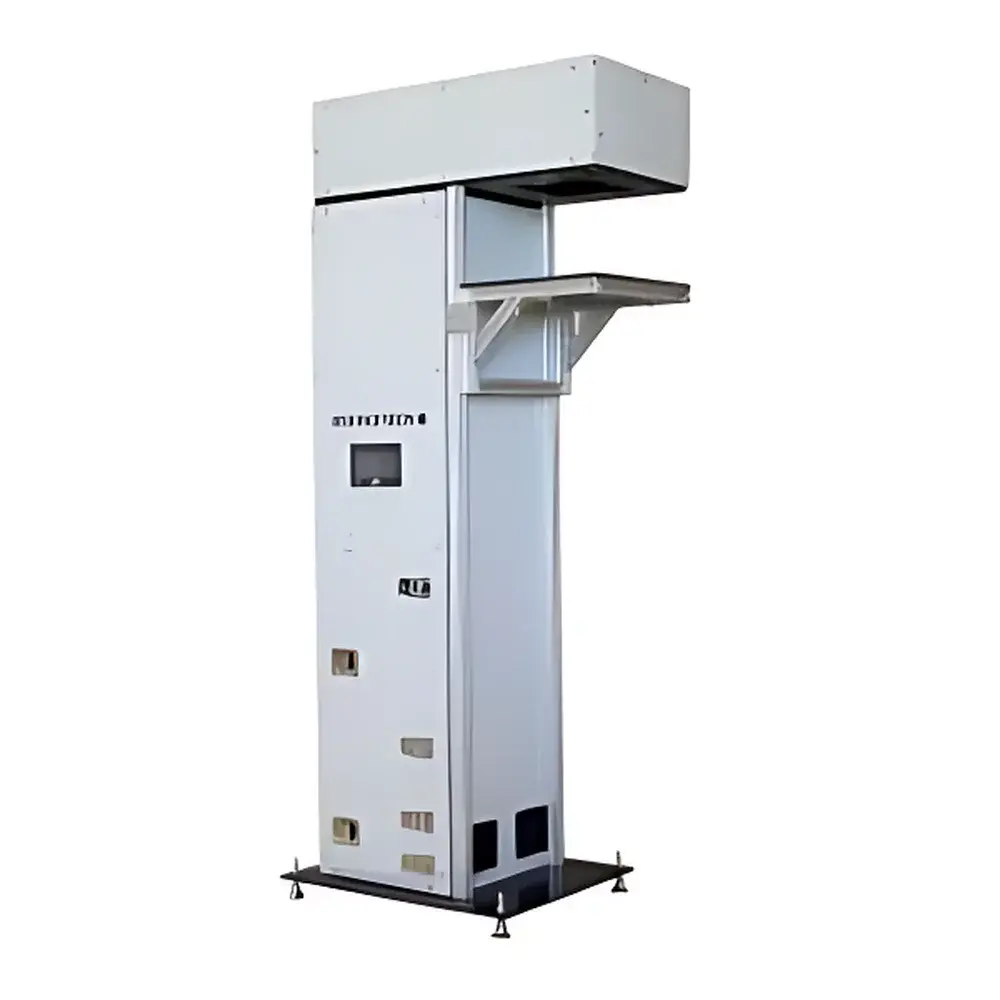

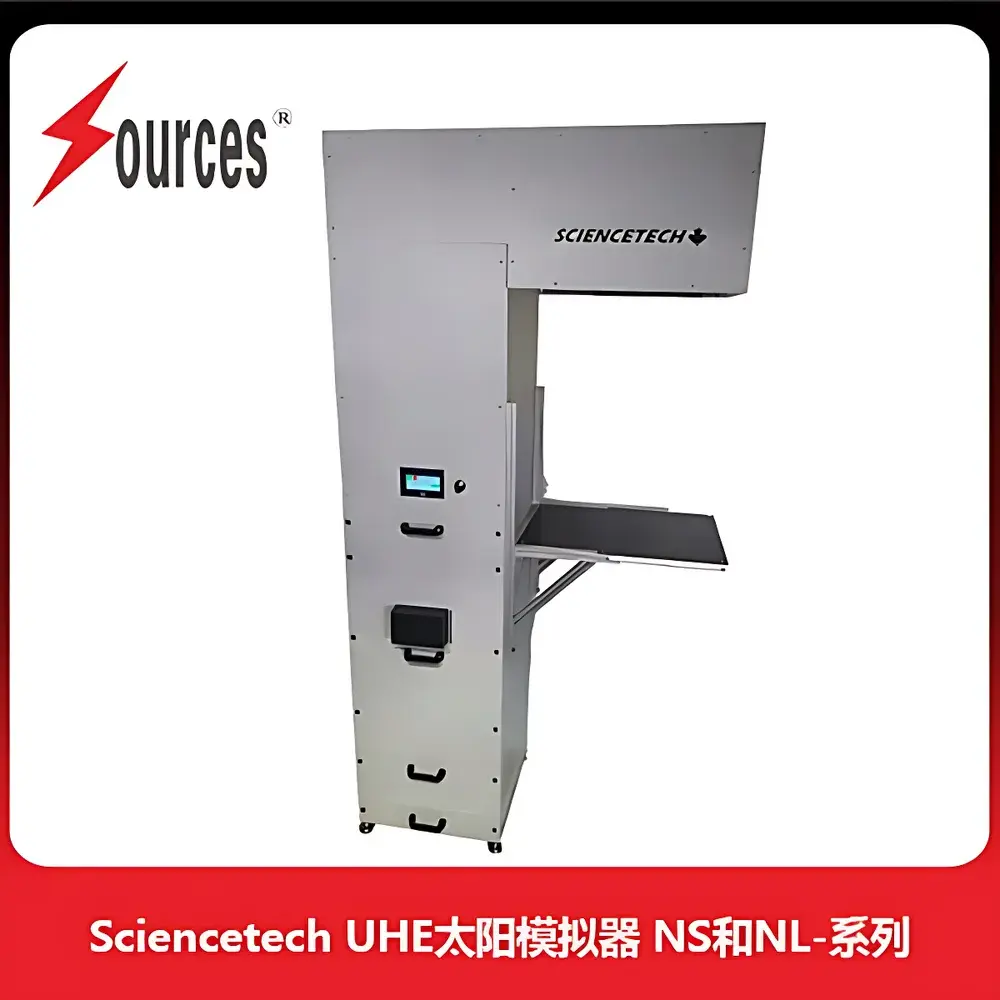
Sciencetech SF Series Solar Simulator
| Brand | Sciencetech |
|---|---|
| Origin | Canada |
| Manufacturer Type | Authorized Distributor |
| Origin Category | Imported |
| Model | SF Series |
| Price Range | USD 13,500 – 13,700 (FOB) |
| Operating Mode | Steady-State |
| Classification | Class AAA (per IEC 60904-9:2020 & ASTM E927-22) |
| Collimation | ≥95% collimated output (full-angle divergence < 2°) |
| Spectral Match | AM0 (space) and AM1.5G (terrestrial) configurable via interchangeable filter sets |
| Spatial Uniformity | ≤2% (measured over 2×2 cm² test area) |
| Temporal Stability | ≤0.5% RMS over 30 min (Class A per standard) |
Overview
The Sciencetech SF Series Solar Simulator is a high-fidelity, steady-state light source engineered to replicate the spectral irradiance, spatial uniformity, and temporal stability of natural sunlight under controlled laboratory conditions. Based on calibrated xenon arc lamp technology with precision optical conditioning—including elliptical reflectors, homogenizing rods, and multi-element collimating optics—the SF Series delivers Class AAA performance per IEC 60904-9:2020 and ASTM E927-22. This classification certifies compliance across all three critical metrics: spectral match (A), spatial non-uniformity (A), and temporal instability (A). The system supports dual operational configurations: AM0 (Air Mass Zero, representative of extraterrestrial solar irradiance at 1366 W/m²) and AM1.5G (terrestrial global spectrum at 1000 W/m²), selected via user-replaceable spectral filter modules. Its collimated output—achieving full-angle divergence under 2°—enables accurate angular response characterization essential for space photovoltaic testing, concentrator cell evaluation, and optical sensor calibration.
Key Features
- Steady-state illumination architecture with closed-loop electronic feedback control ensuring ±0.2% irradiance regulation over extended operation periods.
- Modular spectral configuration: factory-aligned AM0 and AM1.5G filter sets meet ISO 9022-18 and ECSS-E-ST-20-07C requirements for space simulation environments.
- Optimized collimation system delivering >95% collimated flux within ±1° half-angle, validated using NIST-traceable goniophotometric measurement protocols.
- Integrated reference photodiode with temperature-compensated calibration traceable to NRC (Canada) and NIST standards; real-time irradiance monitoring with 0.1% linearity.
- Rugged aluminum chassis with active thermal management, enabling continuous 8-hour operation without spectral drift beyond Class A thresholds.
- Compliance-ready design: preconfigured audit trails, electronic logbook, and metadata tagging aligned with FDA 21 CFR Part 11 and ISO/IEC 17025 documentation frameworks.
Sample Compatibility & Compliance
The SF Series accommodates samples up to 200 mm × 200 mm in active illumination area, with optional beam expanders supporting up to 300 mm diameter fields. It is routinely deployed in accredited PV calibration labs (ISO/IEC 17025), aerospace component qualification facilities (per ECSS-Q-ST-70-08C), and university research centers conducting perovskite, multi-junction, and quantum dot solar cell studies. All optical components comply with RoHS 2011/65/EU and REACH Annex XVII restrictions. System-level validation reports include spectral irradiance data (280–1200 nm, 1 nm resolution), spatial uniformity maps (grid-based CCD scan), and temporal stability histograms—each generated under GLP-compliant procedures and archived with digital signatures.
Software & Data Management
Control and analysis are executed via Sciencetech’s proprietary SimuLab v4.2 software suite, compatible with Windows 10/11 (64-bit) and supporting TCP/IP, USB 2.0, and RS-232 interfaces. The software provides real-time irradiance normalization, automated spectral mode switching, and scheduled exposure protocols with programmable ramp rates. Raw photodiode and spectroradiometer data are exported in HDF5 and CSV formats, preserving timestamped metadata including ambient temperature, lamp hours, filter position, and operator ID. Audit trail functionality records all parameter changes with user authentication, session timestamps, and immutable hash-verified logs—fully compliant with 21 CFR Part 11 Subpart B requirements for electronic records and signatures.
Applications
- Primary calibration of reference solar cells and pyranometers against SI-traceable standards.
- Performance evaluation of III-V multijunction cells under AM0 conditions for LEO and GEO satellite power systems.
- Accelerated aging studies of encapsulation materials and anti-reflective coatings under UV-enhanced AM0 spectra.
- Quantum efficiency (QE) and external quantum efficiency (EQE) mapping of thin-film photovoltaics.
- Testing of solar-blind UV sensors and visible-light photodetectors requiring broadband spectral fidelity.
- Validation of optical concentrator designs via angular irradiance profiling at focal planes.
FAQ
What standards does the SF Series comply with for solar simulator classification?
It meets Class AAA requirements per IEC 60904-9:2020 Edition 3 and ASTM E927-22, with independent verification reports available upon request.
Can the SF Series be configured for AM1.5D or AM1.0 spectra?
Yes—custom spectral filters can be fabricated and validated for AM1.5D, AM1.0D, or application-specific spectra (e.g., Mars surface irradiance), subject to optical transmission constraints and NIST-traceable characterization.
Is collimation adjustable or fixed?
Collimation is fixed at design stage per configuration (standard: 2° full divergence); optional high-collimation kits (<1° divergence) are available with recalibrated spatial uniformity certification.
How is lamp aging compensated during long-term testing?
The system integrates real-time photodiode feedback with automatic intensity compensation algorithms; lamp spectral degradation is tracked via periodic onboard spectroradiometer checks and logged in the audit trail.
Does Sciencetech provide installation qualification (IQ) and operational qualification (OQ) documentation?
Yes—factory-issued IQ/OQ protocols, completed checklists, and as-tested validation reports are included with each shipment, fully editable for site-specific GxP adaptation.




