
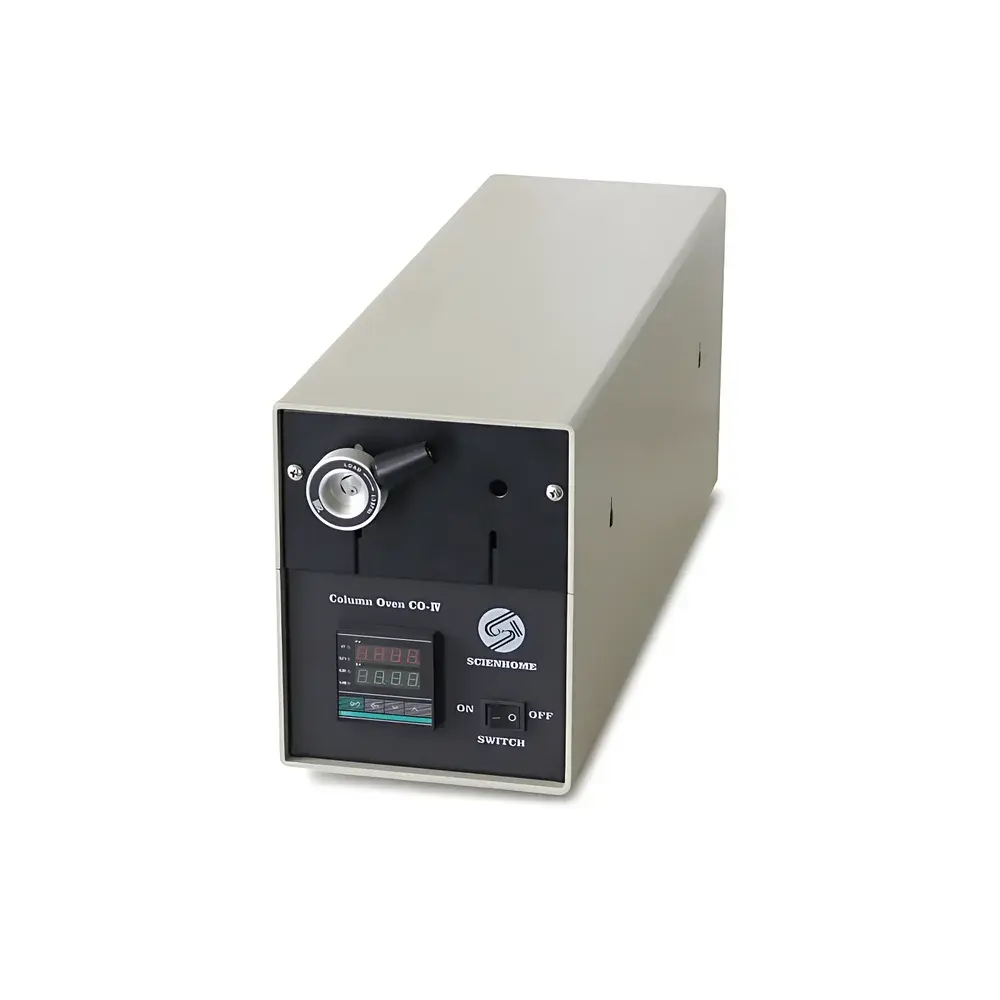
Scienhome CO-IV Integrated Column Oven
| Brand | Scienhome |
|---|---|
| Origin | Tianjin, China |
| Model | CO-IV |
| Temperature Control | Heating-only (no refrigeration) |
| Temperature Range | Ambient +5°C to 100°C |
| Temperature Stability | ±0.1°C |
| Repeatability | ±0.1°C |
| External Dimensions | 440 × 170 × 140 mm |
| Internal Chamber Dimensions | 350 × 44 × 45 mm |
| Power Consumption | 125 W |
| Weight | 5 kg |
| Input Voltage | 220 V ±10%, 50 Hz |
| Operating Environment | 0–50°C, <85% RH |
Overview
The Scienhome CO-IV Integrated Column Oven is an engineered thermal management solution designed specifically for high-performance liquid chromatography (HPLC) and ultra-high-performance liquid chromatography (UHPLC) systems. It maintains precise, uniform column temperature throughout the entire separation process—critical for minimizing retention time drift, optimizing peak shape, enhancing resolution, and ensuring reproducible retention behavior across analytical runs. Unlike ambient-temperature operation, which introduces thermal gradients along the column length and between mobile phase and stationary phase, the CO-IV employs a thermally stable chamber architecture with active air circulation and intelligent dual-mode temperature regulation (fuzzy logic + PID auto-tuning) to deliver spatially homogeneous thermal conditions. Its heating-only design targets applications where column stabilization above ambient is required—such as method development, gradient elution, or analyses involving viscous solvents or temperature-sensitive analytes—without introducing mechanical complexity or condensation risks associated with refrigerated ovens.
Key Features
- Integrated monolithic chassis eliminates external mounting brackets or alignment adjustments—enables direct placement beneath or beside standard HPLC modules without footprint compromise.
- Dual-stage temperature control algorithm combines fuzzy logic pre-heating response with adaptive PID feedback for rapid ramp-up (≤15 min from 25°C to 80°C) and long-term stability (±0.1°C at setpoint).
- Uniform thermal field verified across axial and radial axes: temperature deviation between column inlet, center, and outlet remains ≤0.1°C under steady-state conditions.
- Optional flow-path insulation sleeve accommodates standard 6-port injection valves and 1/16″ tubing, reducing thermal loss from heated mobile phase prior to column entry.
- Over-temperature cut-off circuitry (hardware-limited to 110°C) provides fail-safe protection against column degradation due to controller malfunction or ambient overheating.
- Low-power consumption (125 W nominal) ensures compatibility with shared laboratory circuits and reduces cumulative heat load in instrument cabinets.
Sample Compatibility & Compliance
The CO-IV supports all commercially available analytical and semi-preparative HPLC columns (1.0–4.6 mm ID, up to 250 mm length) mounted in standard column holders or cartridge-based trays. Its internal chamber (350 × 44 × 45 mm) accommodates stacked or parallel column configurations with integrated detector flow-cell routing. The oven complies with IEC 61010-1:2010 safety requirements for electrical equipment used in laboratory environments. While not certified for GLP/GMP-regulated workflows out-of-the-box, its temperature logging capability (via optional RS-232/USB interface) supports audit-ready data capture when paired with compliant third-party software meeting FDA 21 CFR Part 11 requirements for electronic records and signatures.
Software & Data Management
The CO-IV operates in standalone mode with front-panel digital display and tactile keypad interface. For integration into automated workflows, an optional communication module enables bidirectional serial control (ASCII protocol) compatible with major HPLC data systems—including Thermo Chromeleon, Waters Empower, and Agilent OpenLab CDS. Real-time temperature telemetry, setpoint history, and event logs (e.g., power-on, over-temp alert, setpoint change) are timestamped and exportable in CSV format. Firmware supports user-defined calibration offsets to compensate for sensor drift over extended service intervals, aligning with ISO/IEC 17025 traceability principles for measurement equipment.
Applications
- Method transfer and robustness testing per ICH Q2(R2), where column temperature is a critical method parameter requiring strict control and documentation.
- Analysis of thermolabile compounds (e.g., peptides, oligonucleotides, labile pharmaceuticals) where sub-ambient cooling is unnecessary but consistent 40–60°C stabilization improves peak symmetry and sensitivity.
- Isocratic and gradient separations in reversed-phase, HILIC, and ion-pair chromatography where retention time precision <0.05% RSD is mandated.
- Quality control laboratories performing routine assays under pharmacopeial standards (USP <621>, EP 2.2.46) that specify column temperature tolerances.
- Academic and industrial research labs conducting structure–retention relationship studies requiring systematic variation of column temperature while holding all other parameters constant.
FAQ
Does the CO-IV support cooling functionality?
No. The CO-IV is a heating-only column oven optimized for temperature stabilization above ambient. Refrigerated operation requires dedicated Peltier- or compressor-based systems.
Can it accommodate multiple columns simultaneously?
Yes—the internal chamber volume allows parallel mounting of two 150 mm × 4.6 mm columns or one 250 mm column with auxiliary fittings, provided total thermal mass remains within 125 W power budget.
Is temperature calibration traceable to NIST standards?
The unit ships with factory calibration using NIST-traceable reference thermometers; users may perform in-house verification using calibrated PT100 probes inserted into designated port openings.
What safety certifications does it hold?
It conforms to IEC 61010-1:2010 for electrical safety in laboratory use, including dielectric strength, creepage/clearance, and protective earth continuity testing.
How is firmware updated?
Firmware upgrades are performed via USB-to-serial adapter using Scienhome-provided utility software—no disassembly or service technician required.





