
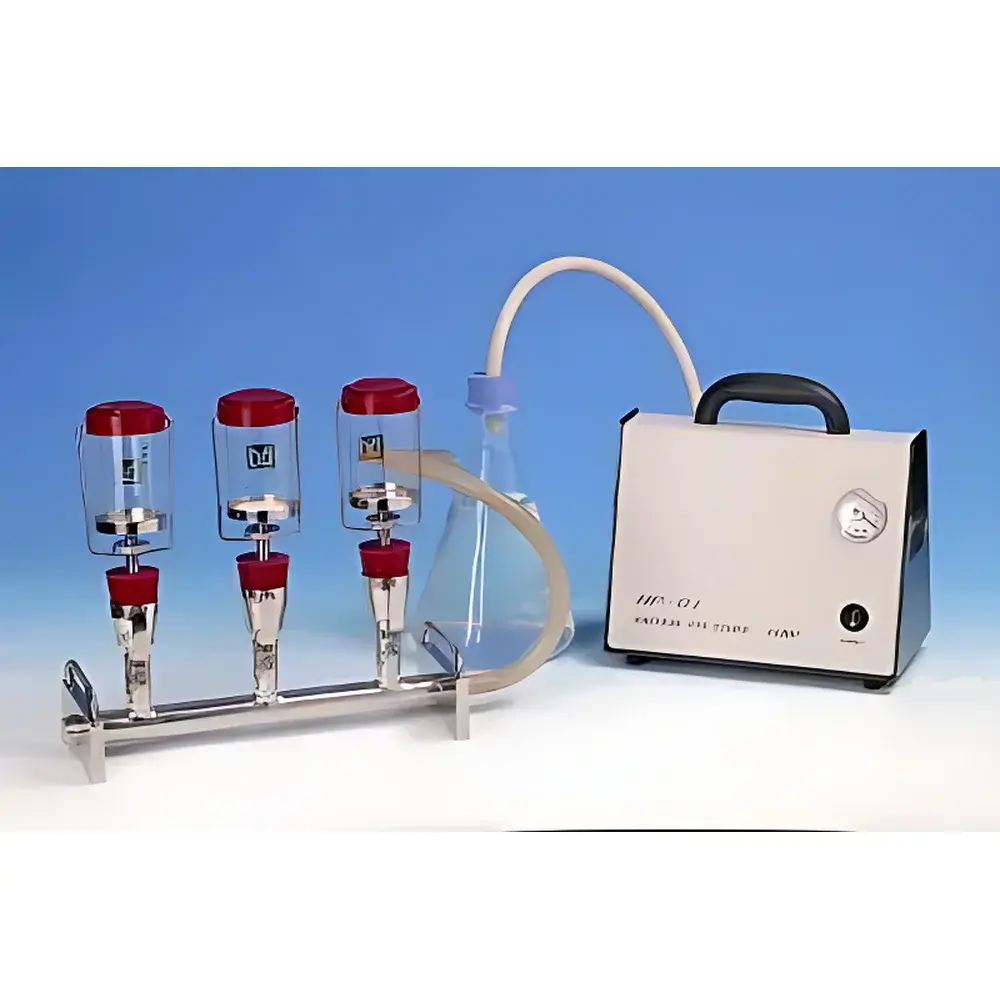
Scienhome WDG Series Multi-Station Sterile Filtration System
| Brand | Scienhome |
|---|---|
| Model | WDG-1 / WDG-3 / WDG-6 |
| Filter Cup Capacity | 100 mL × 1 / × 3 / × 6 |
| Required Vacuum Flow Rate | ≥6 L/min / ≥10 L/min / ≥20 L/min |
| Weight | 1.2 kg / 3.0 kg / 5.6 kg |
| Dimensions (L×W×H) | 110×110×280 mm / 360×110×280 mm / 660×110×280 mm |
| Construction | 316L stainless steel支架, borosilicate glass filter cups, medical-grade silicone gaskets and seals |
| Sterilization Compatibility | Autoclavable (121°C, 20 min), dry heat, and ethylene oxide |
| Regulatory Alignment | Designed to support USP <71>, EP 2.6.1, ISO 8573-7, and Chinese Pharmacopoeia 2005 Edition Appendix XIII-B & XIII-C |
Overview
The Scienhome WDG Series Multi-Station Sterile Filtration System is an engineered solution for quantitative microbial recovery and particulate removal in regulated laboratory environments. It operates on the principle of vacuum-assisted membrane filtration—where liquid samples are drawn under controlled negative pressure across a sterile, pre-validated microporous membrane (typically 0.22 µm or 0.45 µm pore size), retaining microorganisms or particles on the membrane surface while allowing filtrate to pass into a collection vessel. This method conforms to standardized sterility testing (e.g., Chinese Pharmacopoeia 2005 Edition Appendix XIII-B) and microbial limit testing (Appendix XIII-C), as well as parallel applications in environmental water analysis, food safety validation, public health surveillance, and airborne particulate sampling. The system’s modular architecture supports both open-mode filtration (for direct sample introduction and post-filtration membrane transfer) and closed-mode operation (enabling aseptic injection of culture media through sealed septa—four precisely positioned injection ports per filter head—minimizing contamination risk during incubation).
Key Features
- Modular multi-position design: Available in single (WDG-1), triple (WDG-3), and hexagonal (WDG-6) configurations—each with independently controllable vacuum valves for selective or simultaneous filtration of up to six samples using one vacuum source.
- Full-system autoclavability: Borosilicate glass filter cups withstand repeated sterilization at 121°C for 20 minutes; 316L stainless steel support frames and silicone-sealed components maintain dimensional stability and chemical resistance across pH 1–14.
- Dual-mode operational flexibility: Open-mode enables rapid membrane placement, wetting, and post-filtration handling; closed-mode integrates septum-sealed tops with four puncturable injection sites for aseptic addition of nutrient media—critical for sterility test workflows compliant with USP and ISO 11737-2.
- Contamination-controlled fluid path: All wetted surfaces contact only pharmaceutical-grade silicone (USP Class VI compliant) and borosilicate glass—no leachables, no extractables, and zero catalytic interference with sensitive biological assays.
- Robust mechanical interface: Stainless steel locking nuts secure filter heads to the base frame; removable silicone gaskets and stainless steel mesh supports allow full disassembly for cleaning, inspection, and membrane replacement without tools.
Sample Compatibility & Compliance
The WDG system accommodates aqueous, mildly acidic or alkaline, and low-viscosity organic solutions—including buffered saline, broth media (TSA, TSB, FTM), environmental water extracts, and food homogenates. It is validated for use with standard 47-mm diameter membranes (cellulose acetate, mixed ester, PVDF, PTFE). Its construction and functional design align with multiple international regulatory expectations: compliance with Chinese Pharmacopoeia 2005 Appendix XIII-B/C; compatibility with USP sterility test methodology; adherence to ISO 8573-7 for compressed air microbiological testing; and suitability for GLP/GMP environments requiring documented equipment qualification (IQ/OQ/PQ). Optional accessories—including sterile, pyrogen-free collection bottles and oil-free vacuum pumps meeting ISO 8573-1 Class 0 purity standards—further extend its applicability in high-integrity laboratories.
Software & Data Management
While the WDG Series is a manually operated, non-electronic filtration platform, its design inherently supports audit-ready documentation practices required under FDA 21 CFR Part 11 and EU Annex 11. Each filter station permits unambiguous labeling (via engraved stainless steel tags or laser-marked identification zones), traceable membrane lot logging, and sequential filtration records. When integrated into broader lab workflows, it interfaces seamlessly with LIMS platforms via manual entry of batch IDs, operator initials, filtration start/stop times, and vacuum pressure logs. Optional digital vacuum gauges (not included) can be added externally to capture real-time pressure profiles for process consistency verification—supporting trend analysis and deviation investigations in quality systems.
Applications
- Sterility testing of injectables, ophthalmic solutions, and medical device rinsates per CP 2005 XIII-B and USP .
- Microbial enumeration in pharmaceutical excipients, raw materials, and non-sterile finished products (CP 2005 XIII-C).
- Environmental monitoring of cleanroom rinse waters, HVAC condensates, and purified water systems.
- Food and beverage safety testing: total viable count (TVC), coliforms, and E. coli detection in beverages, dairy, and processed foods.
- Public health and epidemiology: filtration of drinking water, wastewater effluents, and clinical specimens for downstream culture or molecular analysis.
- Aerosol sampling support: coupling with impingers or cyclones for viable particle capture and culture-based viability assessment.
FAQ
Can the WDG system be used for sterility testing of oily or viscous formulations?
No—this system is optimized for low-viscosity, aqueous-compatible liquids. Oily, highly viscous, or particulate-laden samples require pre-dilution, filtration aids, or alternative methods (e.g., centrifugation followed by membrane filtration).
Is the silicone used in gaskets and seals certified for pharmaceutical use?
Yes—medical-grade silicone components meet USP Class VI biocompatibility requirements and are supplied with full material traceability and extractables profile documentation.
What vacuum pump specifications are recommended for WDG-6 operation?
A minimum flow rate of 20 L/min at ≤−0.095 MPa is required. Oil-free diaphragm pumps with ISO 8573-1 Class 0 certification are strongly recommended to prevent hydrocarbon contamination of sterile membranes.
Can the glass filter cups be sterilized in a dry heat oven?
Yes—borosilicate glass cups are stable up to 500°C; however, autoclaving (121°C, 20 min) is the preferred and validated method for routine sterilization in pharmaceutical settings.
Does Scienhome provide IQ/OQ documentation templates for this system?
Yes—upon request, Scienhome supplies customizable qualification protocols aligned with ASTM E2500 and ISPE GAMP 5 guidelines, including equipment description, acceptance criteria, test procedures, and blank execution records.
Related Products



