
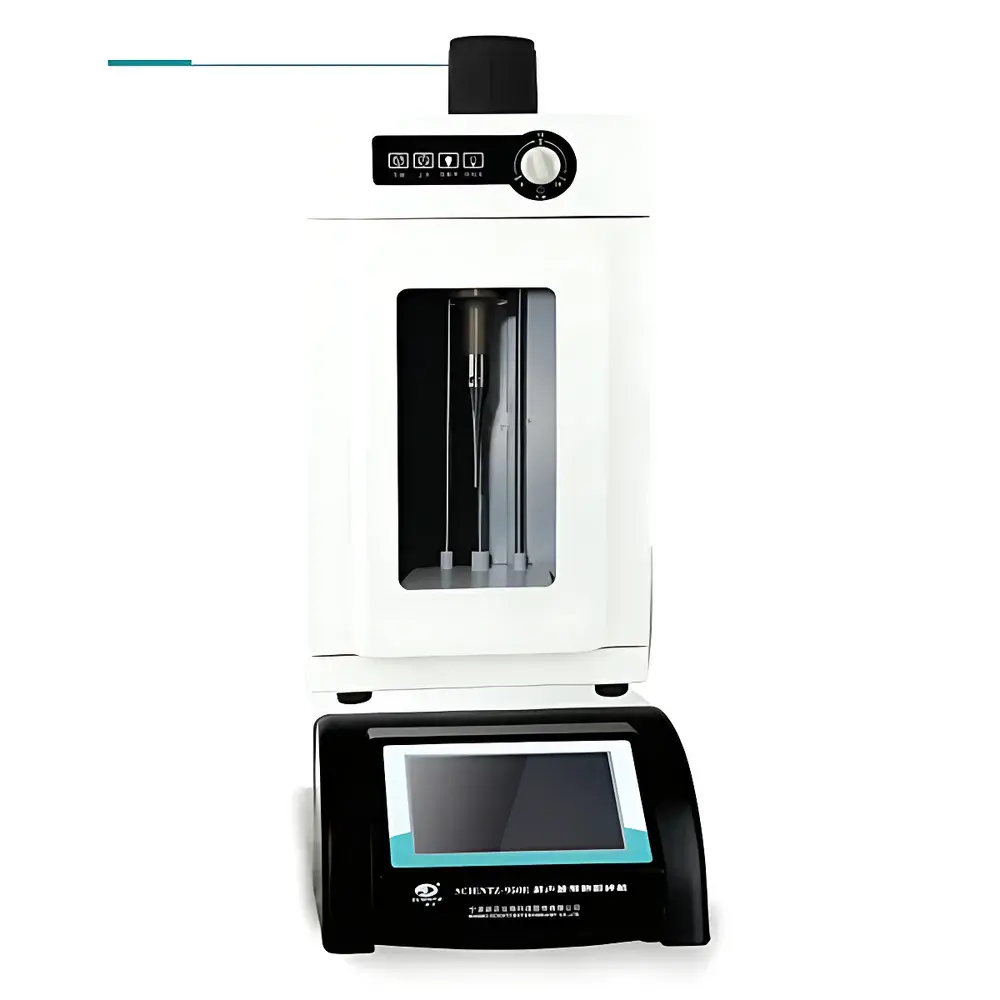
Scientz-950E Ultrasonic Cell Disruptor
| [Origin | Zhejiang, China |
|---|---|
| Manufacturer Type | Authorized Distributor |
| Product Origin | Domestic (PRC) |
| Model | Scientz-950E |
| Instrument Category | Ultrasonic Homogenizer / Cell Disruptor |
| Sample Type | Soft biological tissues & suspensions |
| Output Particle Size | 0.01–0.5 mm |
| Maximum Feed Particle Size | <15 mm |
| Sieve Cut-off | 40 mesh |
| Batch Processing Volume | 0.2–600 mL |
| Output Power Range | 5–950 W adjustable |
| Operating Frequency | 20–25 kHz with automatic frequency tracking |
| Temperature Control Range | 0–100 °C (with integrated PT100 sensor & over-temperature alarm) |
| Timing Range | 0–999 min (extendable to 999 h via software) |
| Pulse Mode | 0.1–99.9 s on/off adjustable |
| Display | 7-inch TFT touchscreen showing real-time temperature, power, amplitude, pulse parameters, and cumulative operating time |
| Communication Interface | RS232/RS485 |
| Safety Features | Auto-diagnostic self-test, impedance adaptation, overload protection, thermal cutoff, user password authentication, door-interlocked acoustic enclosure |
| Acoustic Enclosure Dimensions (W×D×H) | 350 × 345 × 545 mm |
| Standard Configuration | Main generator unit, sealed piezoelectric transducer, Φ6 mm titanium alloy probe (optimized for 10–100 mL volumes), control software suite |
| Optional Accessories | Titanium probes (Φ2, Φ3, Φ10, Φ12 mm), disposable or reusable cup horns (30 mL, 100 mL, 400 mL)] |
Overview
The Scientz-950E Ultrasonic Cell Disruptor is a high-precision, microprocessor-controlled sonication system engineered for reproducible disruption of biological cells, tissues, and subcellular structures through controlled acoustic cavitation. Operating within the 20–25 kHz frequency range, the instrument generates intense localized pressure differentials in liquid media—inducing transient microbubble formation, growth, and violent collapse (inertial cavitation). This physical mechanism delivers efficient shear forces, microstreaming, and shockwaves sufficient to lyse membranes, fragment chromatin, disperse aggregates, and accelerate mass transfer in extraction or synthesis protocols. Unlike mechanical homogenizers or bead mills, ultrasonic disruption preserves labile biomolecules (e.g., enzymes, nucleic acids, membrane receptors) when operated under temperature-regulated, pulsed conditions. The Scientz-950E is designed for benchtop deployment in regulated laboratory environments where traceability, parameter repeatability, and operator safety are critical—meeting foundational requirements for GLP-compliant sample preparation in biopharmaceutical development, academic research, and quality control workflows.
Key Features
- Dual-core digital architecture integrating DSP for real-time signal processing and ARM-based embedded control—ensuring stable amplitude delivery and minimal frequency drift across extended operation cycles.
- Intelligent impedance-matching circuitry automatically adapts transducer load compensation during probe wear or viscosity shifts, maintaining consistent energy coupling efficiency without manual recalibration.
- Programmable pulse modulation (0.1–99.9 s duty cycle) enables precise thermal management—critical for heat-sensitive samples such as primary neurons, exosomes, or recombinant protein complexes.
- Integrated PT100 temperature sensor with closed-loop feedback regulates bath or sample temperature between 0 °C and 100 °C; configurable alarm thresholds prevent thermal denaturation and support ISO/IEC 17025-compliant method validation.
- 7-inch capacitive touchscreen interface displays seven concurrent parameters—including instantaneous power (% of max), peak-to-peak amplitude (µm), elapsed time, set temperature, pulse ratio, and cumulative operational hours—with non-volatile storage of up to 20 user-defined protocols.
- Acoustically insulated enclosure features motorized vertical probe positioning, UV-C sterilization (254 nm), task lighting, and interlocked access door—reducing ambient noise to <65 dB(A) and eliminating airborne aerosol exposure per OSHA 1910.1200 and EU Directive 2004/37/EC guidelines.
Sample Compatibility & Compliance
The Scientz-950E accommodates a broad spectrum of soft biological matrices: cultured mammalian or insect cells, plant leaf homogenates, bacterial pellets (E. coli, Bacillus spp.), yeast slurries, viral suspensions, and tissue fragments (liver, spleen, brain). Its scalable probe configuration—from Φ2 mm microtips for single-cell lysates to Φ12 mm horns for bulk emulsification—supports volume ranges from 0.2 mL (microcentrifuge tube) to 600 mL (jacketed reactor vessel). All wetted components comply with USP Class VI biocompatibility standards. The system’s firmware architecture supports audit trail generation per FDA 21 CFR Part 11 requirements when paired with validated networked software; electronic records include timestamped operator ID, parameter sets, error logs, and environmental metadata. Routine verification follows ASTM E2810–22 (Standard Guide for Validation of Ultrasonic Disruption Parameters) and ISO 13320:2020 (Laser diffraction particle sizing—applicable for post-sonication dispersion analysis).
Software & Data Management
Bundled PC software provides full remote supervision via Ethernet or Wi-Fi: users can initiate/start/stop runs, modify parameters in real time, export CSV-formatted datasets (time-stamped power, temperature, amplitude), and generate PDF reports compliant with internal SOP templates. Data integrity safeguards include role-based access control (admin/operator/guest tiers), mandatory password rotation every 90 days, and SHA-256 hashed log encryption. Network communication adheres to TCP/IP v4/v6 stacks with TLS 1.2+ handshake enforcement. Exported files retain EXIF-like metadata—instrument serial number, firmware revision, calibration certificate ID, and environmental ambient temperature—facilitating traceability in regulatory submissions (e.g., IND, BLA, or MA dossier annexes).
Applications
- Nucleic acid isolation: Efficient release of genomic DNA and total RNA from fibrous or lipid-rich tissues without phenol-chloroform contamination.
- Protein extraction: Solubilization of membrane-bound GPCRs and ion channels while retaining native conformation for downstream SPR or cryo-EM analysis.
- Nanomaterial synthesis: Top-down exfoliation of graphene oxide, TiO₂ nanoparticles, or layered double hydroxides with narrow PDI (<0.15) confirmed by DLS.
- Vaccine development: Disruption of whole-inactivated virus particles for antigen yield optimization and epitope mapping studies.
- Phytochemical profiling: Accelerated solvent-assisted extraction of polyphenols and terpenoids from herbal matrices—reducing extraction time by >60% versus conventional maceration.
- Microbiome research: Selective lysis of Gram-negative bacteria in polymicrobial stool suspensions using frequency-tuned pulses to preserve Gram-positive viability.
FAQ
What safety certifications does the Scientz-950E hold?
The system conforms to IEC 61010-1:2010 (Safety Requirements for Electrical Equipment for Measurement, Control, and Laboratory Use) and carries CE marking for EMC Directive 2014/30/EU and Low Voltage Directive 2014/35/EU. Acoustic enclosure design meets ISO 717-1:2013 sound insulation performance criteria.
Can the instrument be integrated into automated liquid handling platforms?
Yes—via RS485 Modbus RTU protocol or optional OPC UA gateway module, enabling bidirectional handshake with Hamilton STAR, Tecan Freedom EVO, or Andrew Syringe Robot systems for unattended multi-step workflows.
Is probe calibration traceable to national standards?
Each titanium probe is supplied with a factory calibration certificate referencing NIST-traceable laser interferometry measurements of displacement amplitude at 20 kHz, valid for 12 months under normal usage.
How is temperature uniformity verified across different vessel geometries?
Users may perform in-situ validation using calibrated fiber-optic thermometers (e.g., Neoptix Q140) placed at three axial positions (top/mid/base); deviation must remain ≤±1.5 °C at steady state per ISO/IEC 17025 clause 5.4.6.
Does the software support 21 CFR Part 11 compliance out-of-the-box?
Full Part 11 functionality—including electronic signatures, audit trail review tools, and record retention policies—is enabled only after completion of site-specific risk assessment and installation qualification (IQ) documented per vendor-supplied URS template.



