
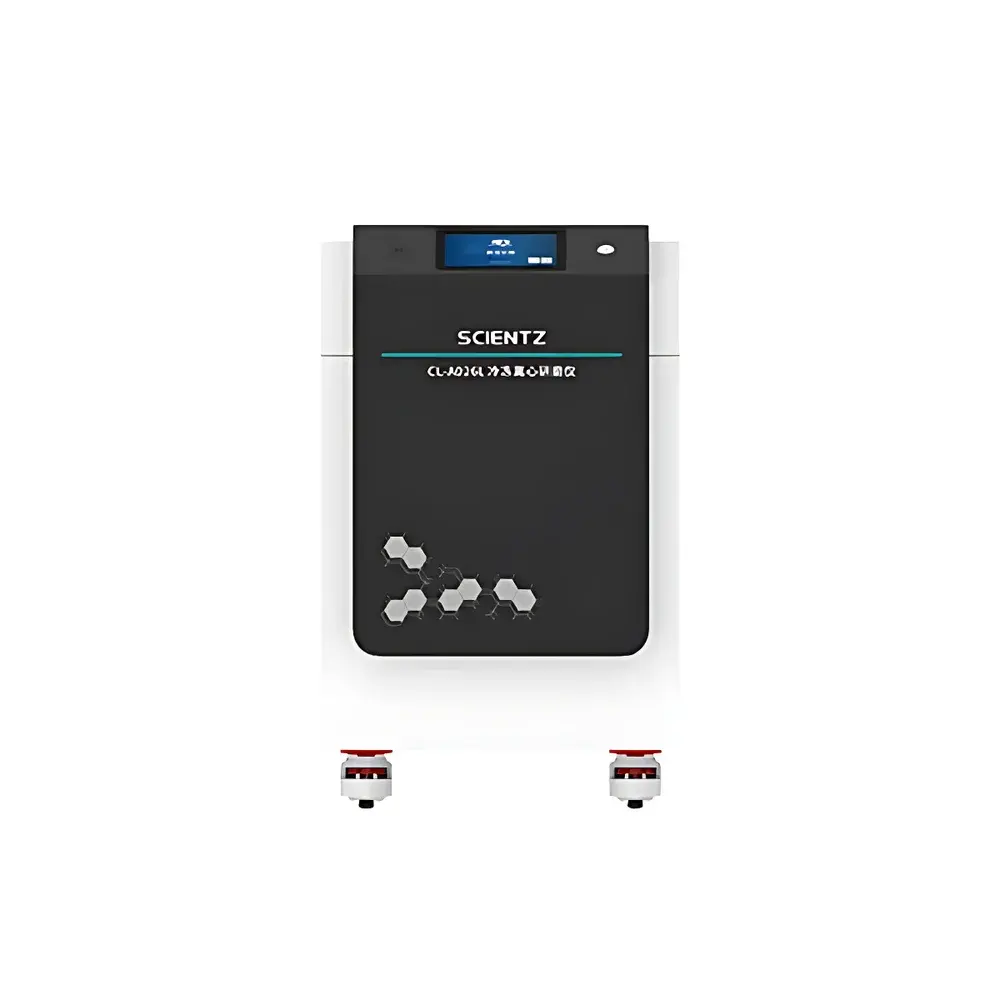
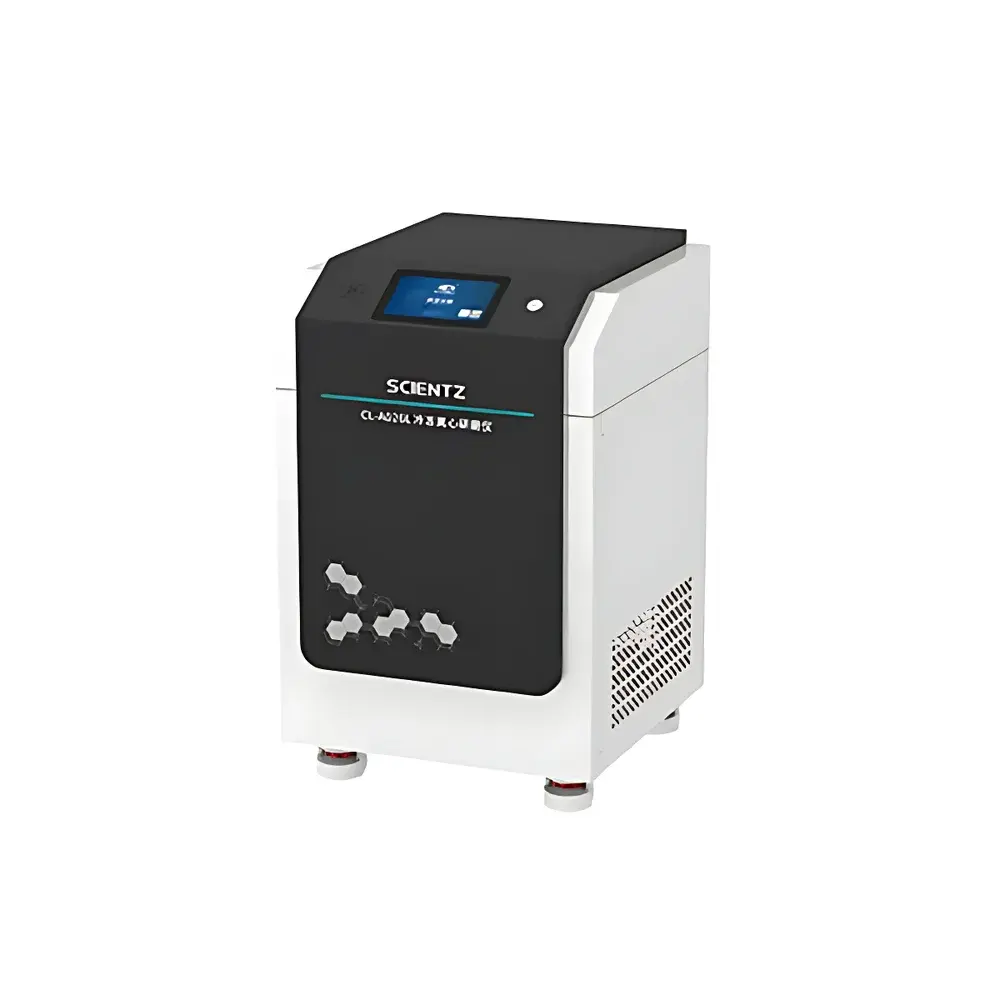
Scientz CL-A026L Cryogenic Centrifugal Tissue Grinder
| Brand | Scientz |
|---|---|
| Origin | Zhejiang, China |
| Manufacturer Type | Direct Manufacturer |
| Country of Origin | China |
| Model | CL-A026L |
| Pricing | Upon Request |
Overview
The Scientz CL-A026L Cryogenic Centrifugal Tissue Grinder is an integrated benchtop sample preparation system engineered for high-efficiency mechanical disruption under precisely controlled low-temperature conditions. It operates on the principle of centrifugal impact grinding: samples sealed in centrifuge tubes are subjected to rapid rotational acceleration, causing grinding beads to collide repeatedly with biological or solid matrices at high kinetic energy. Simultaneously, an integrated refrigeration compressor maintains tube temperatures between –10 °C and –40 °C (adjustable), suppressing enzymatic degradation, thermal denaturation of nucleic acids and proteins, and volatile compound loss. This dual-mode operation—centrifugal force-driven impact combined with active cryogenic stabilization—enables reproducible, scalable, and contamination-controlled homogenization across diverse sample classes, from fibrous plant tissues to lipid-rich animal organs and heat-sensitive microbial cultures.
Key Features
- Integrated cryogenic cooling system with independent temperature control (–10 °C to –40 °C) ensures thermal integrity during high-energy grinding
- Centrifugal acceleration up to 3,000 × g delivers rapid, uniform bead-to-sample impact without external vibration transmission
- Programmable grinding parameters: time (1 s–99 min), speed (500–3,000 rpm), and pause intervals for optimized lysis efficiency
- Multi-bead compatibility: supports stainless steel, hardened steel, tungsten carbide, agate, sintered alumina, zirconia, and PTFE grinding media—each selected based on sample hardness, downstream analytical requirements (e.g., metal-free proteomics), and contamination thresholds
- Robust aluminum alloy housing with reinforced safety interlock and automatic lid-locking mechanism compliant with IEC 61010-1 for laboratory equipment safety
- No external liquid nitrogen handling required—eliminates frost formation, condensation risks, and operator exposure hazards associated with LN2-based cryogrinders
Sample Compatibility & Compliance
The CL-A026L accommodates a broad spectrum of sample types requiring mechanical lysis prior to molecular or biochemical analysis. Validated applications include mammalian tissues (brain, liver, kidney, muscle, bone), plant materials (roots, leaves, seeds), microbial cells (yeast, E. coli, spores), environmental matrices (soil, sludge, feces), pharmaceutical tablets, polymers (PE, PS, resins), and volatile organics (coal, oil shale, waxes). All grinding protocols align with ISO 17025 method validation principles and support GLP/GMP-compliant workflows when paired with audit-trail-enabled software. Bead material selection follows ASTM E2934 guidelines for minimizing elemental interference in ICP-MS, LC-MS/MS, and qPCR applications—e.g., zirconia beads (ZrO2/Y2O3) for trace-metal-sensitive proteomics; PTFE beads for fluorinated compound analysis.
Software & Data Management
The instrument is operated via an intuitive touchscreen interface with onboard protocol storage (≥100 user-defined methods). Optional USB data export enables full parameter logging—including actual temperature profiles, rotational speed traces, and runtime diagnostics—for integration into LIMS or electronic lab notebooks (ELN). When deployed in regulated environments, the system supports 21 CFR Part 11-compliant configurations through third-party ELN platforms, providing electronic signatures, role-based access control, and immutable audit trails for all method modifications and run records.
Applications
- Routine nucleic acid extraction (DNA/RNA) from difficult-to-lyse tissues and Gram-positive bacteria
- Proteome preservation for bottom-up proteomics, particularly phosphoproteomics and ubiquitinomics where thermal artifacts must be minimized
- Metabolite stabilization in targeted and untargeted metabolomics workflows involving labile small molecules
- Homogenization of heterogeneous environmental samples for heavy metal speciation or microplastic quantification
- Particle size reduction and dispersion of polymer composites for rheological or DSC characterization
- Preparation of homogeneous reference materials for proficiency testing and inter-laboratory comparison studies
FAQ
What temperature range does the built-in cooling system maintain during operation?
The compressor-based cooling system sustains sample temperatures between –10 °C and –40 °C, adjustable in 1 °C increments, verified by internal PT100 sensor feedback.
Can the CL-A026L process samples in standard 2 mL or 15 mL centrifuge tubes?
Yes—it accepts common conical-bottom microcentrifuge tubes (0.2–2 mL) and 15 mL polypropylene tubes using optional adapters, ensuring compatibility with most commercial extraction kits.
How is cross-contamination prevented between runs?
The system employs non-porous, autoclavable rotor sleeves and bead-retaining tube caps; recommended cleaning includes ethanol wipe-down followed by UV-C irradiation of the chamber interior.
Is validation documentation available for GMP-regulated laboratories?
Scientz provides IQ/OQ documentation templates and calibration certificates traceable to NIST standards; full PQ support is available upon request for site-specific qualification.
What bead materials are recommended for RNA isolation from fibrous plant tissue?
Zirconia (ZrO2) beads (0.1–0.5 mm) are preferred due to high impact energy, low elemental leaching, and minimal RNAse adsorption compared to stainless steel or tungsten carbide.



