
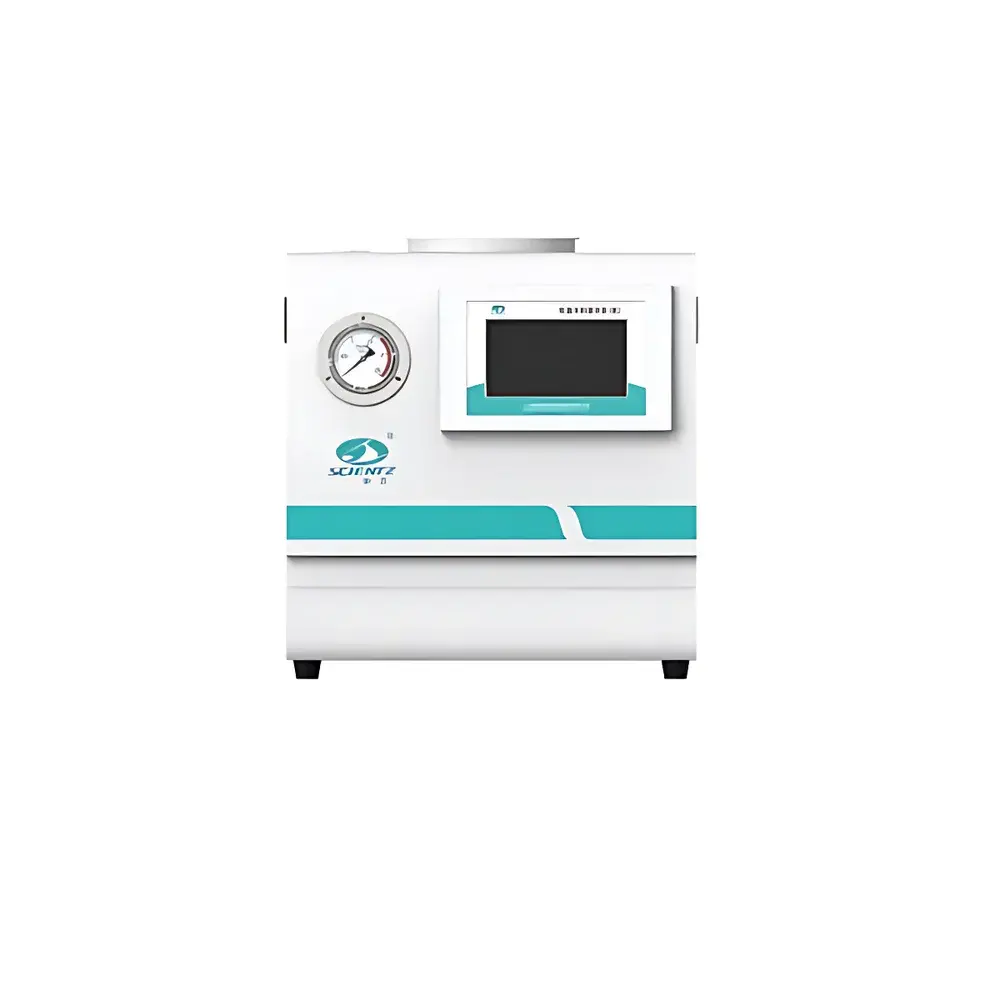
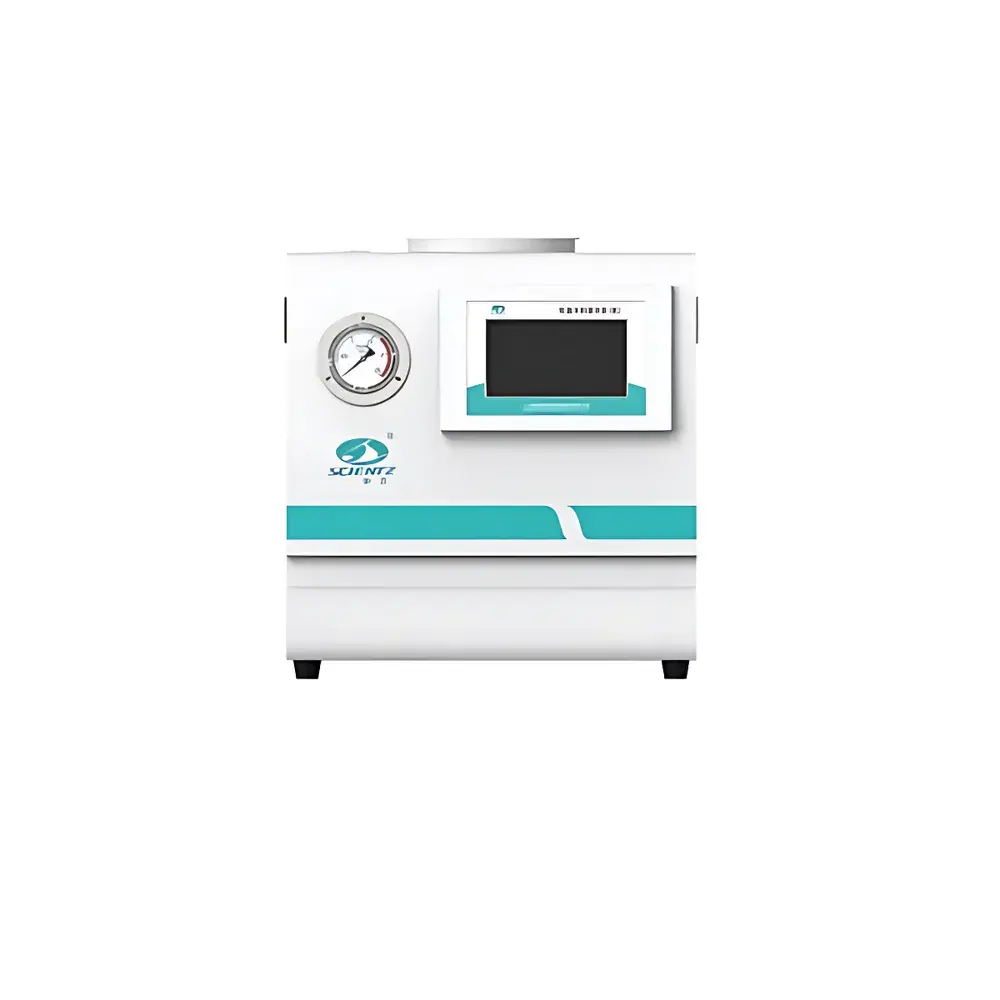
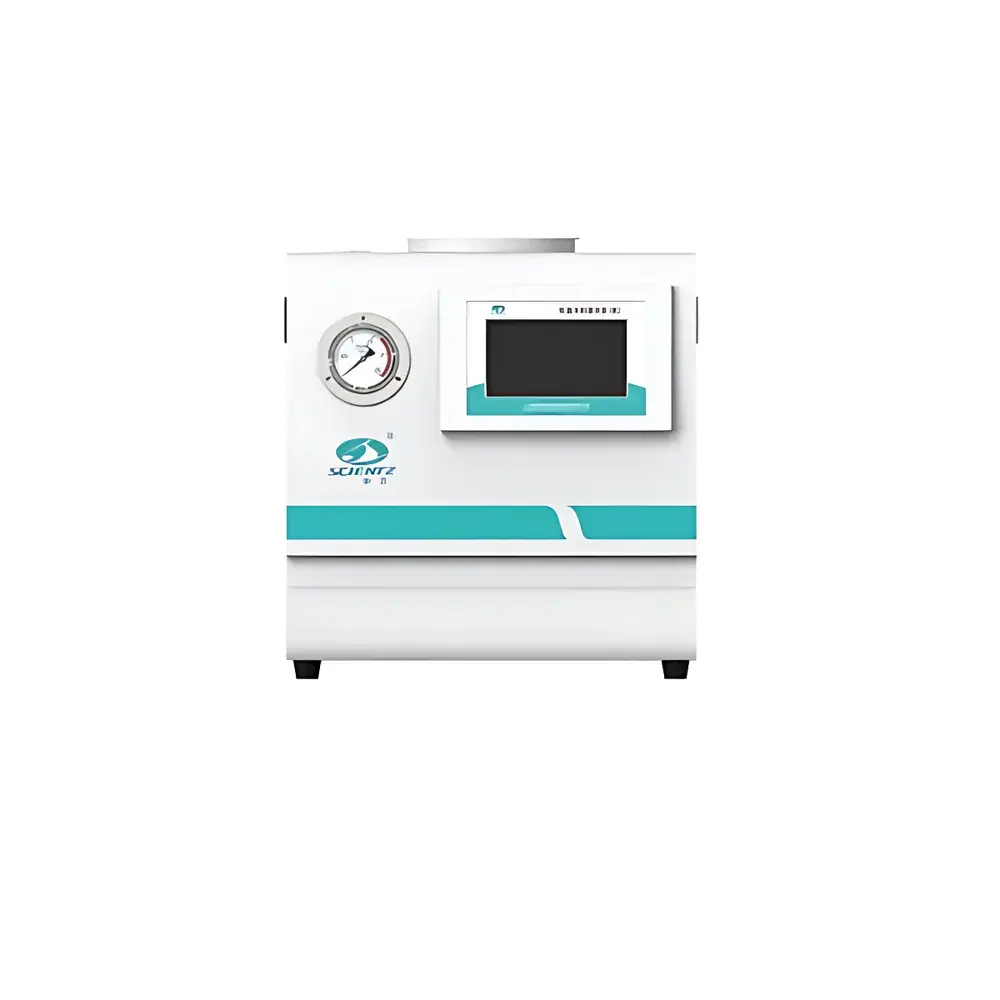
SCIENTZ DLK-2003 Compact Low-Temperature Circulating Chiller
| Brand | SCIENTZ |
|---|---|
| Origin | Zhejiang, China |
| Model | DLK-2003 |
| Instrument Type | Integrated Circulating Chiller |
| Cooling Method | Water-Cooled |
| Temperature Range | −20 °C to +45 °C |
| Temperature Stability | ±2 °C |
| Refrigeration Capacity | 782 W (at 25 °C ambient) |
| Circulation Pump Flow Rate | 20 L/min |
| Maximum Pump Pressure | 1.2 bar |
| Display Resolution | 0.1 °C |
| Reservoir Volume | 3 L |
| Noise Level | ≤57 dB(A) |
| Power Consumption | 0.55 kW |
| Dimensions (L×W×H) | 390×423×445 mm |
| Weight | 29 kg |
Overview
The SCIENTZ DLK-2003 Compact Low-Temperature Circulating Chiller is an integrated refrigeration system engineered for precision thermal management in laboratory environments requiring stable, controllable cooling across a wide operational range (−20 °C to +45 °C). It employs a hermetically sealed, high-efficiency compressor—sourced from Panasonic or Tecumseh—to deliver consistent refrigeration performance under continuous operation. The unit utilizes environmentally compliant refrigerant R-134a, meeting current international standards for ozone depletion potential (ODP = 0) and global warming potential (GWP) compliance. Its thermodynamic architecture follows vapor-compression cycle principles with optimized heat exchange design, enabling reliable heat removal from external equipment such as rotary evaporators, atomic absorption spectrometers, reflux condensers, and synthesis reactors—without reliance on municipal cooling water infrastructure.
Key Features
- 7-inch angled capacitive touchscreen interface with intuitive navigation, real-time display of setpoint/actual temperature, elapsed time, and system status—optimized for visibility at bench height and across shared lab spaces.
- Programmable timer function allows users to define precise run durations; the unit automatically terminates operation upon completion, supporting unattended overnight protocols.
- Dual-mode circulation architecture supports both internal reservoir recirculation and external closed-loop applications via G1/2 threaded ports, accommodating diverse thermal load configurations and manifold setups.
- Robust safety subsystem includes automatic thermal overload protection, compressor high-pressure cutoff, low-level reservoir alarm, and fault-code diagnostics accessible via the HMI.
- Compact footprint (390 × 423 × 445 mm) minimizes spatial demand while maintaining 3 L reservoir capacity—ideal for space-constrained fume hoods, analytical instrument benches, or modular lab carts.
- Power recovery logic preserves user-defined parameters during brief power interruptions; configurable auto-restart mode enables resumption of prior operating state or standby mode upon re-energization.
Sample Compatibility & Compliance
The DLK-2003 is compatible with standard laboratory fluid circuits using aqueous or water-glycol mixtures (up to 30% v/v ethylene glycol). It meets general-purpose laboratory safety requirements per IEC 61010-1:2010 (Safety Requirements for Electrical Equipment for Measurement, Control, and Laboratory Use). While not certified for medical device or pharmaceutical manufacturing use, its stable temperature output supports GLP-aligned workflows where traceable thermal control is required—for example, in AOAC 996.06 fat extraction, USP compounding support systems, or ASTM D2872 rotary evaporation cooling validation. All electrical components comply with CE marking directives (EMC Directive 2014/30/EU and LVD Directive 2014/35/EU).
Software & Data Management
The DLK-2003 operates autonomously via embedded firmware without external PC dependency. Temperature setpoints, timers, and pump activation are configured directly through the touchscreen HMI. Data logging is not natively supported; however, analog 0–10 V or 4–20 mA process output signals (optional accessory) enable integration into centralized building management systems (BMS) or SCADA platforms for remote monitoring. For audit-trail requirements in regulated environments, external data loggers may be connected to the unit’s PT100 sensor output (available upon request), permitting timestamped temperature recording aligned with 21 CFR Part 11 supplementary controls when deployed with validated third-party software.
Applications
- Rotary Evaporation: Provides consistent condenser cooling for 1–4 simultaneous rotovaps at evaporation temperatures up to 40 °C—maintaining condensation efficiency even at ambient temperatures exceeding 35 °C.
- Soxhlet Extraction & Fat Analysis: Delivers reproducible cold trap temperatures for AOAC and ISO 6496-compliant lipid quantification in feed, dairy, and food matrices—eliminating seasonal variability associated with tap-water-cooled systems.
- Atomic Absorption Spectroscopy (AAS): Supplies stabilized coolant flow to graphite furnace assemblies and air-acetylene or nitrous oxide-acetylene burners, preventing thermal drift during extended flame stability tests.
- Synthesis & Reaction Calorimetry: Serves as a temperature sink for jacketed reactors, crystallizers, or cryo-reaction vessels where sub-ambient control is critical to kinetic selectivity or polymorph formation.
- Chromatography Support: Cools column ovens, detector cells, or fraction collectors in preparative HPLC or GC systems requiring auxiliary thermal stabilization outside the primary instrument chassis.
FAQ
What is the minimum ambient temperature at which the DLK-2003 can operate continuously?
The unit is rated for continuous operation in ambient environments between 10 °C and 35 °C. Operation below 10 °C may impair compressor oil return and reduce refrigeration efficiency.
Can the DLK-2003 be used with organic solvents in the circulation loop?
No. Only water or water–glycol (≤30% v/v) solutions are permitted. Organic solvents may degrade seals, gaskets, and pump impellers.
Is remote control via RS-232 or Ethernet available?
Standard configuration does not include digital communication interfaces. Optional analog I/O modules (0–10 V / 4–20 mA) support basic external supervision but do not enable bidirectional command execution.
How often should the refrigerant circuit be serviced?
Under normal laboratory conditions and proper maintenance (clean condenser coils, stable voltage supply), the sealed refrigeration system requires no scheduled refrigerant servicing over its operational lifetime.
Does the unit meet noise requirements for quiet-zone laboratories?
At ≤57 dB(A) measured at 1 m distance, it complies with ISO 15710:2020 recommendations for non-industrial laboratory acoustic environments, though placement away from sensitive acoustic measurement stations is advised.



