
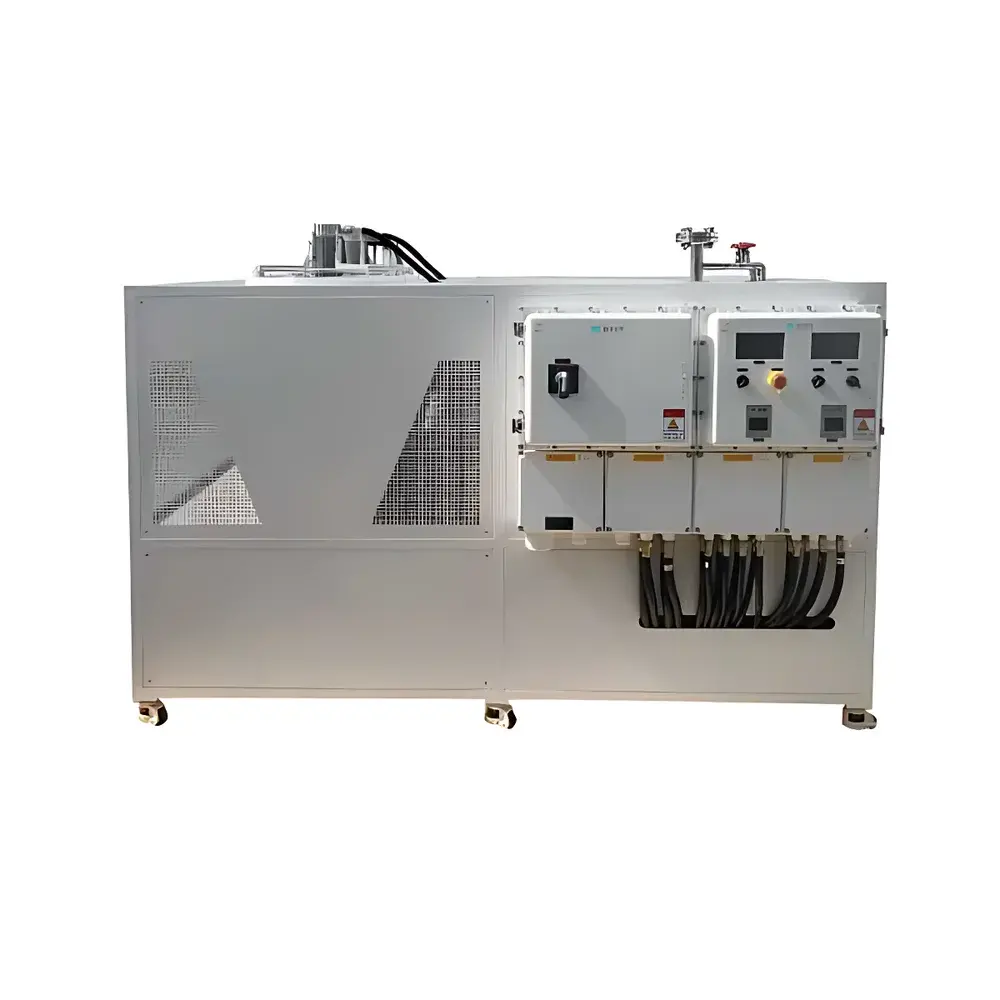
Scientz HL25-220-2T Series Dual-Output High-Low Temperature Circulating Chiller System
| Brand | Scientz |
|---|---|
| Origin | Zhejiang, China |
| Manufacturer Type | Direct Manufacturer |
| Country of Origin | China |
| Model | HL25-220-2T Series |
| Temperature Control Range | -25 °C to 200 °C |
| Temperature Stability (Bath Medium) | ±0.5 °C |
| Temperature Accuracy (Process Load) | ±1 °C |
| Control Interface | 7-inch Color Touchscreen with Real-time Temperature Curve Display & Logging |
| Control Algorithm | PID Fuzzy Logic |
| Communication Protocol | MODBUS RTU over RS-485 |
| Temperature Feedback Points | Three PT100 Sensors (Unit Internal Temp, Outlet Temp, External Process Temp) |
| Programmability | Up to 5 Programs, Each with 30 Segments |
| Differential Temperature Control | Adjustable ΔT between Jacket and Process Material |
| Safety Protections | Compressor Overload Protection, High-Pressure Switch, Thermal Overload Relay, Low-Level Fluid Sensor, Over-Temperature Cut-off, Sensor Fault Detection |
| System Design | Fully Sealed Closed-Loop Circulation (No Oil Mist at High Temp |
Overview
The Scientz HL25-220-2T Series is a dual-output, high-precision circulating temperature control system engineered for demanding laboratory and pilot-scale bioprocessing, chemical synthesis, and materials testing applications. Operating across an exceptionally wide thermal range—from −25 °C to +200 °C—the system utilizes a single, thermally stable heat transfer fluid (e.g., silicone oil or specialized synthetic bath fluid) to eliminate the need for media switching during extended multi-stage protocols. Its core architecture implements a closed-loop circulation design that prevents vaporization at elevated temperatures and moisture absorption at sub-zero conditions—ensuring long-term fluid integrity, consistent thermal performance, and reduced maintenance overhead. The system employs PID fuzzy logic control to dynamically adjust refrigeration and heating power in response to real-time thermal load variations, delivering superior stability (±0.5 °C in bath medium) and reproducibility critical for GLP-compliant reaction monitoring and qualification studies.
Key Features
- Dual independent output channels enable simultaneous temperature control of two separate reactors, microreactors, or test fixtures—maximizing lab throughput without compromising control fidelity.
- Three-point PT100 temperature feedback (internal reservoir, outlet line, and external process vessel) supports both bath-mode and material-mode control strategies, with user-selectable primary setpoint reference.
- Differential temperature control allows precise regulation of the temperature gap (ΔT) between jacket and process material—essential for exothermic reaction management and crystallization kinetics studies.
- Programmable thermal profiles: up to five distinct programs, each comprising up to thirty individually defined segments (ramp rate, hold time, target temp), supporting complex reaction sequences such as polymerization initiation, catalyst activation, and staged crystallization.
- 7-inch capacitive touchscreen interface with embedded data logging—displays real-time temperature curves, stores timestamped readings internally, and exports CSV files via USB for traceable recordkeeping.
- Comprehensive safety architecture includes compressor overload protection, high-pressure cut-off switches, thermal relays, low-fluid-level detection, redundant over-temperature sensors, and automatic sensor fault diagnostics—fully compliant with IEC 61000-6-2/6-4 EMC and UL/CSA electrical safety requirements.
Sample Compatibility & Compliance
The HL25-220-2T is routinely deployed in ISO 17025-accredited laboratories and FDA-regulated environments where thermal process validation is required. It supports compatibility with glass, stainless steel, and Hastelloy reaction vessels (including jacketed reactors from 50 mL to 100 L scale), microfluidic chips, calorimetry cells, and automotive component test fixtures. Its MODBUS RTU RS-485 interface enables seamless integration into SCADA systems and LIMS platforms, facilitating audit-ready data capture per 21 CFR Part 11 requirements—including electronic signatures, change logs, and user-access controls when paired with validated third-party software. All thermal protocols adhere to ASTM E2877 (Standard Guide for Thermal Validation of Bioprocess Equipment) and ISO 13485 Annex C for medical device manufacturing support.
Software & Data Management
While the unit operates autonomously via its onboard controller, optional Scientz LabLink™ software (Windows-based, password-protected) provides remote supervision, multi-unit synchronization, and advanced analytics—including deviation alerts, trend overlays, and automated report generation (PDF/Excel). All logged temperature data include UTC timestamps, operator ID fields, and metadata tags (e.g., program name, segment number, channel ID). Audit trails are immutable and exportable for regulatory submissions. Data retention complies with GxP data integrity principles (ALCOA+), ensuring attributable, legible, contemporaneous, original, accurate, complete, consistent, enduring, and available records.
Applications
- Chemical & Pharmaceutical Synthesis: Precise control of hydrogenation, nitration, sulfonation, and Grignard reactions in jacketed reactors; optimization of residence time distribution in continuous flow microreactors.
- Bioprocess Development: Temperature ramping during seed train expansion, controlled induction of recombinant protein expression, and cryopreservation protocol validation.
- Materials Science Testing: Thermal cycling of battery cells, polymer composites, and semiconductor substrates under simulated automotive or aerospace environmental stress profiles (SAE J2380, ISO 16750-4).
- Food & Cosmetic R&D: Emulsion stability testing, crystallization behavior of lipids and waxes, and accelerated shelf-life studies per AOAC and ISO 22000 guidelines.
- Academic Research: Kinetic modeling of enzyme-catalyzed reactions, phase transition analysis in supramolecular gels, and calorimetric calibration using NIST-traceable reference materials.
FAQ
What is the maximum allowable working pressure of the circulation loop?
The system is rated for continuous operation at ≤3.5 bar (gauge) at 200 °C; pressure relief valves are factory-set to 4.0 bar.
Can the unit be integrated with third-party PLCs or DCS systems?
Yes—via standard MODBUS RTU over RS-485, with register mapping documentation provided upon request for Siemens S7, Rockwell Logix, and Yokogawa CENTUM VP integration.
Is the system compatible with flammable heat transfer fluids?
No—only non-flammable, high-flash-point fluids (e.g., Dow Corning® 200 Fluid, Shell Therminol® LP) are approved per UL 61010-1 and IEC 61010-2-010.
How often does the heat transfer fluid require replacement?
Under normal operation (≤18 hrs/day, no contamination), fluid service life exceeds 24 months; annual viscosity and acid number testing is recommended.
Does the system support 21 CFR Part 11 compliance out-of-the-box?
The hardware meets technical prerequisites; full Part 11 compliance requires implementation of validated software (e.g., LabLink™ v3.2+) with role-based access, electronic signatures, and audit trail configuration.
Related Products



