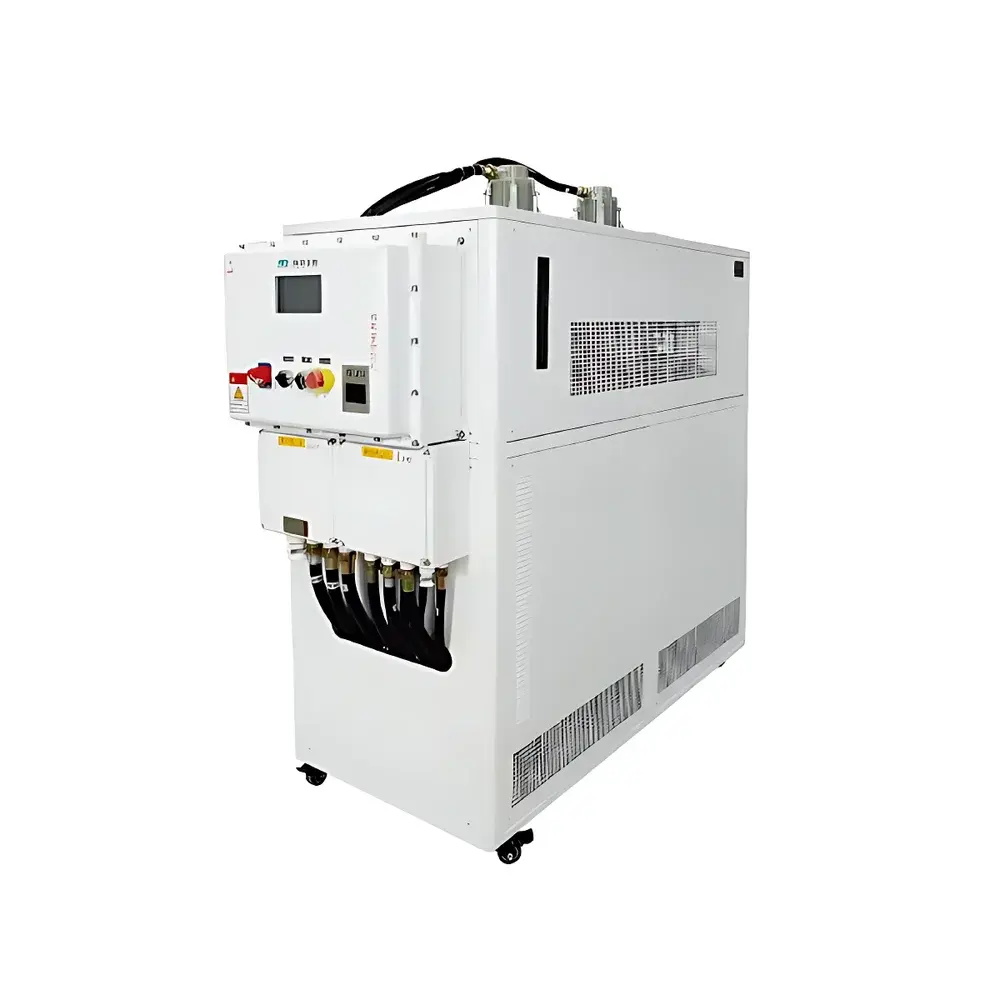
Scientz HL25W-820 Series Low-Temperature to High-Temperature Circulating Chiller System (−80 °C to 200 °C)
| Brand | Scientz |
|---|---|
| Origin | Zhejiang, China |
| Manufacturer Type | Direct Manufacturer |
| Product Origin | Domestic (China) |
| Model | HL25W-820 Series |
| Temperature Control Range | −80 °C to 200 °C |
| Temperature Accuracy (Heat Transfer Medium) | ±0.5 °C |
| Temperature Accuracy (Process Material) | ±1.0 °C |
| Display Interface | 7-inch color touchscreen with real-time temperature curve visualization and logging |
| Control Algorithm | PID-based fuzzy logic control |
| Communication Protocol | MODBUS RTU over RS-485 |
| Max. Operating Medium Temperature | 200 °C |
| Min. Operating Medium Temperature | −25 °C |
| Programmability | Up to 5 multi-step programs, each supporting up to 30 segments |
| Temperature Feedback Points | Three PT100 sensors — chiller internal temperature, outlet fluid temperature, and external process material temperature |
| Safety Protections | Compressor overload protection, high-pressure switch, thermal relay, overtemperature sensor fault detection, low-fluid-level alarm, and integrated self-diagnostic system |
| System Design | Fully sealed closed-loop circulation |
Overview
The Scientz HL25W-820 Series is an engineered circulating temperature control system designed for precise, stable, and wide-range thermal management in demanding life science, chemical engineering, and materials testing applications. Operating across a continuous span from −80 °C to 200 °C, it utilizes a single-fluid, fully sealed thermofluid loop—eliminating the need for medium exchange or atmospheric exposure during operation. Its core architecture integrates dual-sensor feedback (fluid outlet and process material), enabling independent control modes: either direct heat-transfer medium temperature regulation or closed-loop material temperature tracking via externally mounted PT100 probes. This dual-mode capability ensures accurate thermal coupling in jacketed reactors, microchannel flow reactors, and environmental test chambers where thermal inertia, lag, and interfacial resistance must be actively compensated. The system’s refrigeration-heating hybrid design employs cascade compression stages for deep cryogenic performance and high-efficiency electric heating elements for rapid ramping above ambient—enabling controlled cooling rates down to −2 °C/min and heating rates up to +3 °C/min under typical load conditions.
Key Features
- PID-fuzzy hybrid control algorithm delivering ±0.5 °C stability at the fluid outlet and ±1.0 °C at the process point under steady-state conditions
- 7-inch capacitive touchscreen HMI with embedded data logging, real-time multi-curve overlay (internal, outlet, and external sensor), and intuitive program editor
- Full MODBUS RTU support over isolated RS-485, enabling seamless integration into SCADA, LIMS, and PLC-based laboratory automation frameworks
- Triple-point PT100 sensing architecture: internal reservoir, outlet manifold, and user-supplied external probe—each independently configurable for setpoint reference or deviation monitoring
- Programmable thermal profiles: five distinct recipes, each containing up to thirty time-temperature-ramp-hold segments with slope limiting and conditional branching
- Comprehensive safety architecture including compressor overcurrent detection, high-pressure cut-off, redundant overtemperature cutoffs, low-fluid-level optical sensing, and automatic fault-code reporting
- Cold-rolled steel enclosure with electrostatic powder coating (RAL 7035), rated IP20 for laboratory environments
Sample Compatibility & Compliance
The HL25W-820 accommodates diverse thermal interfaces—including double-jacketed glass reactors (1–50 L), stainless-steel pilot-scale vessels, microstructured flow reactors with integrated thermal manifolds, and multi-channel environmental test fixtures. Its sealed-loop design prevents moisture ingress at sub-zero temperatures and eliminates volatile organic compound (VOC) emissions during high-temperature operation—critical for ISO 17025-accredited QC labs and GMP-compliant pilot plants. The system supports traceable temperature validation per ASTM E2877-21 (Standard Guide for Thermal Validation of Closed-Loop Liquid Temperature-Control Systems) and complies with IEC 61000-6-2/6-4 for electromagnetic compatibility. While not intrinsically rated for hazardous areas, optional ATEX-compatible variants are available upon request for Zone 2 installations.
Software & Data Management
Onboard firmware includes timestamped CSV export via USB port, with full audit trail functionality supporting GLP/GMP documentation requirements. Logged parameters include all three PT100 readings, setpoint history, compressor duty cycle, heater power output, and alarm event timestamps. Optional Scientz LabLink™ software (Windows-based) extends capabilities with remote monitoring, automated report generation (PDF/Excel), trend analysis with derivative calculation, and 21 CFR Part 11-compliant user access controls—including electronic signatures, role-based permissions, and immutable audit logs. All data files carry embedded metadata: operator ID, instrument serial number, calibration certificate ID, and environmental ambient reading (via optional external sensor input).
Applications
- Chemical Process Development: Exothermic nitration, sulfonation, and hydrogenation reactions in jacketed reactors—where ΔT between jacket and bulk phase must remain ≤±3 °C to prevent runaway
- Continuous Flow Synthesis: Thermal stabilization of microchannel reactors during photochemical, ozonolysis, or Grignard addition steps requiring sub-10 °C precision at 200 °C inlet temperatures
- Battery Materials Testing: Cycling lithium-ion cathode/anode slurries through −40 °C to 85 °C thermal shock profiles per UN 38.3 Section 5.1.3, with synchronized voltage/current logging
- Biopharmaceutical Stability Studies: Controlled freeze-thaw cycles for monoclonal antibody formulations, with programmable ramp rates matching ICH Q5C guidelines
- Advanced Materials Characterization: In situ DSC-correlated thermal aging of polymer composites under inert atmosphere, using external probe synchronization with TA Instruments or Netzsch platforms
FAQ
What thermal fluids are compatible with the HL25W-820 system?
Silicone oils (e.g., DC200 series), polyalphaolefins (PAOs), and specialized low-temperature heat transfer fluids (e.g., Dowtherm J) are validated. Glycol-water mixtures are not recommended above 120 °C due to degradation risk.
Can the system operate unattended for extended periods?
Yes—integrated watchdog timer, automatic restart after power recovery, and non-volatile program storage ensure 72+ hour autonomous operation when paired with proper fluid level and ventilation monitoring.
Is external temperature feedback mandatory for material temperature control?
Yes. Process temperature mode requires connection of a user-supplied PT100 Class A sensor directly to the reactor contents or wall; the system does not infer material temperature from jacket readings alone.
How often does the system require calibration verification?
Annual verification against NIST-traceable references is recommended. Built-in sensor offset adjustment allows field correction without disassembly.
Does the HL25W-820 meet regulatory requirements for pharmaceutical manufacturing?
The base unit meets mechanical and electrical safety standards (IEC 61010-1). For GMP use, optional IQ/OQ documentation packages and 21 CFR Part 11–enabled software modules are available.