
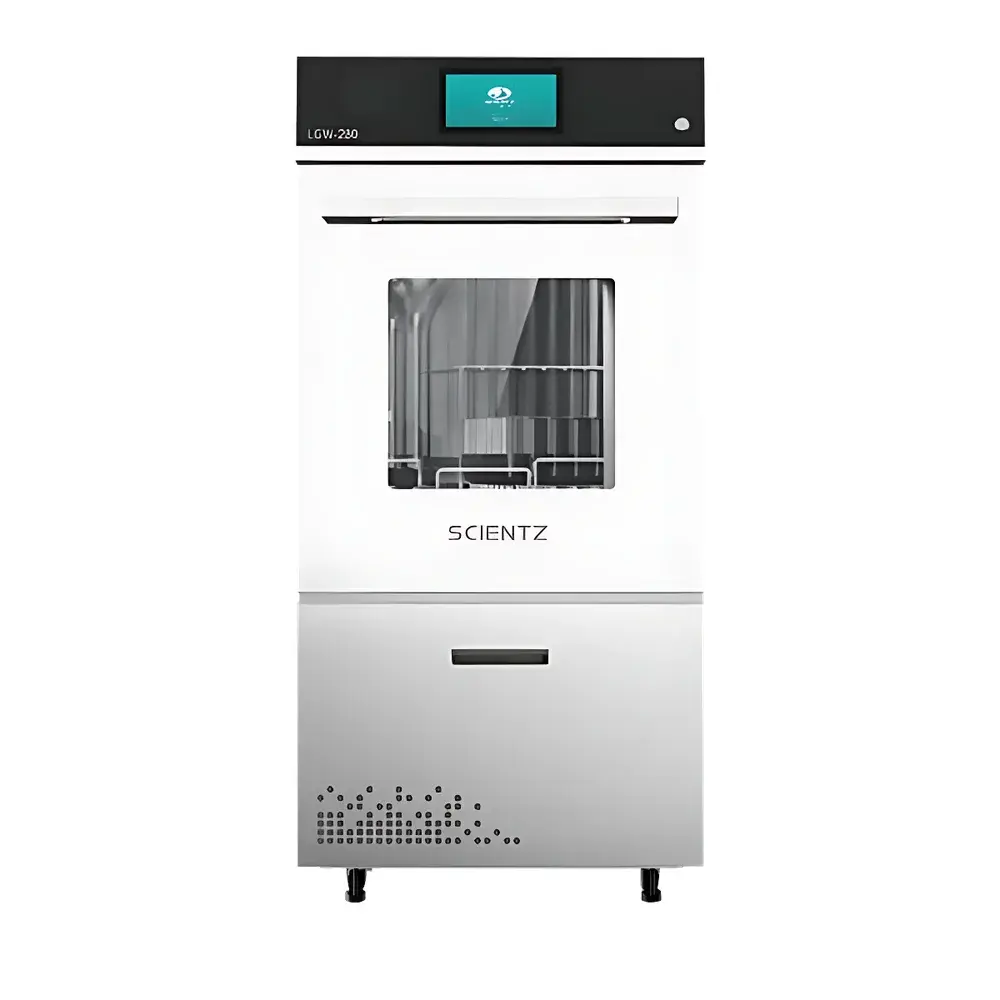
Scientz LGW-280 Laboratory Glassware Washer
| Brand | Scientz |
|---|---|
| Origin | Zhejiang, China |
| Manufacturer Type | Direct Manufacturer |
| Country of Origin | China |
| Model | LGW-280 |
| Chamber Volume | 307 L |
| Heating Power | 6 kW |
| Temperature Range | Ambient to 95 °C |
| External Dimensions (L×W×D) | 710 × 933 × 1445 mm |
Overview
The Scientz LGW-280 Laboratory Glassware Washer is an automated, integrated cleaning, disinfection, and drying system engineered for high-reproducibility processing of laboratory glassware in regulated and research-intensive environments. It operates on the principle of controlled mechanical impingement combined with thermally activated chemical action: pressurized wash solution—delivered via rotating spray arms and bottom-mounted spray nozzles—is recirculated through a closed-loop system using variable-frequency-driven centrifugal pumps. This ensures full 360° coverage of both interior and exterior surfaces of flasks, beakers, pipettes, volumetric glassware, and sample vials. The system supports programmable thermal disinfection at up to 95 °C, compliant with EN ISO 15883-1/2 requirements for thermodesinfection of reusable medical and laboratory devices. Designed for continuous operation in GLP, GMP, and ISO/IEC 17025-accredited laboratories, the LGW-280 reduces manual handling errors, eliminates cross-contamination risks from delayed post-wash handling, and delivers batch-to-batch consistency essential for method validation and audit readiness.
Key Features
- Chamber constructed from seamless, mirror-finished 316L stainless steel with radiused corners—designed to prevent microbial harborage and facilitate cleaning validation per ISO 14644 and EU GMP Annex 1.
- Exterior housing fabricated from fingerprint-resistant 304 stainless steel with double-insulated door assembly, reducing heat loss and acoustic emissions to ≤50 dB(A) during operation.
- 10.1-inch capacitive LCD touchscreen interface supporting multilingual UI, real-time temperature monitoring (PT100 sensors for water and air), fault diagnostics with audible alerts, and hierarchical password protection (three-level access control) meeting FDA 21 CFR Part 11 audit trail requirements.
- Self-cleaning chamber architecture with automatic internal rinse cycles; integrated steam condenser prevents unfiltered vapor release into lab ambient air.
- Modular drawer-type detergent dosing system with dual peristaltic pumps (expandable to four), enabling precise, repeatable chemical delivery independent of inlet pressure fluctuations.
- Triple-layer stainless steel filtration system with quick-release mechanism—retains particulates ≥50 µm and extends pump service life; filter status monitored and reported on HMI.
- HEPA-filtered hot-air drying system (99.99% efficiency at 0.3 µm), including filter saturation alarm and real-time status display on main screen.
- ESL (Emergency Safety Lock) circuitry: immediate power cutoff upon forced door opening during active heating or washing phases; configurable safe-door temperature threshold prevents operator scalding.
Sample Compatibility & Compliance
The LGW-280 accommodates standard laboratory glassware up to 1000 mL capacity—including Erlenmeyer flasks, graduated cylinders, culture tubes, and chromatography vials—across three-tiered, interchangeable basket racks. Its design conforms to international standards for washer-disinfector performance validation: EN ISO 15883-1 (general requirements), EN ISO 15883-2 (thermal disinfection), and ASTM F3191 (test methods for cleaning efficacy assessment). All critical process parameters—including temperature profiles, dwell times, detergent concentration, and rinse conductivity—are fully traceable and exportable via USB or optional thermal printer. The system supports integration into LIMS and electronic lab notebook (ELN) workflows through standardized CSV log export.
Software & Data Management
The embedded control software provides 100 user-configurable wash programs, each permitting independent definition of pre-rinse duration, wash temperature ramp rate, detergent injection timing, number of intermediate rinses, final rinse conductivity threshold, and drying cycle duration. All program modifications are logged with timestamp, operator ID, and parameter delta values. Data integrity is ensured via non-volatile memory storage, automatic backup on USB insertion, and tamper-evident digital signatures. Optional print module generates time-stamped, machine-readable hardcopy reports containing cycle ID, start/stop timestamps, peak temperatures, final rinse resistivity, and any deviation flags—fully compliant with ALCOA+ data governance principles.
Applications
This washer serves laboratories requiring validated, repeatable cleaning across environmental testing (EPA Method 500-series sample preparation), biopharmaceutical QC (USP <1058> analytical instrument qualification), food safety labs (AOAC-certified residue analysis), and clinical research facilities conducting ICH-GCP-aligned bioanalytical studies. Its ability to deliver consistent thermal disinfection at ≥93 °C makes it suitable for decontaminating glassware used in sterility testing (USP <71>) and endotoxin assay (USP <85>). The modular rack system also supports custom fixtures for irregularly shaped vessels such as Schlenk tubes or NMR sample tubes.
FAQ
What water quality specifications are recommended for optimal performance?
Deionized or softened water (conductivity ≤5 µS/cm) is required for final rinses to prevent spotting and mineral deposition; dual-inlet configuration allows separate routing of tap and purified water streams.
Can the LGW-280 be validated for use in GMP environments?
Yes—the system includes IQ/OQ documentation templates, built-in calibration verification routines for PT100 sensors, and full audit trail capability compatible with CSV and 21 CFR Part 11 compliance frameworks.
Is remote monitoring or network connectivity supported?
Standard configuration includes USB data export only; Ethernet or Wi-Fi modules are available as factory-installed options for centralized fleet management.
What maintenance intervals are specified for consumables?
HEPA filters require replacement every 6 months under typical usage; stainless steel filters should be cleaned after each cycle; detergent pumps undergo recalibration annually per manufacturer’s PM schedule.
Does the system support pure water recirculation for ultra-low residue applications?
An optional integrated pure water generation module (RO + EDI) can be added to supply Class I water (ASTM D1193) directly to rinse stages, eliminating external feed dependency.



