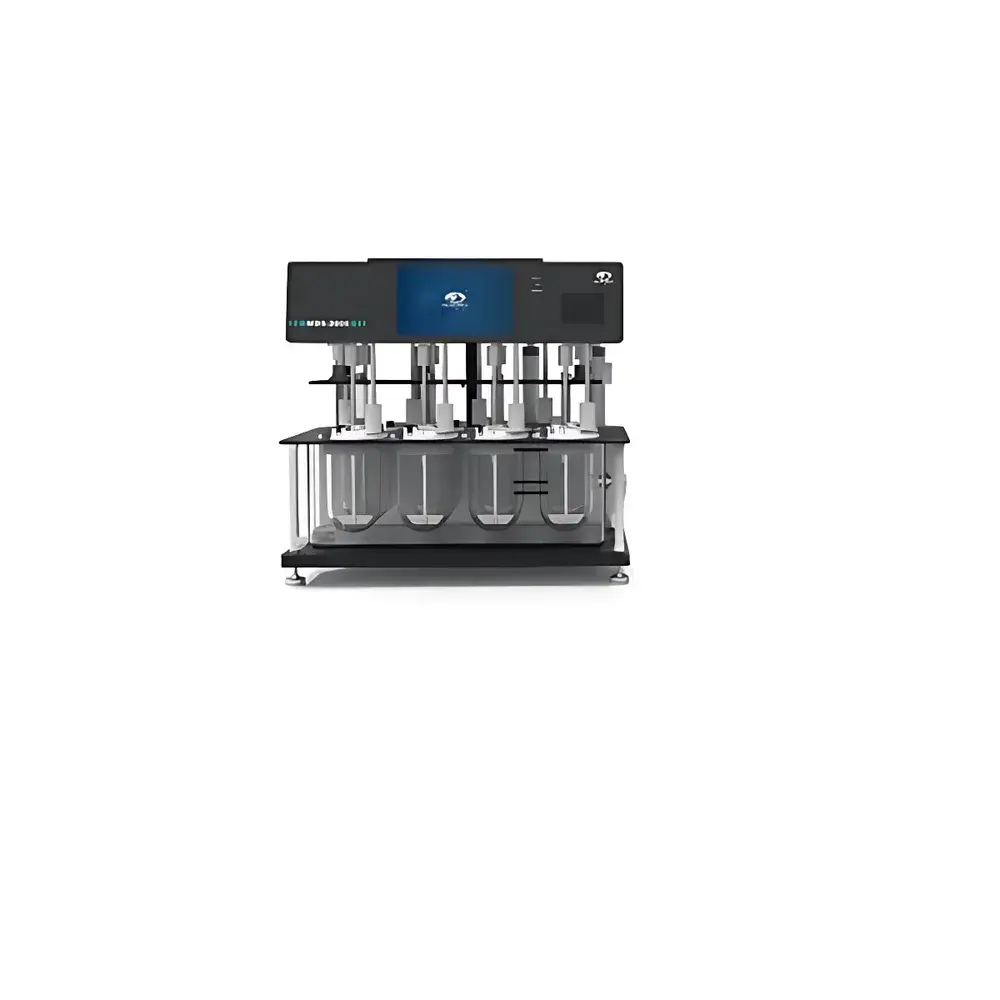
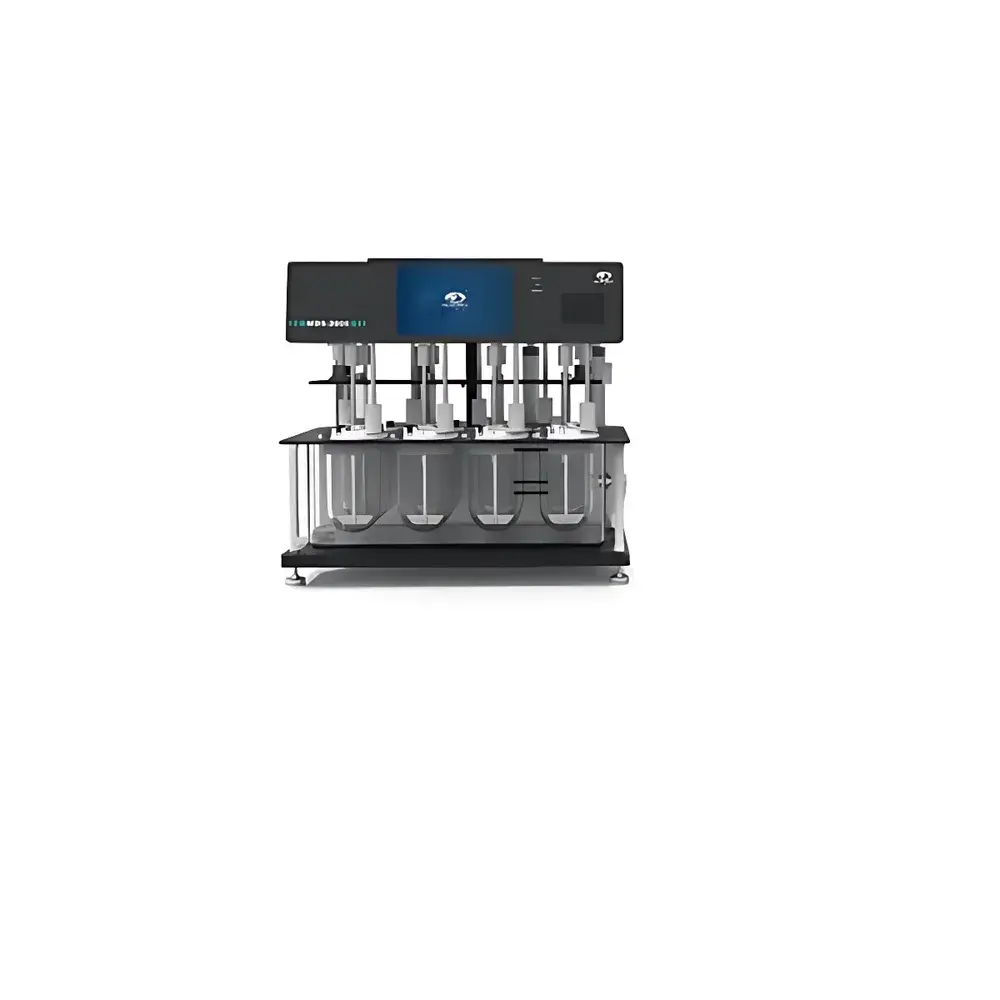
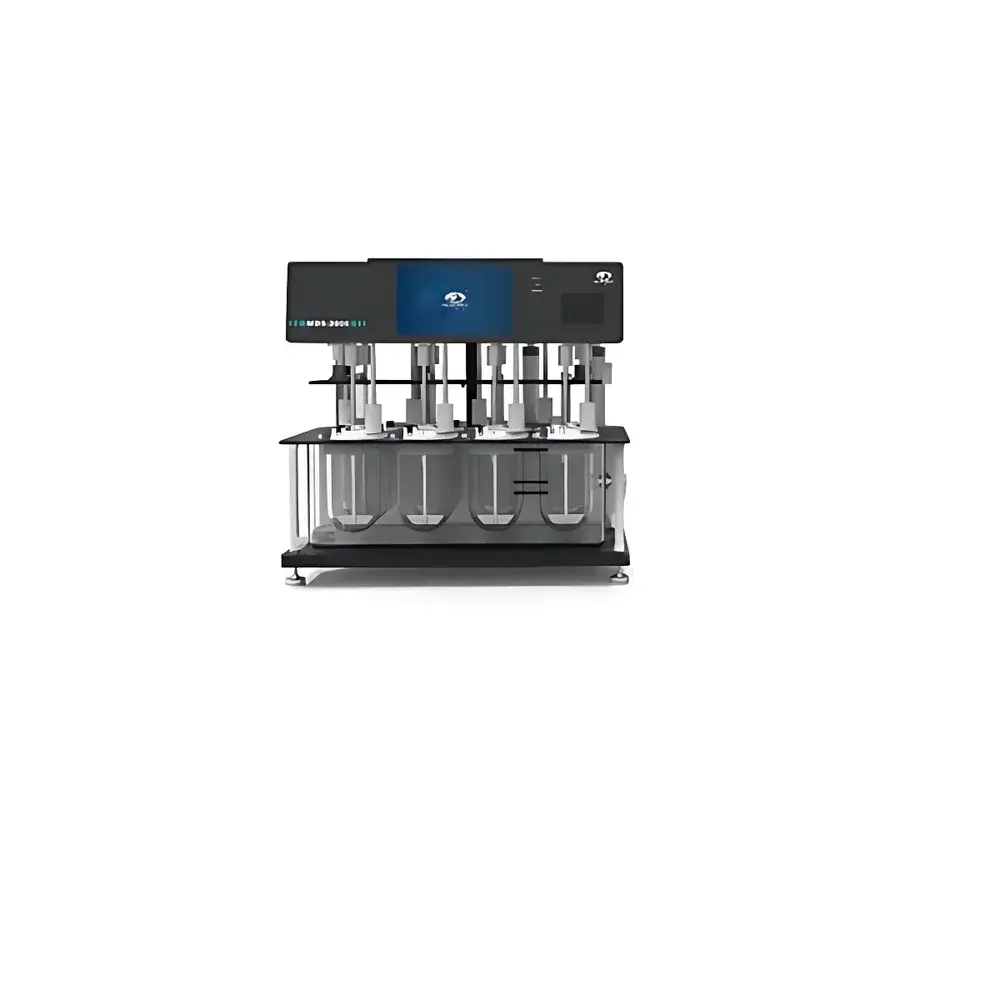
Scientz MDS-2008DS Dissolution Tester
| Brand | Scientz |
|---|---|
| Origin | Zhejiang, China |
| Model | MDS-2008DS |
| Instrument Type | Offline Dissolution Tester |
| Vessel Capacity | 6 or 8 vessels |
| Temperature Accuracy | ±0.2°C |
| Temperature Resolution | 0.1°C |
| Water Bath Range | Ambient to 45.0°C |
| Rotational Speed Range | 10.0–300.0 rpm |
| Rotational Speed Resolution | 0.1 rpm |
| Rotational Speed Accuracy | ±0.5 rpm |
| Basket/Shaft Wobble | ≤0.5 mm |
| Basket Wobble | ≤1.0 mm |
| Shaft-to-Vessel Axis Deviation | ≤±1.5 mm |
| Levelness | ≤0.2° |
| Shaft Verticality | 90° ±0.5° |
| Vessel Options | 250 mL and 1000 mL (amber option available) |
| Compliance | USP <711>, EP 2.9.3, ChP 0931 |
Overview
The Scientz MDS-2008DS Dissolution Tester is an offline, fully compliant pharmaceutical dissolution system engineered for precision, reproducibility, and regulatory readiness in QC laboratories, contract research organizations (CROs), and formulation development units. It operates according to the fundamental hydrodynamic principles defined in USP , European Pharmacopoeia 2.9.3, and Chinese Pharmacopoeia Chapter 0931—utilizing paddle (USP Apparatus 2), basket (USP Apparatus 1), small-volume cup (Apparatus 7), rotating disc (Apparatus 4), and rotating cylinder (Apparatus 3) methods. Its core architecture integrates independent PID + fuzzy logic temperature control, eight-vessel parallel operation with individual real-time temperature monitoring, and mechanically stable shaft alignment—ensuring minimal hydrodynamic perturbation and high inter-vessel consistency across dissolution runs.
Key Features
- Eight-vessel configuration with optional 6-vessel mode—supports simultaneous testing under identical or method-divergent conditions
- Vessel mounting system with embedded circumferential clamping rings ensures optimal centering, vertical alignment, and reduced solvent evaporation; vessel rim alignment markers and diagonal fixation minimize positional variability between runs
- V-shaped anti-evaporation lid design provides full surface contact with standard and amber 250 mL / 1000 mL vessels, significantly reducing solvent loss during extended dissolution profiles
- Modular auto-dosing unit enables synchronized or sequential tablet/capsule introduction across all eight vessels—eliminates manual handling errors and prevents dosage form adhesion or premature disintegration
- One-piece injection-molded water bath with quick-connect fittings and fully drainable, radius-cornered tank geometry prevents microbial retention and simplifies cleaning validation per GMP Annex 1 requirements
- Segmented 316L stainless steel shaft assembly allows tool-free interchange of paddles, baskets, and cylinders without recalibration—maintains consistent immersion depth and axis concentricity
- Multi-point stainless steel guide rods stabilize the head assembly, minimizing mechanical drift and extending long-term positional fidelity (shaft-to-vessel deviation ≤±1.5 mm)
- 10-inch color touchscreen interface with dual-language support (English/Chinese), method encryption, screen lock, and up to 100 stored protocols
- Triple-tier user access control with audit-trail-enabled login management (39 accounts), supporting role-based permissions aligned with FDA 21 CFR Part 11 and EU Annex 11 expectations
Sample Compatibility & Compliance
The MDS-2008DS accommodates solid oral dosage forms including immediate-release tablets, extended-release capsules, orally disintegrating tablets (ODTs), and transdermal patches—compatible with both aqueous and non-aqueous dissolution media. Vessels are available in 250 mL (standard) and 1000 mL (including amber glass for light-sensitive APIs). Integrated photosensitive white/red lighting supports photostability-compliant dissolution testing per ICH Q1B. All mechanical parameters—including shaft wobble (≤0.5 mm), basket runout (≤1.0 mm), and levelness (≤0.2°)—meet or exceed USP mechanical calibration criteria. The system supports formal mechanical qualification (MQ), installation qualification (IQ), operational qualification (OQ), and performance qualification (PQ) documentation packages, including AIQ-certified verification services.
Software & Data Management
The embedded firmware records timestamped temperature, rotation speed, and method execution logs in real time. Built-in thermal printer generates tamper-evident session reports with operator ID, method name, start/end times, and critical parameter deviations. All logs are exportable via USB to encrypted .csv or proprietary binary format (readable only via Scientz’s validated data review software). Audit trail functionality captures all user actions—including method edits, parameter changes, and account modifications—with immutable timestamps and operator attribution. Data integrity safeguards include electronic signatures, password-protected configuration locks, and automatic backup upon power cycle. The system supports integration into LIMS environments via RS-232 or optional Ethernet module (firmware v3.2+).
Applications
- QC release testing of generic and innovator drug products per pharmacopoeial monographs
- Comparative dissolution profiling for bioequivalence assessment (e.g., f2 similarity factor calculation)
- Formulation optimization studies—including excipient screening, coating thickness evaluation, and pH-dependent release modeling
- Stability-indicating dissolution method development under oxidative, thermal, and photolytic stress conditions
- Regulatory submission support—generating GLP/GMP-compliant datasets for ANDA, NDA, and MAA dossiers
- Method transfer between R&D, pilot plant, and commercial manufacturing sites using USB-based protocol cloning
FAQ
Does the MDS-2008DS comply with 21 CFR Part 11 requirements for electronic records and signatures?
Yes—the system implements role-based authentication, audit-trail logging, electronic signature enforcement, and data immutability controls as specified in FDA 21 CFR Part 11 and EU Annex 11.
Can the instrument perform both paddle and basket methods without mechanical recalibration?
Yes—its segmented 316L shaft design maintains fixed immersion depth and axial alignment across apparatus types, eliminating manual height adjustment between methods.
Is amber glass vessel support included as standard or optional?
Amber 1000 mL vessels are optional accessories; standard configurations include clear borosilicate glass 250 mL and 1000 mL vessels.
What temperature uniformity specifications are verified during factory calibration?
Each vessel position undergoes independent temperature mapping at 37.0°C; spatial uniformity is validated to ±0.2°C across all eight positions per USP Annex A.
How is solvent evaporation mitigated during 24+ hour dissolution runs?
The V-shaped lid design achieves >95% vapor barrier efficiency; combined with programmable ambient-humidity compensation (20–80% RH operating range), it ensures mass-loss correction remains within ±0.5% over 48 hours.