
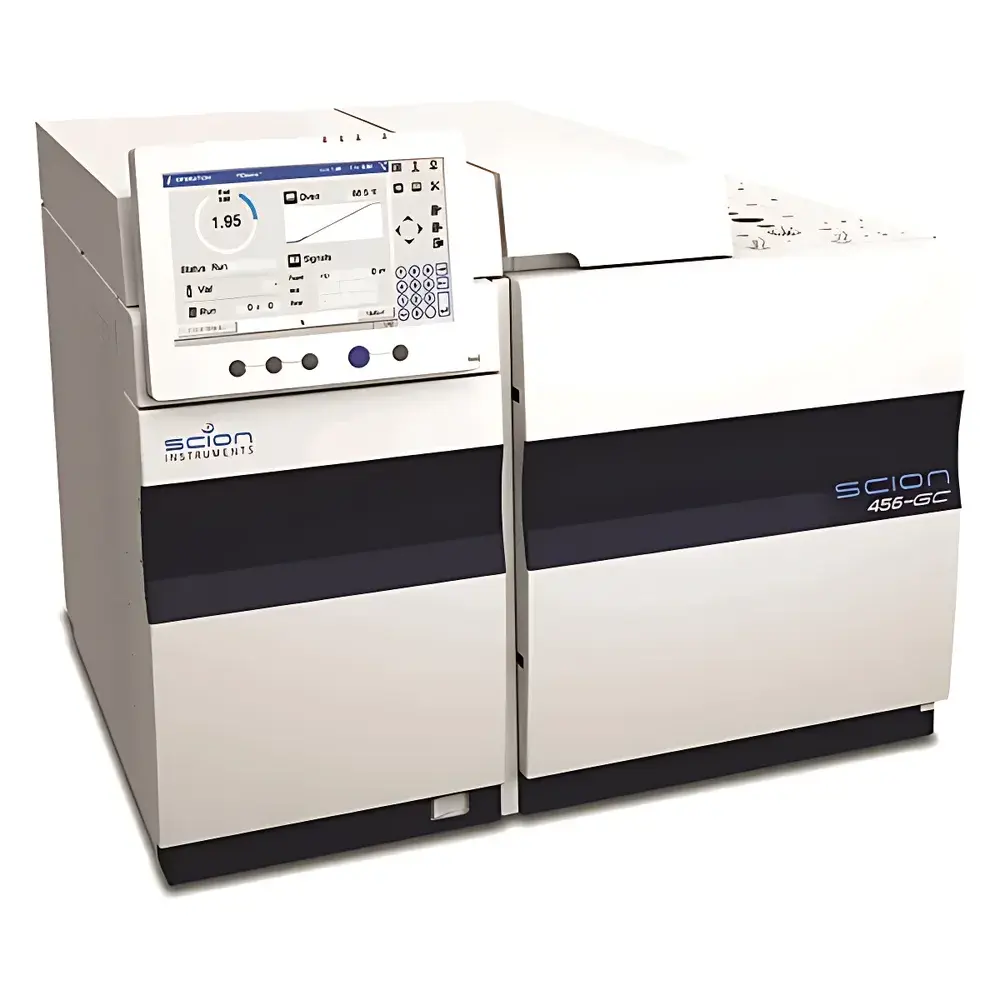
Scion 436-GC and 456-GC Gas Chromatographs
| Brand | Scion |
|---|---|
| Origin | Netherlands |
| Manufacturer Type | Original Equipment Manufacturer (OEM) |
| Product Category | Imported Laboratory Gas Chromatograph |
| Models | 436-GC, 456-GC |
| Temperature Control Range | Ambient +4 °C to 450 °C |
| Maximum Ramp Rate | 150 °C/min |
| Cooling Rate | ~4.5 min from 400 °C to 50 °C |
| Carrier Gas Flow Range & Control | 0–1500 mL/min |
| Carrier Gas Pressure Range & Control | 0–150 psi |
| Injector Maximum Operating Temperature | 450 °C |
| Injector Pressure Setting Range | 0–150 psi |
| Injector Total Flow Setting Range | 0–1500 mL/min |
| Detector Data Acquisition Rate | 600 Hz |
| Column Oven Configuration | Dual-channel (436-GC), Quad-channel (456-GC) |
| Injector Types Supported | Split/Splitless, PTV, Cool-on-Column, Direct Injection |
| Flow Control Mode | Constant Linear Velocity (CLV) |
| System Software | Compass CDS (integrated) |
| Compliance | ASTM, UOP, EN, ISO, GPA, USP methods |
Overview
The Scion 436-GC and 456-GC are high-performance, modular laboratory gas chromatographs engineered for precision, reproducibility, and long-term operational stability in regulated and research-intensive environments. Built on a robust, inert-flow-path architecture, both systems utilize advanced electronic pressure control (EPC) and electronic flow control (EFC) to deliver precise, programmable carrier gas delivery across all operational parameters. The instruments operate on the fundamental principle of separating volatile and semi-volatile compounds based on differential partitioning between a mobile phase (inert carrier gas) and a stationary phase (capillary column), with detection achieved via flame ionization (FID), thermal conductivity (TCD), electron capture (ECD), nitrogen-phosphorus (NPD), or mass spectrometric (MS) detection. Designed and manufactured in the Netherlands by Scion Instruments—a vertically integrated OEM—the 436-GC and 456-GC platforms meet stringent engineering standards for thermal stability, flow accuracy, and system integrity under continuous operation.
Key Features
- Dual-channel configuration (436-GC): Supports two independent injectors (e.g., split/splitless + PTV), one GC detector, and optional MS coupling—ideal for method development and parallel sample analysis.
- Quad-channel configuration (456-GC): Accommodates up to three injectors, three GC detectors (including simultaneous FID/TCD/ECD), and integrated mass spectrometer interface—enabling maximum analytical throughput and multi-detection capability within a single platform.
- High-precision oven system with temperature range from ambient +4 °C to 450 °C and ramp rates up to 150 °C/min; rapid cooling (400 °C → 50 °C in ~4.5 min) minimizes cycle time without compromising column or detector longevity.
- Inertized flow path (siliconized stainless steel and fused silica components) reduces active site adsorption, ensuring high recovery of reactive, polar, and thermally labile analytes—including pesticides, residual solvents, and heteroatom-containing compounds.
- Constant linear velocity (CLV) mode maintains optimal separation efficiency across temperature gradients, eliminating retention time drift caused by viscosity-driven flow changes.
- 600 Hz data acquisition rate across all detectors ensures high-fidelity peak shape resolution—even for narrow, fast-eluting compounds in complex matrices such as petrochemical streams or environmental extracts.
Sample Compatibility & Compliance
The 436-GC and 456-GC accommodate a broad spectrum of sample types—including liquids, gases, headspace vials, and solid-phase microextraction (SPME) fibers—via configurable injector modules (split/splitless, programmed temperature vaporizing [PTV], cool-on-column, and direct injection). Both models support compliance-critical workflows aligned with ASTM D3606, D5501, D6729; UOP 97, 98, 452; ISO 6416, 8518, 10301; EN 14083, 15550; GPA 2145, 2177; and USP and . Instrument qualification documentation, audit-trail-enabled software logs, and electronic signature support in Compass CDS facilitate adherence to GLP, GMP, and FDA 21 CFR Part 11 requirements.
Software & Data Management
Compass CDS is a fully integrated chromatography data system developed specifically for Scion GC platforms. It provides real-time instrument control, automated sequence execution, intelligent baseline correction, peak integration using ISO/IEC 17025-compliant algorithms, and customizable reporting templates. The IntelliUpdate system automatically validates method transfer integrity—including retention time alignment and peak area reproducibility—across instruments and laboratories. System suitability testing (SST) is embedded directly into sequence protocols, with pass/fail criteria configurable per pharmacopeial or internal SOP requirements. All raw data files are stored in vendor-neutral .cdf format, supporting third-party reprocessing and long-term archival.
Applications
These GC systems serve as primary analytical tools across regulated and industrial laboratories. In petroleum refining, they quantify hydrocarbon fractions (PIONA, olefins, aromatics) per ASTM D5769 and D6730. Environmental labs apply them to EPA Method 8260D (VOCs), 8270E (SVOCs), and ISO 17993 for soil/water analysis. Food safety applications include pesticide residue screening (EN 15662), solvent residue testing (ISO 11890-2), and flavor compound profiling. Pharmaceutical QC labs deploy them for residual solvent analysis (ICH Q3C), impurity profiling, and extractables/leachables studies compliant with USP . The modularity and dual-/quad-channel architecture also support academic research in metabolomics, polymer degradation, and reaction monitoring.
FAQ
What distinguishes the 436-GC from the 456-GC in terms of hardware expandability?
The 436-GC supports two independent inlet ports and one detector position (with optional MS interface), while the 456-GC offers four detector positions, three inlet ports, and native MS integration—enabling true multi-detector, multi-inlet concurrent analysis.
Does the system support unattended operation over extended periods?
Yes—both models integrate autosampler compatibility (up to 162-position trays), automated valve switching, and event-driven sequence control with real-time error logging and email alerting.
Is Compass CDS validated for use in FDA-regulated environments?
Compass CDS includes full 21 CFR Part 11 functionality: role-based access control, electronic signatures, immutable audit trails, and electronic record retention—validated per IQ/OQ/PQ protocols supplied with each system.
Can the GC be configured for both constant pressure and constant flow modes?
All EPC/EFC modules operate exclusively in constant linear velocity (CLV) mode by default, but pressure- and flow-based methods can be implemented via user-defined gradient tables compatible with legacy method migration.
What maintenance intervals are recommended for routine GC operation?
Injector liner replacement every 100–200 injections (depending on matrix cleanliness); column trimming every 0.5–1 m per 500 injections; EPC module calibration annually or after major service events; full system performance verification quarterly per ISO/IEC 17025 guidelines.
Related Products





