
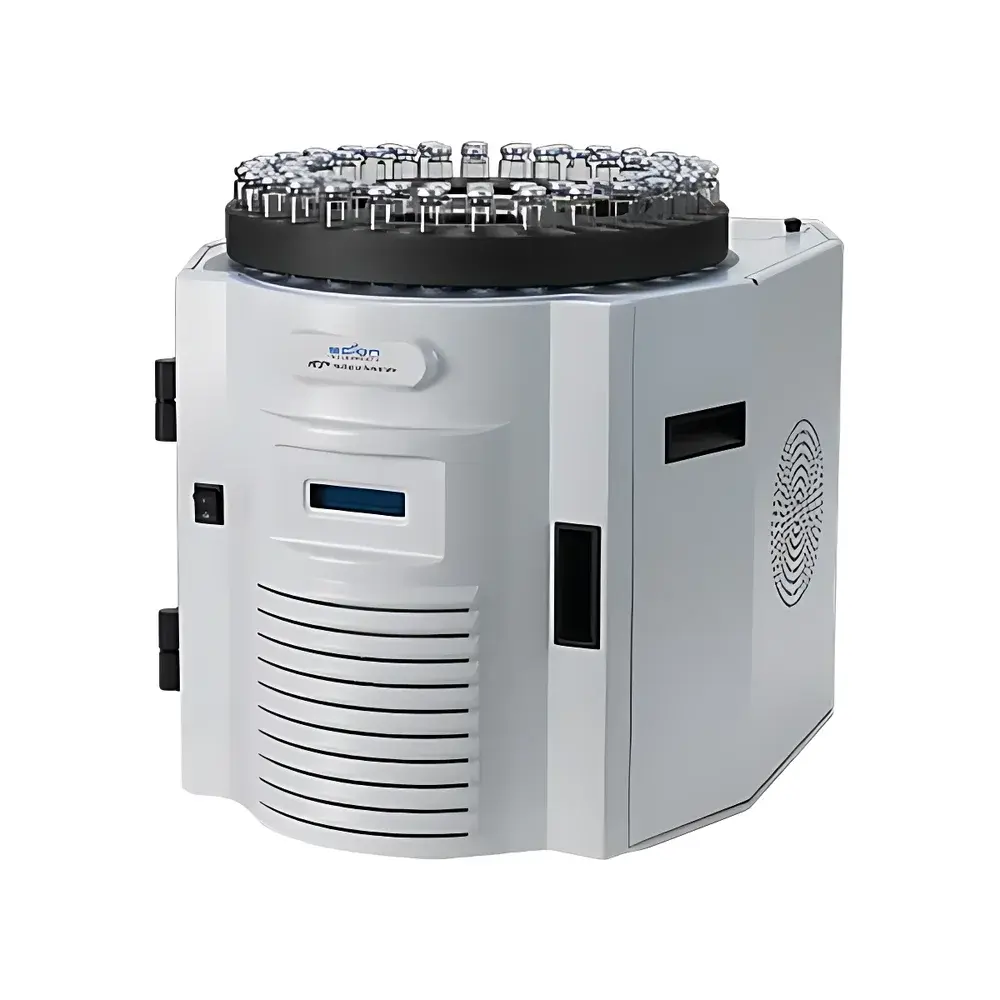
SCION HT3 Headspace Sampler
| Brand | SCION |
|---|---|
| Origin | Netherlands |
| Manufacturer Type | Original Equipment Manufacturer (OEM) |
| Origin Category | Imported Instrument |
| Model | HT3 |
| Instrument Type | Dynamic Headspace Sampler |
| Automation Level | Fully Automated |
| Vial Heating Range | Up to 300 °C, 1 °C Incremental Control |
| Valve & Transfer Line Temperature Range | Up to 300 °C, 1 °C Incremental Control |
| Temperature Control Accuracy | ±0.05 °C |
| Sample Loop Volume | 1 mL Silco-coated loop standard |
| optional loops | 100 μL, 250 μL, 300 μL, 500 μL, 2 mL, 3 mL, 5 mL |
| Vial Capacity | 60 positions |
| Vial Size | 22 mL |
Overview
The SCION HT3 Headspace Sampler is a fully automated, dual-mode (static and dynamic) headspace sampling system engineered for precise, reproducible analysis of volatile and semi-volatile organic compounds (VOCs and SVOCs) in complex matrices. It operates on the principle of phase equilibrium partitioning—where analytes distribute between a solid/liquid sample phase and its overlying vapor phase—and enables quantitative transfer of equilibrated headspace vapors directly into gas chromatography (GC) or GC–mass spectrometry (GC–MS) systems. Unlike direct liquid injection or purge-and-trap methods, headspace sampling eliminates matrix interference, minimizes column contamination, and avoids thermal degradation of thermally labile compounds. The HT3 integrates advanced thermal management, mass-flow-controlled purge dynamics, and inert Silco-coated fluidic pathways to ensure trace-level sensitivity, method robustness, and long-term analytical stability—making it suitable for regulated environments including environmental testing, pharmaceutical residual solvent analysis (per USP ), food flavor profiling, and forensic toxicology.
Key Features
- Dual operational modes: configurable static headspace for rapid screening and dynamic headspace (purge-and-trap) for enhanced sensitivity—enabling detection limits down to sub-ppt levels in aqueous and solid samples.
- Independent, high-precision temperature control of vial oven (up to 300 °C, ±0.05 °C), valve manifold, and transfer lines—eliminating condensation and ensuring quantitative vapor transport.
- Integrated mass flow controller (MFC) for simultaneous regulation of purge gas flow rate and system pressure, improving retention time reproducibility and peak shape fidelity across multi-method sequences.
- 60-position vial carousel with standardized 22 mL crimp-top vials; supports programmable vial agitation, incubation time, and equilibration ramp profiles per sample.
- Modular, Silco-coated sample loops (standard 1 mL; optional volumes from 100 μL to 5 mL) minimize surface adsorption and carryover—critical for polar, reactive, or sulfur-containing VOCs.
- Method flexibility: up to 99 independent methods can be scheduled within a single run sequence, each with unique temperature ramps, purge durations, trap desorption parameters, and loop selection.
Sample Compatibility & Compliance
The HT3 accommodates diverse sample types—including aqueous solutions, soils, polymers, pharmaceutical tablets, beverages, and biological tissues—without derivatization or solvent extraction. Its inert Silco-treated surfaces comply with EPA Method 502.2, 524.4, 8260D, and ASTM D7622 for VOC analysis in drinking water and wastewater. For pharmaceutical applications, the system supports USP Class 1–3 residual solvent testing and aligns with ICH Q2(R2) validation requirements for accuracy, precision, and linearity. All temperature and timing parameters are logged with audit-trail-capable timestamps, satisfying FDA 21 CFR Part 11 data integrity requirements when paired with compliant LIMS or GC software platforms.
Software & Data Management
Controlled via SCION’s intuitive ChromaLink™ software (Windows-based), the HT3 supports remote configuration, real-time status monitoring, and automated report generation. Method templates adhere to ISO/IEC 17025 documentation standards, and all instrument events—including vial positioning, temperature setpoint changes, loop actuation, and MFC calibration logs—are stored in encrypted binary files with SHA-256 checksum verification. Data export options include CSV, PDF, and XML formats compatible with ELN integration. Optional 21 CFR Part 11 compliance packages include electronic signatures, role-based access control, and full audit trail review functionality.
Applications
- Environmental: Quantification of BTEX, chlorinated solvents, and gasoline-range organics in groundwater and soil extracts.
- Pharmaceutical: Residual solvent profiling in APIs and final drug products per ICH guidelines.
- Food & Beverage: Flavor compound profiling, ethanol quantification, and off-odor detection in dairy, wine, and packaged foods.
- Forensics: Detection of ignitable liquids in fire debris per ASTM E1387 and E1441.
- Materials Science: Outgassing analysis of adhesives, coatings, and automotive interior components (VDA 278, ISO 12219-4).
FAQ
Is the HT3 compatible with third-party GC and GC–MS systems?
Yes—the HT3 features universal pneumatic and electrical interfaces (including TTL triggers and analog voltage outputs) and has been validated with Agilent, Thermo Fisher, Shimadzu, PerkinElmer, and Bruker GC platforms.
Can the system perform both static and dynamic headspace in a single sequence?
No—static and dynamic modes require distinct hardware configurations (e.g., trap module installation); however, method switching is software-enabled and requires only reconfiguration of the sequence table and parameter set.
What maintenance intervals are recommended for the MFC and valve manifold?
The MFC should be calibrated annually using certified NIST-traceable gases; the heated valve manifold requires quarterly inspection of sealing surfaces and annual replacement of PTFE/graphite ferrules.
Does the HT3 support unattended overnight operation?
Yes—equipped with automatic vial recognition, end-of-sequence shutdown, and thermal safety interlocks, the system meets IEC 61010-1 Class II safety certification for continuous unattended operation.
How is carryover mitigated during high-concentration sample analysis?
Carryover is minimized through programmable bake-out cycles (up to 300 °C), inert Silco-coated loops, and optional post-injection blank vial rinsing with heated carrier gas.




