
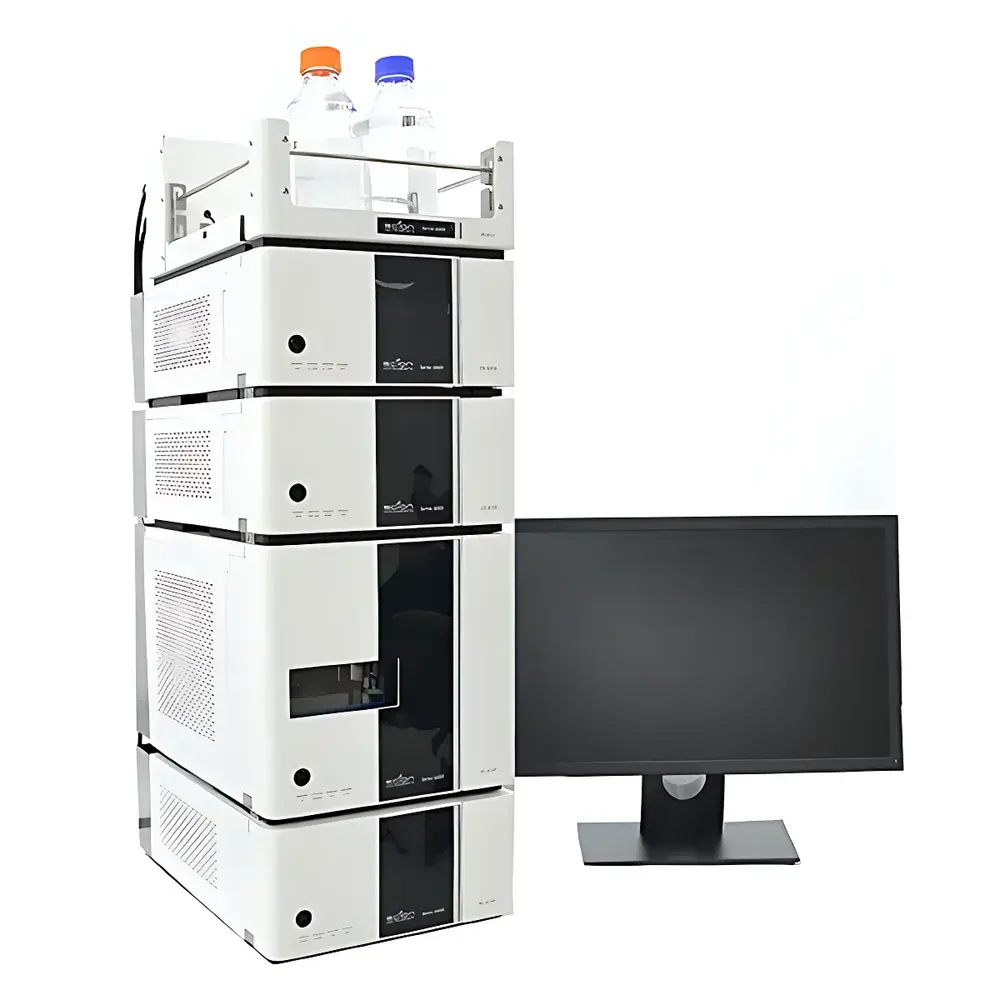
SCION LC6000-DAD Diode Array Detector Ultra-High Performance Liquid Chromatograph
| Brand | SCION |
|---|---|
| Origin | Shanghai, China |
| Manufacturer Type | Original Equipment Manufacturer (OEM) |
| Regional Classification | Domestic (China) |
| Model | LC6000-DAD |
| Instrument Category | Conventional High-Performance Liquid Chromatograph (HPLC) |
| Application Scope | General-purpose analytical platform |
| Flow Rate Range | 0.001–5.000 mL/min |
| Maximum Pressure Rating | 60 MPa |
| Flow Precision | <0.05% RSD |
| Sample Tray Capacity | 200 positions (1.5 mL vials) |
| Optional Trays | 128 positions (4 mL vials), 288 positions (96-well microplate), 1152 positions (384-well microplate) |
| Injection Volume Range | 0.1–100 µL (standard) |
| DAD Wavelength Range | 190–900 nm |
| Spectral Acquisition Rate | Multi-step adjustable |
Overview
The SCION LC6000-DAD is a modular, ultra-high performance liquid chromatography system engineered for precision, regulatory compliance, and method flexibility in modern analytical laboratories. Built upon a unified hardware architecture and controlled by Compass CDS software, it integrates a high-pressure binary or quaternary solvent delivery system, a low-dead-volume autosampler with refrigerated options, a thermally stabilized column oven, and a high-fidelity diode array detector (DAD). The system operates on standard HPLC principles—employing pressure-driven mobile phase delivery through packed columns to separate analytes based on differential partitioning—and extends functionality via real-time spectral acquisition across the full UV-Vis range (190–900 nm). Its design targets laboratories requiring robust, scalable platforms for routine QC, stability-indicating assays, impurity profiling, and method development under GLP/GMP environments.
Key Features
- High-precision dual-pump architecture supporting both binary high-pressure and quaternary low-pressure gradient modes, enabling seamless method transfer and complex multi-solvent programming.
- “Pre-mix, post-pump” solvent blending and high-frequency pressure feedback control suppress pulsation, delivering <0.05% RSD flow precision and exceptional retention time reproducibility.
- Modular autosampler (AS-6210/6220) with <0.01% cross-contamination rate, configurable refrigeration (4–40 °C), and interchangeable syringes for injection volumes from 0.1 µL to 2500 µL.
- Column oven (OV-6310) with triple-zone temperature control (–10 to 80 °C), integrated pre-heater for mobile phase conditioning, and capacity for up to six 250 mm columns.
- DAD detector (DA-6430) featuring a sealed, thermostatted flow cell option, built-in mercury lamp (254 nm) for wavelength calibration, and spectral resolution optimized for peak purity assessment and library matching.
- All modules—including PU-6100 pump, AS-6220 sampler, OV-6310 oven, and DA-6430 DAD—are fully bidirectionally controlled via Compass CDS, eliminating manual configuration errors.
Sample Compatibility & Compliance
The LC6000-DAD accommodates diverse sample formats including 1.5 mL vials (200-position standard tray), 4 mL vials, 96-well and 384-well microplates—supporting high-throughput screening and biopharmaceutical workflows. Its pressure rating of 60 MPa ensures compatibility with sub-2 µm particle-packed columns and core-shell technologies. The system meets international regulatory expectations: Compass CDS implements full audit trail, electronic signatures, role-based access control, and data integrity safeguards aligned with FDA 21 CFR Part 11, EU Annex 11, and ISO/IEC 17025 requirements. All detectors—including UV-6410, FL-6440, ELS-6455, and RI-6460—share identical communication protocols and calibration traceability, facilitating multi-detector validation per ICH Q2(R2) and USP .
Software & Data Management
Compass CDS serves as the central command interface for instrument control, sequence management, and data processing. It supports standalone operation and client-server deployment, with native integration into LIMS via ASTM E1384-compliant interfaces. Raw data are stored in vendor-neutral .cdf format; processed results export to PDF, CSV, and XML for regulatory submission. The software includes automated baseline correction, peak deconvolution, spectral library search (NIST-compatible), and quantitative reporting with uncertainty estimation. Audit trails record all user actions, parameter changes, and data modifications with timestamps and operator IDs—fully compliant with ALCOA+ principles.
Applications
The LC6000-DAD is validated for pharmaceutical assay and dissolution testing (USP ), pesticide residue analysis (AOAC 2007.01), natural product fingerprinting (Chinese Pharmacopoeia), polymer additive quantification (ASTM D5295), and clinical biomarker profiling (CLSI EP28-A3c). Its DAD module enables peak purity evaluation via spectral overlay, photodiode ratio tracking, and multivariate curve resolution—critical for forced degradation studies and co-elution diagnosis. When coupled with ELSD or RI detection, it supports non-chromophoric compound analysis such as carbohydrates, lipids, and surfactants without derivatization.
FAQ
Does the LC6000-DAD support method transfer from legacy HPLC systems?
Yes—the system replicates dwell volume, gradient delay, and dispersion characteristics via programmable mixer selection and flow path optimization, ensuring direct translation of methods from Agilent 1260, Waters e2695, or Shimadzu Nexera platforms.
Is the DAD wavelength calibration traceable to NIST standards?
Yes—built-in Hg lamp (254 nm) provides primary wavelength reference; secondary verification uses holmium oxide filter (241, 279, 333, 360, 418, 480, 536 nm) per ISO 17025-accredited calibration procedures.
Can the autosampler operate unattended overnight with temperature-sensitive samples?
Yes—refrigerated tray option maintains 4–10 °C stability over 16+ hours; condensation management is achieved via active drainage channels and sealed chamber design.
What data security protocols does Compass CDS implement?
Role-based permissions, encrypted database storage, automatic backup scheduling, and immutable audit logs meeting HIPAA, GDPR, and 21 CFR Part 11 §11.10(c) requirements.
Are column oven and detector flow cells compatible with aggressive mobile phases (e.g., TFA, HFIP)?
Yes—wetted parts include PEEK, sapphire, and Hastelloy C-276; all fluidic components are rated for pH 1–12 and organic/aqueous solvent blends containing up to 0.1% TFA or 10% HFIP.




