
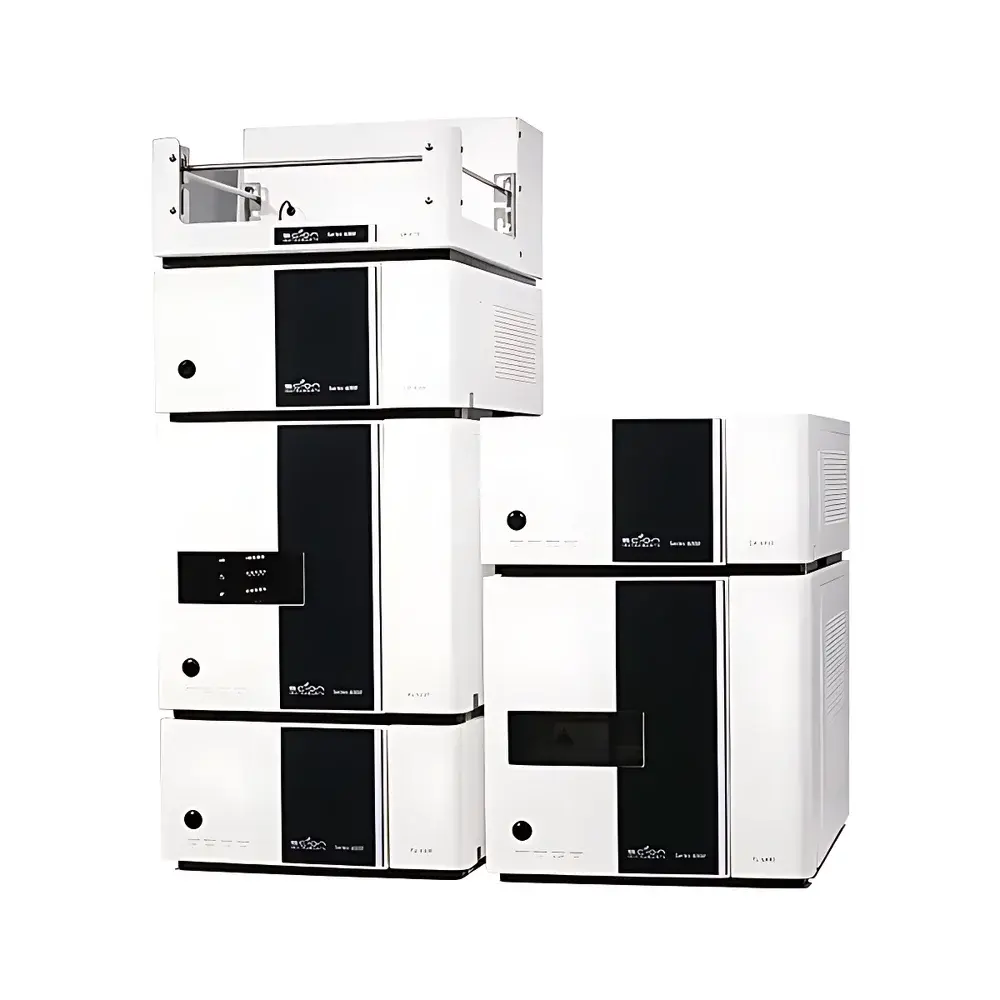
SCION LC6000-FLD Fluorescence Detector for Ultra-High Performance Liquid Chromatography (UHPLC)
| Brand | SCION |
|---|---|
| Origin | Shanghai, China |
| Manufacturer Type | Original Equipment Manufacturer (OEM) |
| Product Category | Domestic UHPLC System |
| Model | LC6000-FLD |
| Instrument Type | Ultra-High Performance Liquid Chromatograph with Fluorescence Detection |
| Flow Rate Range | 0.001–5.000 mL/min |
| Maximum Pressure | 60 MPa |
| Flow Precision | <0.05% RSD |
| Sample Tray Capacity | 200 positions (1.5 mL vials) |
| Optional | 128 positions (4 mL vials), 288 positions (96-well microplate), 1152 positions (384-well microplate) |
| Injection Volume Range | 0.1–100 µL (standard) |
| Excitation Wavelength Range | 200–850 nm |
| Emission Wavelength Range | 250–900 nm |
| Data Acquisition Frequency | Multi-step adjustable |
Overview
The SCION LC6000-FLD is a fully integrated ultra-high performance liquid chromatography (UHPLC) system equipped with a high-sensitivity fluorescence detector (FLD), engineered for demanding quantitative and qualitative analysis in pharmaceutical, environmental, food safety, and life science laboratories. It operates on the principle of reversed-phase or normal-phase chromatographic separation coupled with selective excitation and emission-based detection—leveraging the inherent quantum yield and spectral characteristics of analytes containing native or derivatized fluorophores. With a maximum operating pressure of 60 MPa and sub-microliter injection precision, the LC6000-FLD delivers robust resolution of complex matrices while maintaining retention time stability (<0.1% RSD over 24 h) and gradient reproducibility essential for method transfer and regulatory compliance.
Key Features
- High-pressure binary/quaternary solvent delivery architecture combining advantages of both high-pressure mixing (low dwell volume, precise gradient formation) and low-pressure blending (flexible multi-solvent access)
- “Pre-pump confluence, post-pump mixing” fluidic design ensures homogeneous mobile phase composition prior to column entry
- Real-time flow feedback control using high-frequency piezoelectric sensing suppresses pulsation and enhances gradient fidelity
- Modular, rack-mounted configuration with full remote control via Compass CDS software—each module (pump PU-6100, autosampler AS-6210/6220, column oven OV-6310, FLD FL-6440) supports independent firmware updates and diagnostics
- FLD-specific optical innovations: variable slit monochromator, low-volume flow cell (<1.5 µL), tunable excitation/emission bandwidths, and built-in Hg lamp (254 nm line) for automatic wavelength calibration
- Autosampler with <0.01% carryover (tested with caffeine in acetonitrile/water), refrigerated sample tray option (4–40 °C), and dual-injection syringe support (10 µL and 100 µL standard; up to 2500 µL optional)
Sample Compatibility & Compliance
The LC6000-FLD accommodates diverse sample formats—including 1.5 mL screw-thread vials, 4 mL wide-mouth vials, 96-well and 384-well microplates—enabling seamless integration into high-throughput workflows. Its flow cell temperature stabilization (±0.1 °C), low-dead-volume fluid paths, and inert wetted materials (e.g., PEEK, sapphire, fused silica) minimize adsorption and degradation of labile compounds such as peptides, nucleotides, and oxidized metabolites. The system complies with ISO/IEC 17025:2017 requirements for testing laboratories and supports full audit trail generation per FDA 21 CFR Part 11, EU Annex 11, and WHO TRS 996 guidelines. All hardware modules are CE-marked and meet IEC 61010-1 safety standards for laboratory equipment.
Software & Data Management
Compass CDS is a validated, multi-tier chromatography data system supporting standalone, client-server, and LIMS-integrated deployment models. It features role-based user management, electronic signatures, automated backup, and tamper-proof audit trails—including instrument state logs, sequence execution records, and detector parameter changes. The software supports AIA/CDF export, peak purity assessment (via spectral deconvolution in DAD mode), and customizable report templates aligned with GLP/GMP documentation practices. Raw data files are stored in vendor-neutral .cdf format compliant with ASTM E1946-17 and are compatible with third-party review tools including OpenLab CDS and Chromeleon.
Applications
- Pharmaceutical QC/QA: quantification of vitamin B2, tetracyclines, fluoroquinolones, and catecholamines using native fluorescence
- Environmental monitoring: polycyclic aromatic hydrocarbons (PAHs), mycotoxins (aflatoxin B1), and heterocyclic amines in water and soil extracts
- Food & beverage analysis: determination of biogenic amines, polyphenols, and folic acid in fortified products
- Clinical research: simultaneous measurement of neurotransmitters (e.g., serotonin, dopamine) and their metabolites in cerebrospinal fluid or plasma after pre-column derivatization
- Natural product isolation: real-time tracking of fluorescent alkaloids and flavonoids during preparative UHPLC fractionation
FAQ
What is the minimum detectable concentration for fluorescein using the FL-6440 detector?
Detection limits are matrix- and method-dependent; under optimized conditions (excitation 490 nm, emission 520 nm, 10 mm pathlength flow cell), typical LODs range from 5–10 pg on-column for fluorescein.
Can the LC6000-FLD be operated in series with a UV or DAD detector?
Yes—the system supports dual- or triple-detector configurations via low-volume T-connectors and backpressure regulation; all detectors are synchronously controlled and time-aligned within Compass CDS.
Is method validation support included with the instrument?
Compass CDS includes IQ/OQ/PQ protocol templates aligned with USP , ICH Q2(R2), and ISO/IEC 17025, along with instrument qualification reports and calibration certificates traceable to NIST standards.
Does the autosampler support needle wash during sequence execution?
Yes—AS-6210/6220 offers programmable internal and external needle wash steps with solvent selection, dwell time, and rinse cycles configurable per injection.
How is data integrity ensured during networked operation?
All network communications use TLS 1.2 encryption; database writes are transaction-locked and journaled; unauthorized modification triggers immediate alerting and immutable log duplication across redundant storage nodes.





