
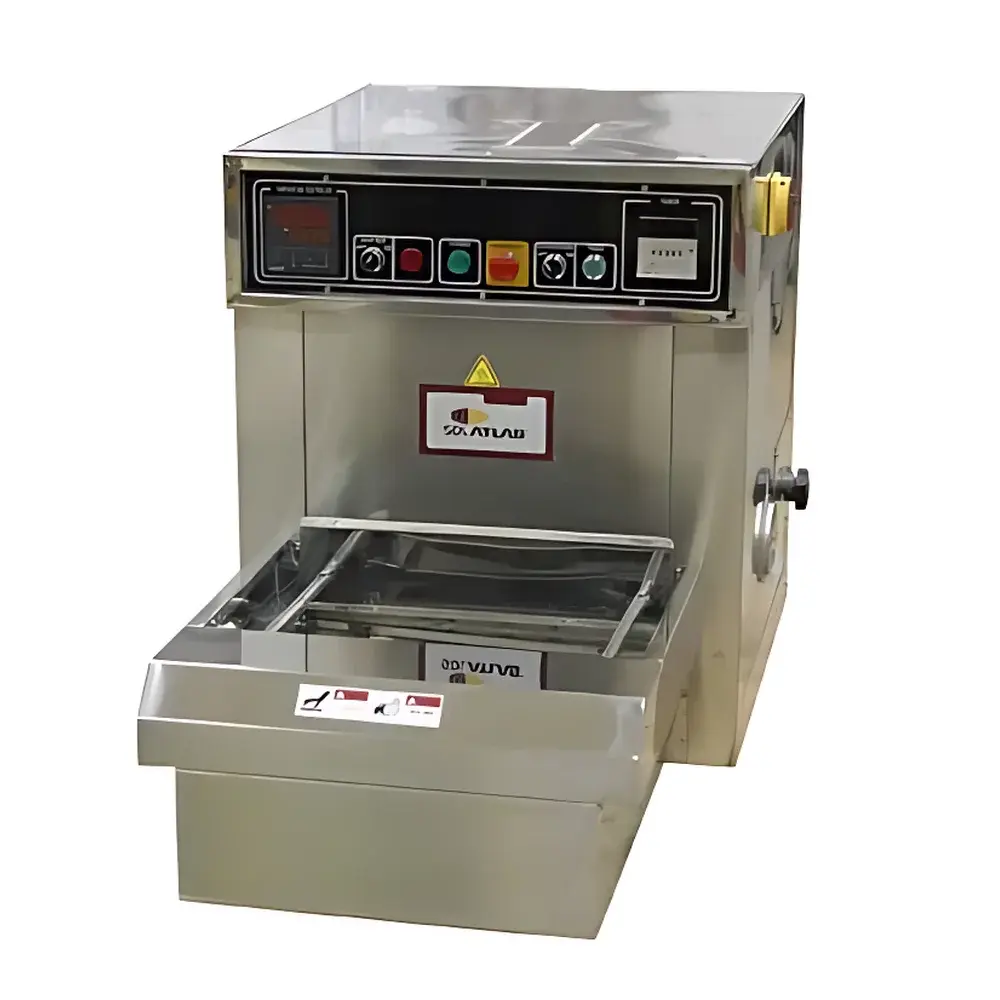
SDL Atlas D398 Desktop Stenter and Heat-Setting Oven
| Brand | SDL Atlas |
|---|---|
| Origin | Guangdong, China |
| Manufacturer Type | Manufacturer |
| Country of Origin | China |
| Model | D398 |
| Pricing | Upon Request |
| Application | Drying, Color Fixation, Baking, Thermosol Processing |
| Form Factor | Benchtop |
| Max Sample Size | 36 × 42 cm |
| Conveyor Mechanism | Automated Pin Chain Drive |
| Dwell Time Range | 10 s – 6 min (adjustable) |
| Heating Power | 6 kW |
| Temperature Range | 20–250 °C |
| Air Circulation | Forced convection fan system |
| Sample Holder | Interchangeable pin frame for variable fabric dimensions |
| Operation Mode | Batch (discontinuous) |
| Compatibility | Compatible with pneumatic padding mangle |
Overview
The SDL Atlas D398 Desktop Stenter and Heat-Setting Oven is a compact, benchtop-scale thermal processing instrument engineered for precise, repeatable heat treatment of textile specimens in R&D laboratories, quality control environments, and small-batch production validation. It operates on the principle of controlled convective heating combined with mechanical fabric tensioning—mimicking industrial stenter functionality at laboratory scale. Unlike conventional drying cabinets or hot plates, the D398 integrates a synchronized pin-chain conveyor system that maintains dimensional stability during thermal exposure, critical for evaluating dimensional change, colorfastness after heat treatment (e.g., ISO 105-P01), thermosol dye fixation (e.g., disperse dyes on polyester), and resin curing behavior. Its design conforms to fundamental textile testing requirements defined in ISO 139 (standard atmosphere), ISO 13934-1 (tensile strength), and AATCC Test Method 135 (dimensional change), ensuring data traceability and methodological alignment with global textile standards.
Key Features
- Benchtop footprint (approx. 750 × 650 × 550 mm) enables integration into constrained lab spaces without compromising functional capacity.
- Automated pin-chain drive system with digitally adjustable dwell time (10 seconds to 6 minutes in 1-second increments), supporting standardized exposure durations per ISO 105-P01, ISO 105-X11, and AATCC 23.
- 6 kW high-efficiency resistive heating assembly with dual-zone temperature control (±1.5 °C uniformity across chamber), calibrated to NIST-traceable references and validated per ASTM E220.
- Forced-air circulation via axial fan ensures rapid thermal equilibration and minimizes temperature gradients—critical for reproducible thermosol processing of synthetic fibers.
- Modular pin-frame assembly accommodates specimens up to 36 × 42 cm; interchangeable frames support narrow-width ribbons (e.g., 5 cm strips for shrinkage testing) or full-width swatches without re-clamping.
- Robust stainless-steel chamber interior with insulated double-wall construction reduces external surface temperature rise and improves energy efficiency.
Sample Compatibility & Compliance
The D398 accepts woven, knitted, nonwoven, and coated fabrics—including cotton, polyester, nylon, elastane blends, and technical textiles such as flame-retardant or hydrophobic finishes. Specimens are mounted taut using stainless-steel pins to prevent edge curling or puckering during heating—a prerequisite for accurate assessment of heat-induced shrinkage (ISO 6330), crease recovery (ISO 2313), or thermofixation stability. The instrument supports batch-mode operation aligned with ISO/IEC 17025 clause 7.2.2 (method validation) and is routinely employed in GLP-compliant textile labs for pre-production thermal process qualification. While not certified to IEC 61000-6-3 (EMC) or CE for full industrial deployment, its electrical safety design complies with GB 4706.1 (equivalent to IEC 60335-1) and includes overtemperature cut-off, ground-fault protection, and thermal fuse redundancy.
Software & Data Management
The D398 operates via an integrated digital controller with LCD interface, offering manual setpoint entry and real-time display of chamber temperature, dwell timer, and heater status. Though it lacks embedded PC connectivity or cloud-based logging, its analog/digital hybrid architecture supports external data acquisition via 4–20 mA or 0–10 V output signals (optional interface module). Users may integrate the unit into LIMS or ELN platforms using third-party analog-to-digital converters compliant with FDA 21 CFR Part 11 when audit trails and electronic signatures are required. Calibration records—including annual verification of thermocouple accuracy against reference RTD probes—are maintained per ISO/IEC 17025 Section 6.4.10.
Applications
- Thermosol fixation of disperse dyes on polyester and PES/cotton blends (AATCC 106, ISO 105-E01).
- Evaluation of heat-setting effects on dimensional stability of synthetic knits (ISO 6330, AATCC 135).
- Resin curing optimization for wrinkle-resistant cotton (e.g., DMDHEU-based finishes).
- Accelerated aging studies involving thermal oxidative degradation (ISO 18185-2).
- Pre-treatment conditioning prior to pilling, abrasion, or colorfastness testing.
- Process correlation between lab-scale D398 parameters and full-width industrial stenters (e.g., Monforts, Brückner).
FAQ
Is the D398 suitable for continuous processing?
No—the D398 is designed exclusively for discontinuous (batch) operation. Continuous web processing requires industrial-scale stenters with integrated feeding/unwinding systems.
Can the pin frame be customized for non-standard specimen geometries?
Yes—SDL Atlas offers optional custom pin frames with user-defined pin pitch, row count, and frame material (e.g., high-temp alloy for >220 °C applications).
What maintenance intervals are recommended for the heating elements and fan motor?
Heating elements require visual inspection every 500 operational hours; forced-air fan bearings should be lubricated quarterly and replaced every 2 years under typical lab usage.
Does the D398 meet ISO/IEC 17025 calibration traceability requirements?
Yes—when calibrated using NIST-traceable reference thermometers and documented per ISO/IEC 17025 Annex A.3, the unit satisfies metrological requirements for accredited textile testing laboratories.
Is exhaust ducting required for safe operation?
Ventilation is strongly recommended—especially during thermosol processing—to remove volatile organic compounds (VOCs) released from dye sublimation or resin decomposition; connection to a fume hood or dedicated extraction system is advised per OSHA 1910.1200.




