
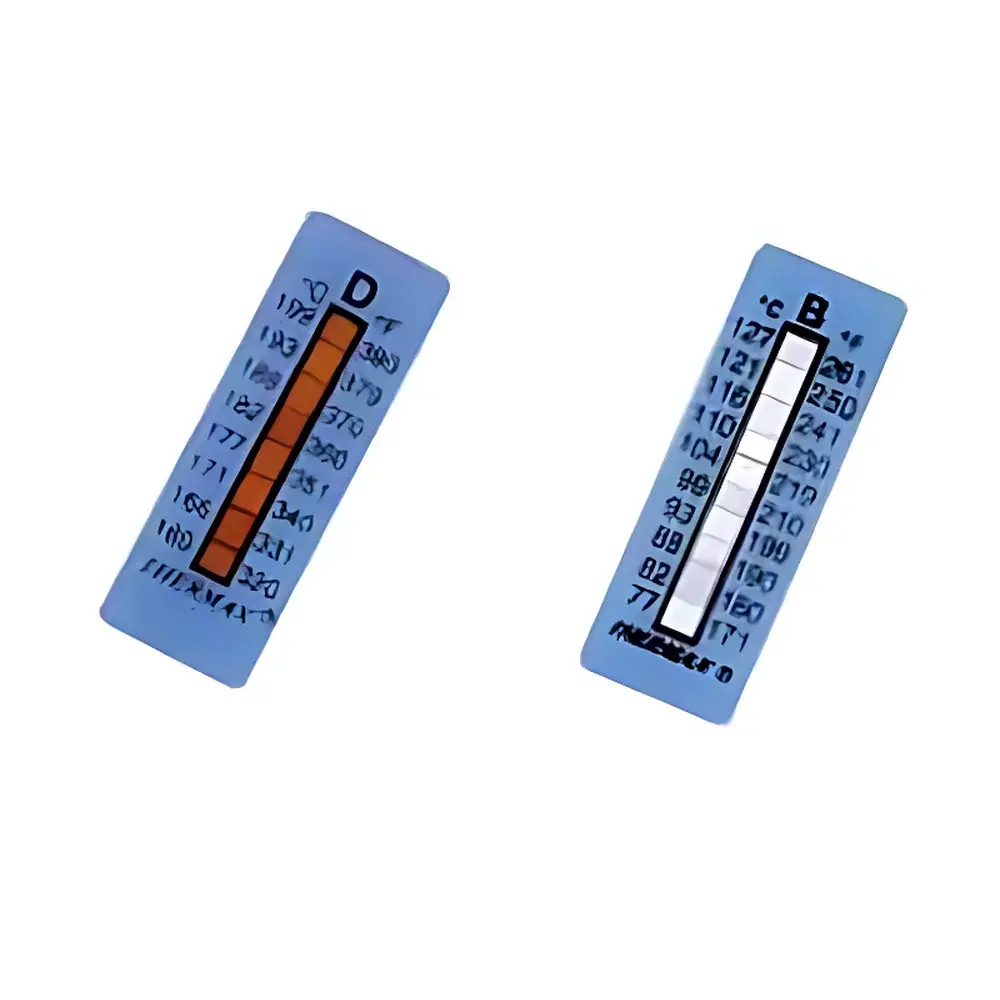
SDL Atlas D440 Temperature Indicator Strip
| Brand | SDL Atlas |
|---|---|
| Origin | Guangdong, China |
| Manufacturer Type | Manufacturer |
| Country of Origin | China |
| Model | D440 |
| Pricing | Upon Request |
| Temperature Range | 40–260 °C (105–500 °F) |
| Indication Principle | Thermochromic Phase Transition |
| Adhesion Type | Pressure-Sensitive Self-Adhesive Backing |
| Environmental Resistance | Resistant to Oil, Water, and Saturated Steam |
Overview
The SDL Atlas D440 Temperature Indicator Strip is a precision-engineered, single-use thermal monitoring device designed specifically for process validation and quality assurance in textile dyeing, printing, heat-setting, steaming, and curing operations. Unlike electronic data loggers or infrared thermometers—whose readings reflect instantaneous surface temperature—the D440 operates on irreversible thermochromic pigment technology. Each strip contains microencapsulated liquid crystal or leuco dye formulations that undergo a permanent, visible color transition at a pre-calibrated threshold temperature. Once activated, the color change records the *maximum temperature* experienced by the strip during exposure, providing objective, tamper-evident evidence of thermal history. This principle aligns with fundamental requirements of process qualification under ISO 9001 and ASTM D7518 (Standard Practice for Thermal Process Validation in Textile Finishing), where documenting peak thermal exposure is critical for reproducibility and compliance.
Key Features
- Irreversible thermochromic indication: Provides unambiguous visual confirmation of peak temperature attainment without ambiguity or reset capability.
- Wide operational range: Covers 40 °C to 260 °C (105 °F to 500 °F) in discrete increments—standard configurations include 40, 60, 80, 100, 120, 140, 160, 180, 200, 220, 240, and 260 °C variants.
- Industrial-grade adhesion: Features a pressure-sensitive acrylic adhesive backing engineered for reliable bonding to metal surfaces (e.g., autoclave walls, steam chamber interiors), ceramic rollers, and fabric substrates—even under high-humidity or condensing steam conditions.
- Chemical and environmental resilience: Validated resistance to textile processing media including alkaline scouring solutions, reducing agents (e.g., sodium hydrosulfite), reactive dye baths, silicone softeners, and saturated steam up to 3 bar(g).
- No power or calibration required: Fully passive operation eliminates battery dependency, firmware updates, or periodic recalibration—reducing total cost of ownership and operator training burden.
Sample Compatibility & Compliance
The D440 strip is routinely deployed in AATCC TM183 (Heat Resistance of Textiles), ISO 105-X11 (Colorfastness to Hot Pressing), and GB/T 3921 (Colorfastness to Washing) test setups to verify thermal exposure consistency across test specimens. Its compact footprint (typically 25 mm × 6 mm active area) allows placement adjacent to fabric samples without interfering with clamping mechanisms or thermal mass distribution. The substrate material complies with RoHS Directive 2011/65/EU and REACH Annex XVII restrictions on hazardous substances. While not an ISO/IEC 17025-accredited measurement standard, its use supports GLP-aligned documentation practices when integrated into validated thermal mapping protocols per ISO/IEC 17025 Clause 7.8.2 (Reporting of Results).
Software & Data Management
As a passive physical indicator, the D440 does not generate digital output or interface with software platforms. However, it integrates seamlessly into structured paper-based or LIMS-supported quality records: operators record strip batch numbers, application location, exposure duration, and observed color-change status directly into process logs. For audit readiness, photographs of activated strips—annotated with timestamp, lot number, and operator ID—serve as traceable evidence acceptable under FDA 21 CFR Part 11 (when captured via validated imaging workflows) and ISO 9001:2015 Clause 8.5.2 (Identification and Traceability). Calibration certificates for reference thermocouples used alongside D440 strips are recommended for cross-verification in critical validation studies.
Applications
- Steam autoclave cycle verification in reactive dye fixation processes
- Monitoring hot-can temperature profiles during thermosol dyeing of polyester
- Validating heat-setting parameters on stenter frames (e.g., dwell time at ≥190 °C)
- Mapping temperature uniformity across drying cylinders in rotary screen printing lines
- Confirming minimum cure temperature for resin-finishing applications (e.g., durable press treatments)
- Supporting root-cause analysis during shade variation incidents linked to thermal deviation
FAQ
Can the D440 strip be reused after cooling?
No. The thermochromic transition is chemically irreversible; once activated, the color change remains stable indefinitely and cannot be reset.
Does humidity affect accuracy?
No. The encapsulated pigments and protective laminate are specifically formulated to maintain thermal response fidelity under 100% relative humidity and direct steam contact.
How should strips be stored prior to use?
Store unopened packages at 15–25 °C in low-light conditions; avoid prolonged exposure to UV radiation or ambient temperatures exceeding 35 °C to prevent premature activation.
Is there a shelf life?
Yes. Unopened strips retain specification compliance for 24 months from date of manufacture when stored per instructions; lot-specific expiration dates are printed on packaging.
Can D440 replace thermocouples in process validation?
No. It complements—not substitutes—contact sensors. Use D440 for qualitative max-temp verification at specific points; use calibrated thermocouples or RTDs for continuous, quantitative thermal profiling per ISO 14644-3 or ASTM E2251.





