
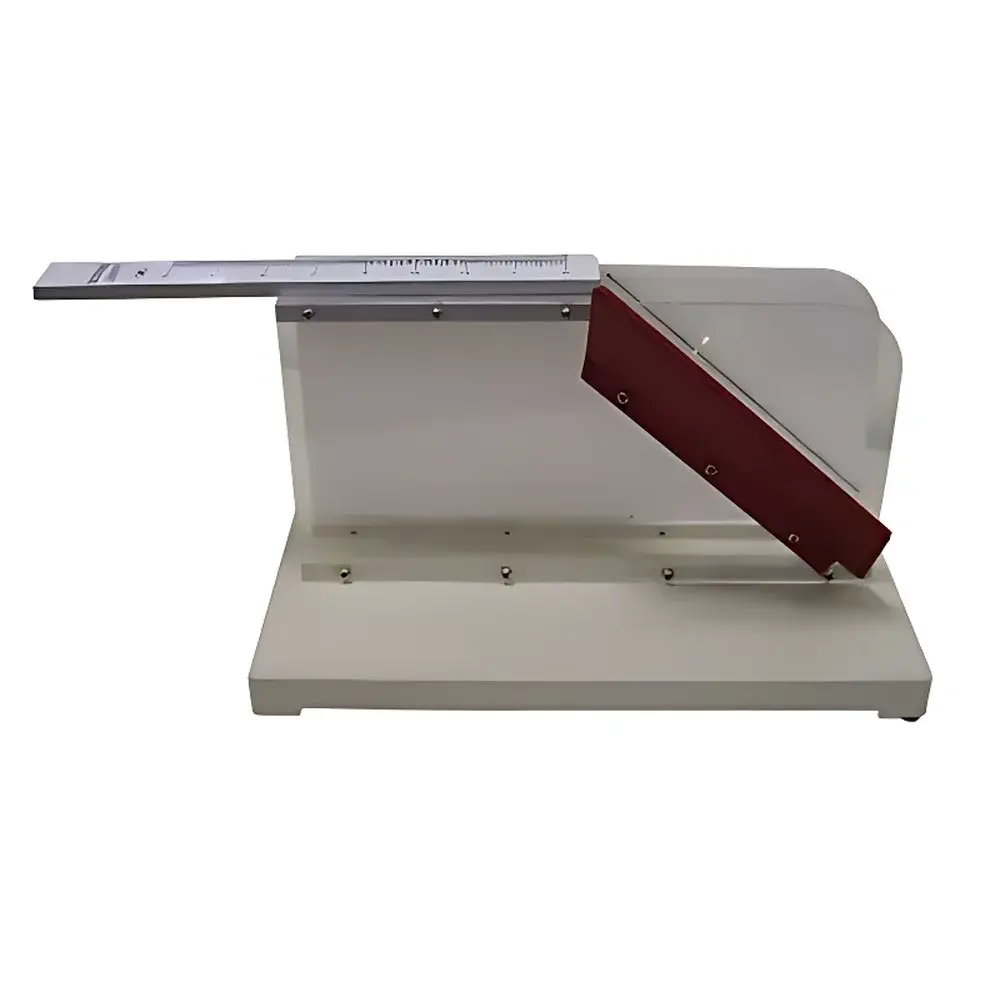
SDL Atlas M003B Fabric Stiffness Tester
| Brand | SDL Atlas |
|---|---|
| Model | M003B |
| Origin | Guangdong, China |
| Manufacturer Type | Direct Manufacturer |
| Regional Classification | Domestic (China) |
| Price Range | USD 7,000 – 14,000 |
Overview
The SDL Atlas M003B Fabric Stiffness Tester is an engineered instrument designed for quantitative mechanical evaluation of textile flexibility and resistance to bending deformation. It operates on the principle of controlled cantilever beam deflection, in accordance with standardized test methods including ASTM D1388 (Standard Test Method for Stiffness of Fabrics), ISO 2411 (Rubber- or plastics-coated fabrics — Determination of stiffness), and GB/T 18318.1–2009 (Textiles — Determination of fabric stiffness — Part 1: Cantilever method). The device measures the gravitational bending behavior of a fixed-length fabric strip clamped at one end, enabling derivation of three fundamental mechanical parameters: bending height (mm), bending rigidity (mg·cm), and bending modulus (g·cm²/cm). These metrics provide objective, repeatable indicators of handle, drape, and structural integrity—critical for quality control in apparel, home textiles, technical fabrics, and nonwovens.
Key Features
- Single-axis cantilever test platform with precision-machined stainless-steel support and calibrated scale (0.1 mm resolution)
- Adjustable specimen clamp with consistent 2.5 cm width and 15 cm free length per ASTM D1388 requirements
- Integrated angle-measuring protractor and digital height gauge for direct bending height readout
- Modular design allowing rapid setup and minimal operator training—no external power supply or software required
- Compliant with GLP-aligned documentation practices: all test conditions (temperature, RH, conditioning time) are manually recorded per ISO 139 and ASTM D1776
- Robust aluminum alloy frame with anti-vibration base, suitable for benchtop use in QC laboratories and textile mills
Sample Compatibility & Compliance
The M003B accommodates woven, knitted, nonwoven, coated, and laminated fabrics with thicknesses ranging from 0.1 mm to 3.0 mm and areal densities between 30 g/m² and 500 g/m². Specimen preparation follows ISO 139 conditioning (24 h at 20 ± 2 °C / 65 ± 4 % RH) prior to testing. Results are traceable to national metrological standards via factory calibration certificates (NIST-traceable reference weights and dimensional gauges included). The instrument meets essential safety and electromagnetic compatibility requirements per GB/T 18268.1–2010 (IEC 61326-1) for laboratory equipment. While not certified to CE or UKCA under full Machinery Directive scope, its mechanical operation falls outside high-risk classification when used as intended.
Software & Data Management
The M003B is a manual, analog-digital hybrid instrument: no embedded firmware or proprietary software is installed. All calculations—including bending rigidity (C = W × L³ / (4 × H)) and bending modulus (B = C / t³, where t = fabric thickness)—are performed externally using standardized spreadsheets compliant with ISO/IEC 17025 documentation requirements. Users may integrate results into LIMS or ERP systems via CSV export from validated Excel templates. Audit trails, operator ID, environmental logs, and calibration records are maintained manually in bound lab notebooks or electronic QA systems satisfying FDA 21 CFR Part 11 and EU Annex 11 expectations for paper-based or hybrid workflows.
Applications
- Quality assurance of finishing treatments (resin, softener, flame retardant) affecting hand feel
- Comparative analysis of fiber composition (e.g., cotton vs. polyester blends) and yarn twist effects on drape
- R&D validation of biodegradable or recycled textile substrates for stiffness retention after washing
- Pre-shipment inspection for OEM garment suppliers requiring ASTM D1388 pass/fail thresholds
- Academic research in textile mechanics, including correlation studies between bending modulus and Kawabata Evaluation System (KES-F) parameters
- Regulatory submission support for medical textiles (e.g., surgical drapes) where stiffness influences barrier performance and user ergonomics
FAQ
What standards does the M003B support out of the box?
ASTM D1388, ISO 2411, GB/T 18318.1–2009, and JIS L 1096 (Method D). Calibration verification tools and procedural checklists are provided.
Can the instrument measure both warp and weft directions?
Yes—specimens are cut parallel to warp and weft axes per standard practice; separate tests yield directional stiffness ratios critical for anisotropic fabric assessment.
Is third-party calibration service available?
SDL Atlas offers annual calibration services with accredited certificates (CNAS ISO/IEC 17025) and on-site verification upon request.
How is bending modulus calculated without automated software?
The instrument provides raw bending height (H) and specimen dimensions; users apply the classical Euler–Bernoulli beam equation using thickness (t) measured separately with a micrometer per ISO 5084.
Does the M003B require environmental controls during operation?
Testing must occur in a conditioned room meeting ISO 139 specifications (20 ± 2 °C, 65 ± 4 % RH); the instrument itself has no active climate regulation but includes a hygrometer mount for ambient monitoring.





