
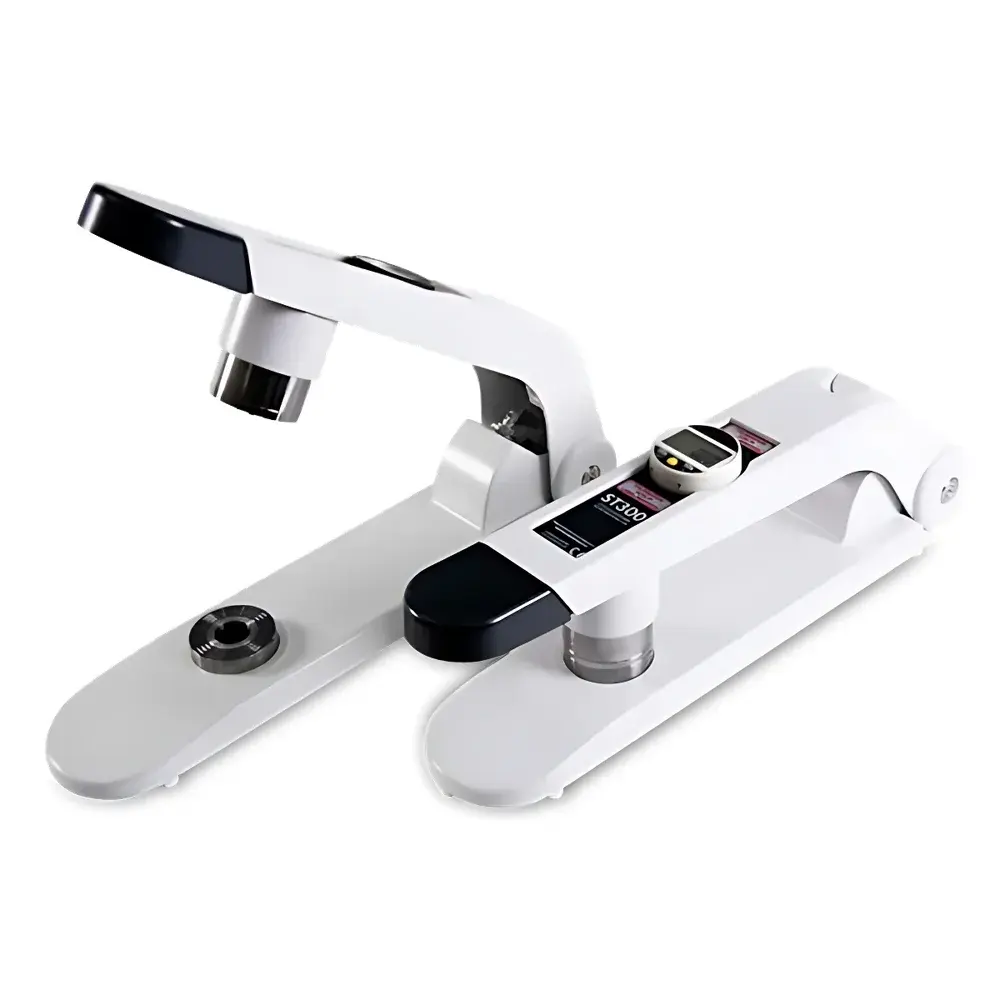
SDL Atlas M003C/E Fabric Softness Tester
| Brand | SDL Atlas |
|---|---|
| Origin | USA |
| Manufacturer Type | Manufacturer |
| Origin Category | Imported |
| Model | M003C/E |
| Price Range | USD 6,800 – 13,600 |
Overview
The SDL Atlas M003C/E Fabric Softness Tester is a precision mechanical instrument engineered for objective, repeatable quantification of fabric flexibility and drape resistance—critical parameters in textile and leather quality assurance. It operates on the principle of controlled bending deformation under standardized load application, conforming to the fundamental mechanics of beam deflection (Euler–Bernoulli theory) as adapted for thin, anisotropic planar materials. Unlike subjective hand-evaluation methods, this tester delivers traceable, operator-independent softness metrics by measuring the vertical displacement (deflection) of a conditioned fabric specimen clamped over a circular orifice of defined diameter (typically 25.4 mm or 1 in), while a calibrated plunger of smaller diameter applies a fixed static load (commonly 100 g or 200 g). The resulting deflection—expressed in millimeters or inches—is directly correlated with material compliance and serves as a robust proxy for perceived softness in end-use applications such as apparel, upholstery, technical textiles, and coated leathers.
Key Features
- Mechanically stable base frame with hardened steel anvil and precision-machined orifice plate, ensuring long-term dimensional integrity and minimal thermal drift
- Two measurement configurations: analog version with high-contrast vernier scale (0.1 mm resolution) and digital version with linear encoder-based displacement sensor (0.01 mm / 0.0005 in resolution)
- Interchangeable orifice plates (standard 25.4 mm; optional 12.7 mm or 50.8 mm) to accommodate varying fabric stiffness ranges and industry-specific test protocols
- Calibrated loading system using certified stainless-steel weights or pneumatic actuation (M003C/E variant), compliant with ASTM D1388 and ISO 20219 for fabric stiffness testing
- Adjustable specimen clamping mechanism with uniform pressure distribution to prevent edge distortion and ensure consistent test area exposure
- Designed for ambient laboratory conditions (20 ± 2 °C, 65 ± 5 % RH); includes conditioning support bracket for pre-test environmental stabilization per ISO 139 and ASTM D1776
Sample Compatibility & Compliance
The M003C/E accommodates flat, non-stretchable or low-extensibility specimens up to 150 mm × 150 mm, including woven and knitted fabrics, laminated textiles, coated leathers, synthetic membranes, and nonwovens. Specimen thickness must fall within 0.1–5.0 mm to ensure reliable contact geometry and avoid buckling artifacts. The instrument meets mechanical calibration traceability requirements per ISO/IEC 17025 when used with accredited verification procedures. Test methodology aligns with ASTM D1388 (Stiffness of Fabrics), ISO 20219 (Determination of fabric stiffness by bending length method), and GB/T 18318 (Chinese national standard for fabric bending rigidity). Optional documentation packages support GLP-compliant audit trails and 21 CFR Part 11–ready data export when integrated with validated software modules.
Software & Data Management
While the base M003C/E operates as a standalone mechanical tester, the digital variant (M003C/E-D) interfaces via RS-232 or USB to SDL Atlas’ proprietary TestWorks™ software suite. This platform enables automated data capture, statistical analysis (mean, SD, CV%), pass/fail threshold evaluation, batch reporting, and export to CSV, PDF, or XML formats. All measurement events—including timestamp, operator ID, sample ID, environmental readings (if external hygrothermograph linked), and raw deflection values—are logged with immutable audit trail functionality. Software validation documentation (IQ/OQ/PQ protocols) is available upon request for regulated environments requiring FDA or EU MDR compliance.
Applications
- Quality control of garment fabrics during finishing (e.g., softener efficacy validation post-resin treatment)
- Comparative assessment of coating formulations on technical textiles (e.g., flame-retardant, waterproof, or antimicrobial finishes)
- R&D screening of novel fiber blends and biodegradable substrates for tactile performance optimization
- Leather goods manufacturing: evaluating flex retention after tanning, dyeing, or surface embossing
- Automotive interior suppliers: verifying seat cover and headliner fabric compliance with OEM stiffness specifications
- Medical textile development: characterizing drapability and conformability of surgical gowns and wound-contact layers
FAQ
What standards does the M003C/E comply with?
ASTM D1388, ISO 20219, GB/T 18318, and ISO 139 for conditioning.
Can the instrument be calibrated in-house?
Yes—using NIST-traceable gauge blocks and certified deadweights; full calibration procedure and certificate templates are included.
Is the digital version compatible with LIMS integration?
Yes, via configurable ASCII output or OPC UA interface when deployed with TestWorks™ Enterprise Edition.
Does the tester require compressed air or electrical power?
The analog model is fully manual and requires no utilities; the digital version uses 100–240 VAC, 50/60 Hz, and optional pneumatic loading requires 6 bar clean dry air.
How often should verification checks be performed?
Daily before use (zero check and reference weight verification); full calibration recommended annually or per ISO/IEC 17025 internal schedule.
Related Products






