
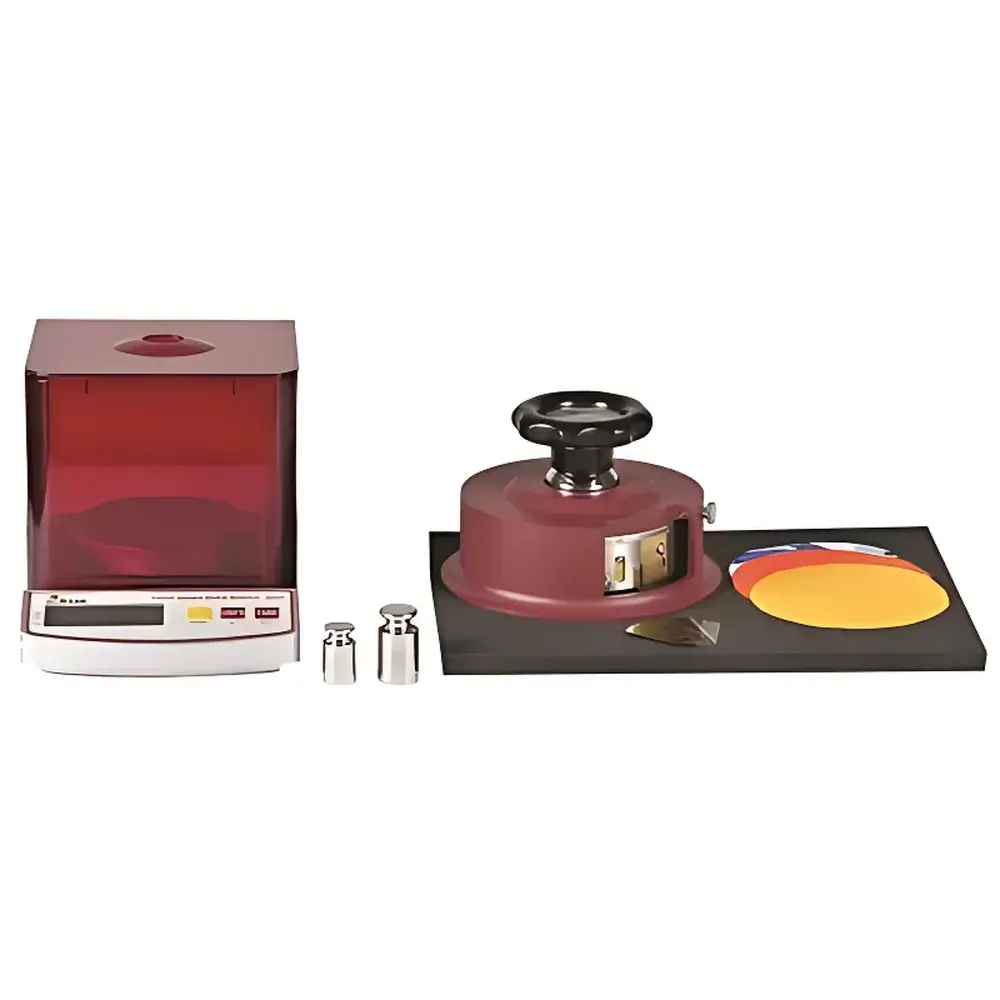
SDL Atlas M236/1-2 Fabric GSM Testing Kit
| Brand | SDL Atlas |
|---|---|
| Origin | Guangdong, China |
| Manufacturer Type | Direct Manufacturer |
| Country of Origin | China |
| Model | M236/1-2 |
| Price Range | USD 7,000 – 14,000 |
Overview
The SDL Atlas M236/1-2 Fabric GSM Testing Kit is a precision-engineered, manually operated system designed for the standardized determination of fabric mass per unit area—commonly expressed as grams per square meter (g/m²) or ounces per square yard (oz/yd²). This measurement, known internationally as “Grams per Square Meter” (GSM), is a fundamental physical property in textile quality control, production consistency verification, and material specification compliance. The kit implements a gravimetric principle: a precisely defined sample area is cut from the fabric using calibrated circular dies, then weighed on an integrated electronic balance. The instrument’s firmware automatically converts the measured mass into the selected unit (g/m² or oz/yd²) based on the fixed geometric area of the die—eliminating manual calculation errors and ensuring traceable, repeatable results across laboratories and production shifts.
Key Features
- Two-configurable system: M236/1 includes a dedicated 100 cm² circular cutter (5 mm cutting depth), cutting pad, and 12 spare blades; M236/2 features a universal handle-mounted press with a 68.35 mm (2.698 in) diameter die, plunger, and 100 reusable cutting pads—optimized for high-throughput sampling across variable fabric thicknesses and stiffness.
- Integrated battery-powered electronic balance with pre-programmed GSM conversion logic—no external software or PC required. Auto-zeroing, tare function, and dual-unit display (g/m² / oz/yd²) support global reporting requirements.
- Calibrated die geometry ensures ISO 3801:1977 and ASTM D3776-22 compliant sample area definition. The 100 cm² die (M236/1) corresponds directly to the standard test area for woven and knitted fabrics; the 68.35 mm die (M236/2) yields a nominal area of 36.6 cm², enabling multi-point sampling per ASTM D3776 Method C (average of eight specimens).
- Robust aluminum alloy frame and ergonomic handle design ensure long-term dimensional stability and operator fatigue reduction during repetitive testing cycles.
- No consumables beyond replacement blades—cutting pads are reusable and resistant to compression set after repeated use under standard laboratory conditions.
Sample Compatibility & Compliance
The M236/1-2 kit accommodates a broad spectrum of textile substrates including woven, knitted, nonwoven, coated, laminated, and technical fabrics up to 5 mm in thickness. Its mechanical cutting architecture avoids thermal distortion or fiber pull-out associated with laser or heated cutters—preserving sample integrity for accurate mass measurement. The system conforms to key international textile testing standards: ISO 3801 (determination of mass per unit area of textiles), ASTM D3776 (standard test methods for mass per unit area of fabric), and GB/T 4669 (Chinese national standard for textile GSM testing). It supports GLP-aligned workflows through documented calibration intervals (balance certified to OIML R76 Class II), traceable die dimension certification, and operator-recorded test logs.
Software & Data Management
While the M236/1-2 operates as a standalone hardware system without embedded connectivity, its balance module stores up to 99 measurement records with timestamp and unit selection metadata. Data export is supported via optional RS-232 interface (available upon request) for integration into LIMS or QA databases. All firmware operations comply with basic data integrity principles: no editable raw weight values post-measurement, immutable unit conversion logic, and no user-accessible calibration parameter modification without physical security key authentication—aligning with FDA 21 CFR Part 11 expectations for audit-ready manual instruments in regulated textile supply chains.
Applications
- Quality assurance in spinning, weaving, knitting, and finishing mills—verifying batch-to-batch GSM uniformity against purchase specifications.
- Technical textile development—evaluating coating weight distribution, laminated layer contribution, or substrate density changes after functional finishing (e.g., flame retardant, waterproofing).
- Third-party testing laboratories performing accredited GSM determinations per ISO/IEC 17025 requirements.
- R&D departments correlating GSM with tensile strength, air permeability, or thermal resistance in fabric performance modeling.
- Apparel and home textile buyers conducting incoming inspection per AATCC TM147 or retailer-specific QC protocols.
FAQ
What is the certified accuracy class of the integrated balance?
The balance meets OIML R76 Class II specifications (maximum permissible error ±0.02 g at 100 g load), validated annually per ISO/IEC 17025 calibration procedures.
Can the M236/2 be used for GSM testing of very stiff or coated fabrics?
Yes—the universal handle design delivers consistent 1.5 kN pressing force, sufficient for cutting dense upholstery fabrics, PVC-coated polyester, and industrial geotextiles when paired with fresh blades and flat cutting pads.
Is calibration documentation provided with shipment?
Each unit ships with a factory calibration certificate for both the balance and die diameter (measured via coordinate measuring machine), traceable to NIM (National Institute of Metrology, China).
How many test repetitions are recommended per fabric lot per ISO 3801?
ISO 3801 specifies a minimum of four specimens taken at equal intervals across the fabric width; the M236/2 configuration supports eight-specimen averaging per ASTM D3776 Method C for enhanced statistical confidence.
Are replacement blades and cutting pads available as consumables?
Yes—SDL Atlas supplies OEM-matched stainless-steel blades (part #M236-BL-12) and polyurethane cutting pads (part #M236-CP-100) with full dimensional and hardness certification.





