
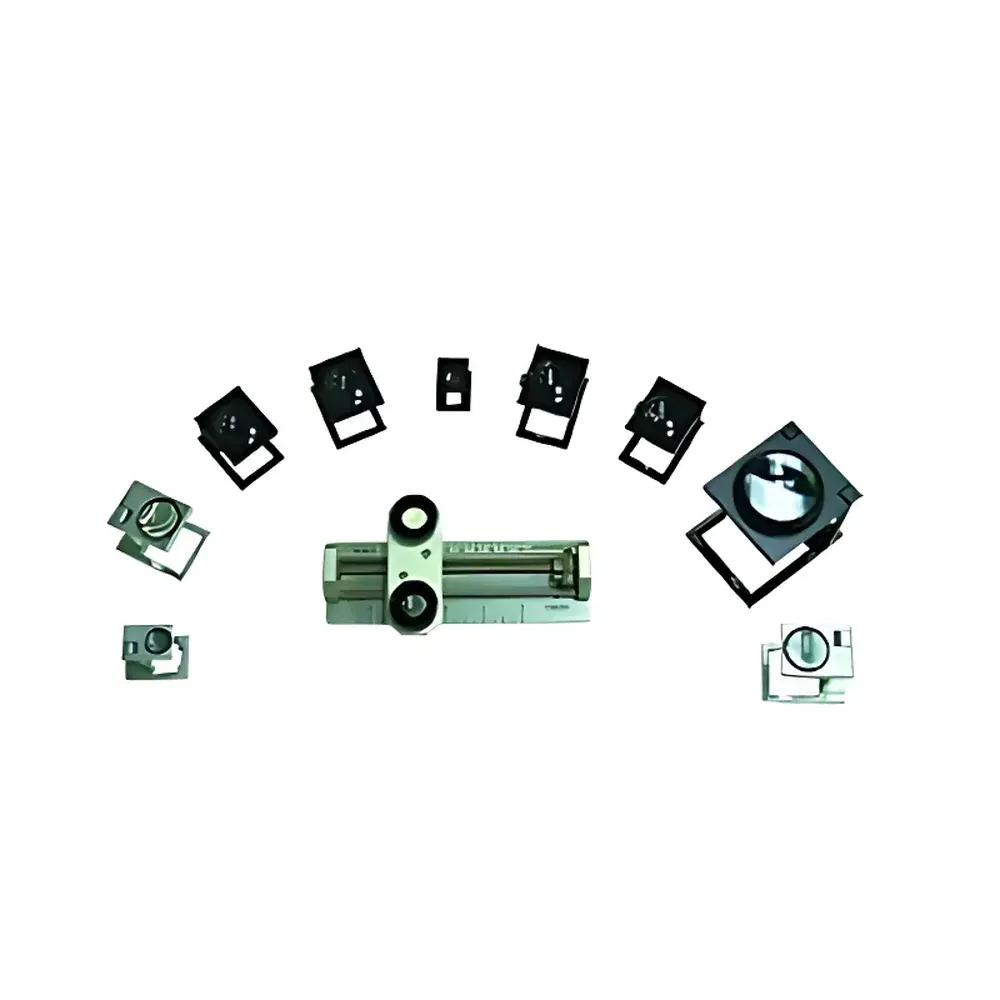
SDL Atlas M240C-M Fabric Density Microscope
| Brand | SDL Atlas |
|---|---|
| Origin | USA |
| Manufacturer Type | Original Equipment Manufacturer (OEM) |
| Import Status | Imported |
| Model | M240C-M |
| Price Range | USD 1,400 – 4,200 |
Overview
The SDL Atlas M240C-M Fabric Density Microscope is a precision optical instrument engineered for quantitative analysis of fabric construction parameters—specifically, the number of warp and weft yarns per linear centimeter or inch (commonly referred to as “ends per inch” [EPI] and “picks per inch” [PPI]). It operates on the principle of high-contrast transmitted-light microscopy combined with calibrated reticle eyepieces and standardized magnification (typically 10× objective with 10× wide-field eyepiece), enabling direct visual enumeration of interlaced yarns under consistent illumination. Designed for textile quality control laboratories, R&D facilities, and third-party testing centers, the M240C-M delivers repeatable, operator-independent density measurements critical for compliance with ASTM D3775, ISO 7211-2, and GB/T 4668 standards. Its rigid mechanical stage, coaxial coarse/fine focus mechanism, and adjustable LED cold-light source ensure stable imaging across diverse fabric types—from sheer synthetics to heavy-duty canvas—without thermal distortion or glare-induced counting errors.
Key Features
- Optically calibrated dual-scale reticle eyepiece (metric and imperial) for simultaneous EPI/PPI readout without unit conversion
- Adjustable intensity LED illuminator with uniform Köhler illumination geometry, minimizing shadowing and enhancing yarn edge definition
- Fixed-stage mechanical platform with vernier-controlled X-Y translation (0.1 mm resolution) for precise positioning across fabric repeats
- Robust aluminum alloy housing and anti-vibration base, certified to meet IEC 60068-2-6 for operational stability in industrial lab environments
- No moving optics—objective lens and condenser are factory-aligned and sealed, eliminating collimation drift during routine use
- Compliant with ISO/IEC 17025 calibration traceability requirements; supplied with NIST-traceable verification certificate
Sample Compatibility & Compliance
The M240C-M accommodates flat, non-stretch, and moderately extensible woven fabrics up to 5 mm thickness and 150 mm × 150 mm footprint. It supports transparent, semi-transparent, and opaque specimens via optimized backlighting configuration. Fabrics requiring pre-conditioning per ISO 139 (standard atmosphere: 20 ± 2 °C, 65 ± 4 % RH) must be equilibrated prior to measurement. The instrument meets essential safety and EMC requirements per UL 61010-1 and EN 61326-1. Measurement procedures align with ASTM D3775 (Standard Test Method for Fabric Count of Woven Fabric), ISO 7211-2 (Textiles — Woven Fabrics — Determination of Number of Threads per Unit Length — Part 2: Microscope Method), and AATCC Test Method 20A. Data records generated during routine operation satisfy GLP documentation integrity expectations when paired with laboratory SOPs.
Software & Data Management
The M240C-M is a standalone optical instrument with no embedded digital imaging or software interface. All measurements are performed manually using the reticle and recorded in laboratory notebooks or LIMS-integrated spreadsheets. However, its design enables seamless integration into digital QA workflows: users may pair it with third-party USB microscopes (e.g., AmScope MU1403) for image capture and annotation, provided such add-ons comply with internal IT security policies. Raw count data—when entered into validated Excel templates or LIMS platforms—supports audit trails, statistical process control (SPC) charting (e.g., X-bar/R charts), and trending analysis across batches. For regulated environments subject to FDA 21 CFR Part 11, electronic records derived from M240C-M measurements require supplementary validation of the associated data entry and review processes—not the microscope itself, as it produces no electronic output.
Applications
- Verification of fabric specification conformance during incoming raw material inspection
- Process validation in weaving and finishing lines to detect loom timing or reed wear anomalies
- Comparative analysis of prototype vs. production fabric density for technical textile development
- Root-cause investigation of dimensional instability, shrinkage, or pilling behavior linked to yarn spacing
- Supporting claims substantiation for certifications including OEKO-TEX Standard 100 and GOTS (Global Organic Textile Standard)
- Training tool for textile engineering students and QC technicians in fundamental fabric structure evaluation
FAQ
Is the M240C-M suitable for knitted fabric density assessment?
No. It is specifically designed for woven constructions where warp and weft yarns form orthogonal, countable arrays. Knit loop density requires alternative methods such as image analysis of scanned stitch structures.
Does the instrument include calibration tools or reference standards?
Yes—each unit ships with a certified glass stage micrometer (100 µm division) and a woven fabric reference slide with documented EPI/PPI values, traceable to NIST SRM 2051.
Can it measure fabrics with metallic or reflective yarns?
Yes, but optimal contrast requires adjustment of LED intensity and use of the included neutral density filter to suppress specular reflection.
What maintenance is required beyond routine cleaning?
Annual verification of reticle scale accuracy and illumination uniformity is recommended; SDL Atlas offers accredited on-site verification services per ISO/IEC 17025.
Is operator training included with purchase?
SDL Atlas provides a comprehensive user manual, ASTM/ISO procedure checklists, and optional virtual instructor-led training (ILT) covering measurement uncertainty estimation and inter-laboratory reproducibility protocols.







