
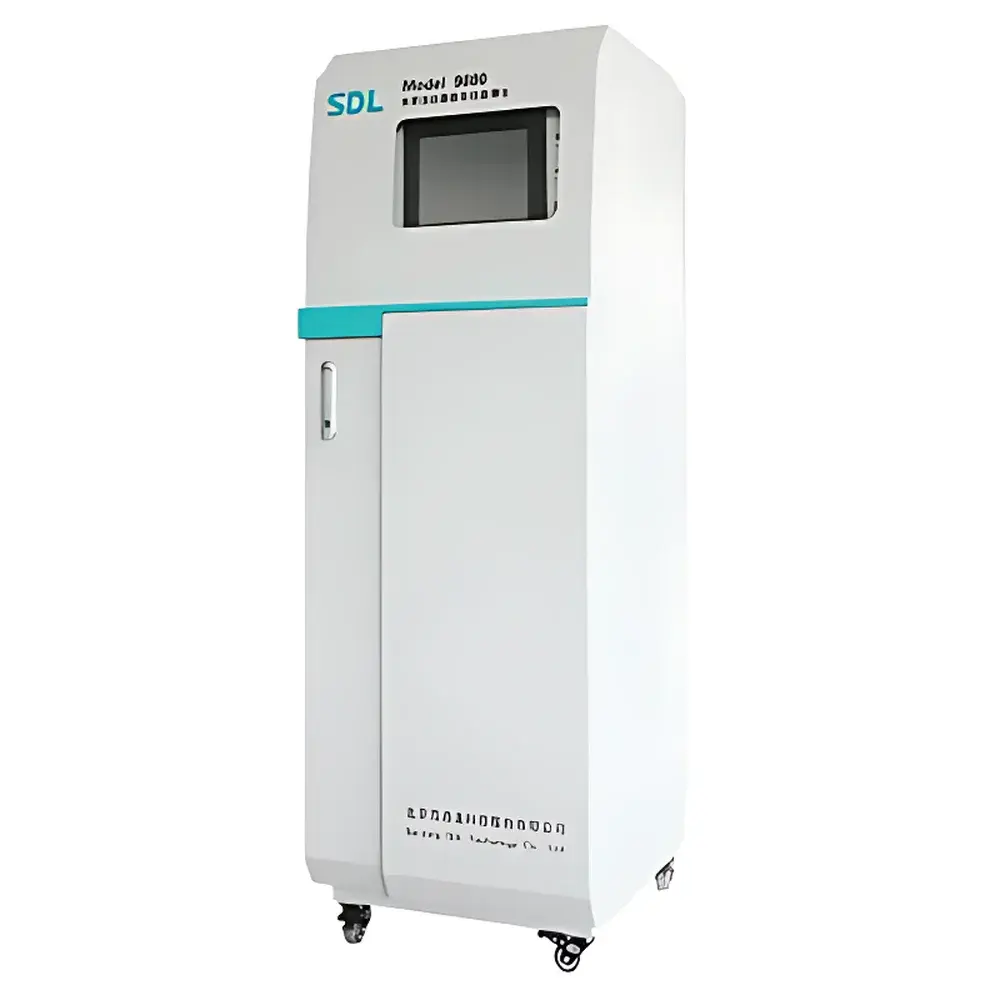
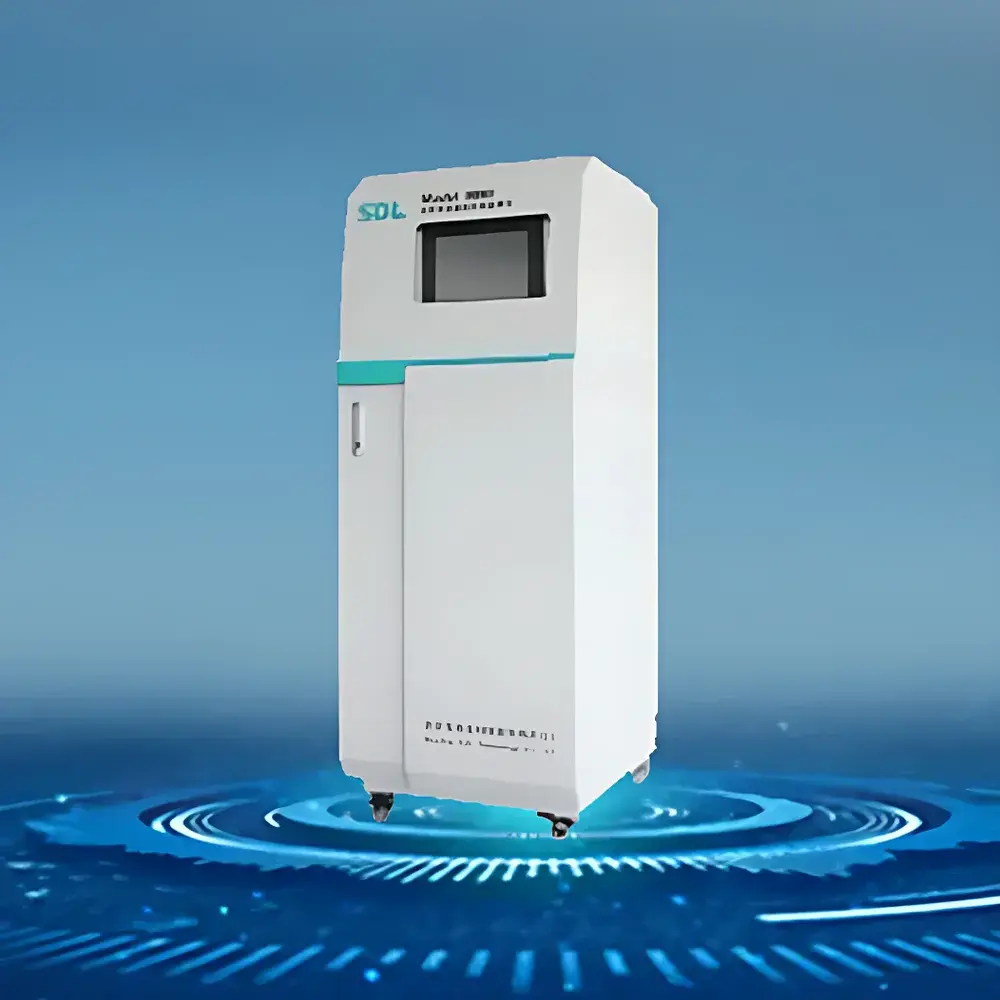
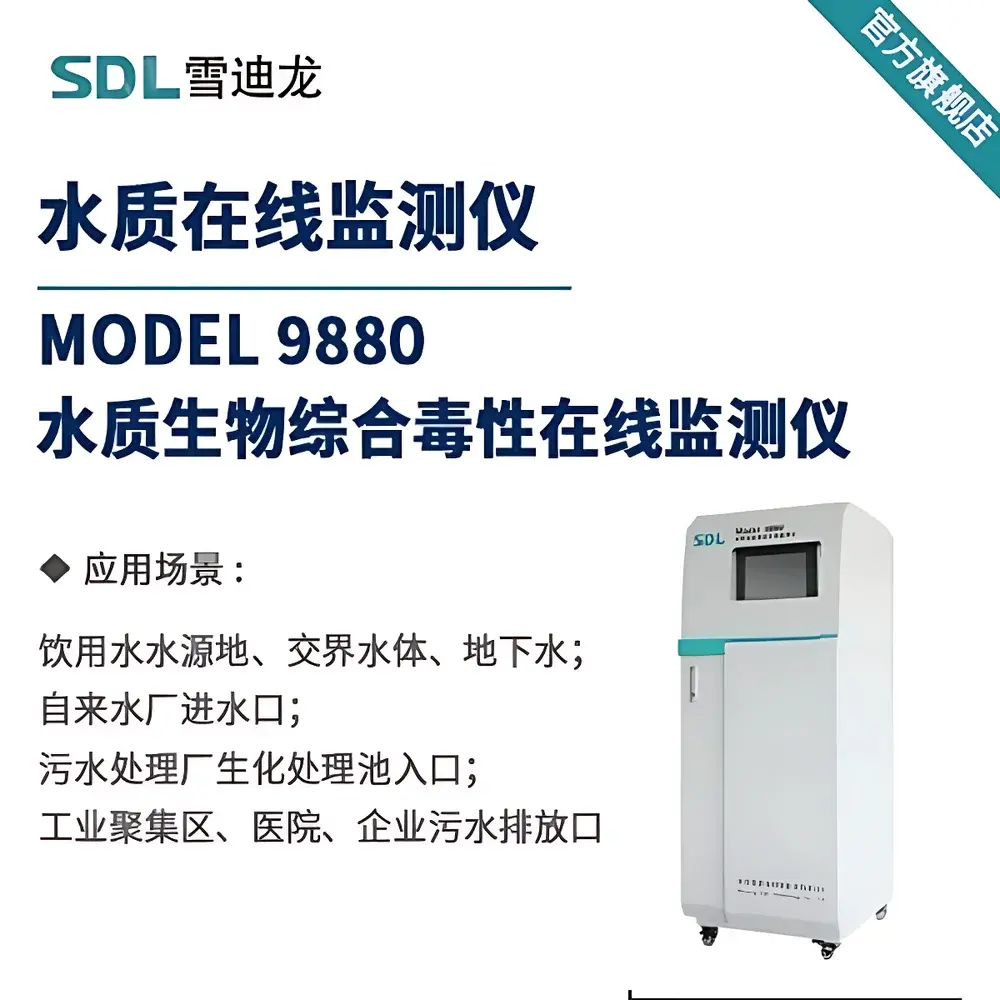
SDL MODEL 9880 Integrated Water Toxicity Analyzer Based on Microbial Fuel Cell Technology
| Brand | SDL |
|---|---|
| Origin | Beijing, China |
| Manufacturer Type | Direct Manufacturer |
| Country of Origin | China |
| Model | MODEL 9880 |
| Instrument Type | Online Analyzer |
| Biological Sensing Element | Electroactive Bacteria (Exoelectrogens) |
| Repeatability | ±30% |
| Detection Principle | Microbial Fuel Cell (MFC)-Based Current Response to Toxic/Nutrient Perturbations |
| Communication Interfaces | RS485, Modbus TCP, 4–20 mA Output, Optional 3G/4G LTE |
| Display Interface | Chinese-Language Touchscreen HMI |
| Compliance Framework | Designed for ISO 11348-3 and ASTM D5664 alignment in operational context |
Overview
The SDL MODEL 9880 Integrated Water Toxicity Analyzer is an online, real-time biosensor system engineered for continuous monitoring of acute toxicity and organic load fluctuations in aqueous environments. It operates on the well-established principle of microbial fuel cell (MFC) electrochemistry: electroactive bacteria—primarily exoelectrogenic strains such as Shewanella oneidensis or Geobacter sulfurreducens—are immobilized on a conductive anode surface within a flow-through bioreactor chamber. As these microorganisms metabolize biodegradable organic substrates present in the sample stream, electrons are transferred extracellularly to the anode, generating a measurable current proportional to metabolic activity. This current—converted via precision load resistance into a stable voltage signal—is continuously digitized and processed using a calibrated dose–response algorithm. A rapid decline in output voltage indicates inhibition of microbial respiration due to toxicant exposure (e.g., heavy metals, pesticides, cyanides), while a sustained increase reflects elevated bioavailable organic carbon (BOD-like response). Unlike endpoint assays (e.g., luminescent Vibrio fischeri tests), the MODEL 9880 delivers dynamic, second-by-second electrophysiological feedback without reagent consumption per measurement cycle.
Key Features
- Dual independent MFC sensor modules with automatic cross-validation logic—enabling fault-tolerant operation and early drift detection
- Integrated temperature-compensated signal conditioning circuitry optimized for ambient water temperature ranges (5–35 °C operational envelope; calibration stability maintained across 10–30 °C)
- Robust optical and electrochemical interference rejection: validated performance under turbidity up to 500 NTU and true color ≤ 200 Pt-Co units without pre-filtration
- Low-maintenance biocatalyst retention design—biofilm stabilization matrix extends functional sensor lifetime beyond 12 months under continuous operation
- Onboard data logging with ≥30-day local storage (microSD), timestamped at 1-second resolution, compliant with GLP audit-trail requirements
- Modular hardware architecture supporting field-upgradable firmware and plug-in communication modules (RS485/Modbus RTU, Ethernet/IP, optional LTE-M for remote telemetry)
Sample Compatibility & Compliance
The MODEL 9880 is validated for use with raw surface water, groundwater, treated drinking water influents, secondary wastewater effluents, and industrial discharge streams containing total suspended solids (TSS) ≤ 150 mg/L. It meets functional equivalency benchmarks referenced in ISO 11348-3 (inhibition of bacterial bioluminescence) and ASTM D5664 (standard test method for determining toxicity of aqueous samples using Photobacterium phosphoreum)—though it employs a fundamentally distinct, metabolism-coupled transduction mechanism. While not certified under EPA Method 1604 or ISO 9308-1, its output correlates strongly with conventional toxicity surrogates (e.g., EC50 values derived from Daphnia magna assays) when deployed in paired validation studies. The system supports routine verification using potassium ferricyanide (positive control) and copper sulfate (toxic reference standard), traceable to NIST SRM 1643e for conductivity-based calibration anchoring.
Software & Data Management
Embedded firmware implements IEC 62443-3-3 Level 1 security controls, including role-based user access (Admin/Operator/Viewer), encrypted local storage, and secure boot integrity verification. Data export supports CSV and XML formats with embedded metadata (sensor ID, UTC timestamps, QA/QC flags). Remote configuration and diagnostics are accessible via HTTPS-enabled web interface or dedicated SCADA integration toolkit (OPC UA server included). All measurement events—including sensor health status, voltage baseline shifts >5%, and communication timeouts—are logged with immutable timestamps, satisfying FDA 21 CFR Part 11 requirements for electronic records when deployed in regulated utilities infrastructure. Firmware updates undergo SHA-256 signature validation prior to installation.
Applications
- Early-warning monitoring at drinking water source intakes (rivers, reservoirs, karst aquifers) for accidental or intentional contamination events
- Real-time assessment of biotoxicity breakthrough in granular activated carbon (GAC) or ozone-biofiltration trains
- Process control feedback at wastewater treatment plant influent channels—differentiating shock loads (toxic inhibition) from surge loads (nutrient-driven activity spikes)
- Compliance verification at industrial outfalls subject to multi-parameter discharge permits (e.g., textile, pharmaceutical, electroplating sectors)
- Long-term ecological trend analysis in transboundary river monitoring networks where chemical speciation data are sparse but biological impact signals remain critical
FAQ
What biological mechanism underpins the toxicity response?
The system relies on respiratory inhibition of obligate exoelectrogens—metabolically active biofilms that couple organic oxidation directly to extracellular electron transfer. Toxicants disrupt membrane integrity, cytochrome function, or quinone pool dynamics, causing immediate, reversible current suppression.
Does the analyzer require daily reagent replenishment?
No consumables are required during normal operation. Only periodic replacement of the anode biofilm cartridge (recommended annually) and electrolyte buffer solution (every 6 months) constitute scheduled maintenance.
Can it distinguish between heavy metal toxicity and organic pesticide exposure?
Not at the compound-specific level. It reports integrated acute toxicity units (TU) reflecting net physiological impact on the defined microbial consortium—complementary to targeted chemical analysis, not substitutive.
Is remote calibration supported?
Yes—reference standard challenges (e.g., CuSO4 spike) can be initiated remotely via command protocol; full calibration curves must be established onsite during commissioning.
What cybersecurity certifications does the device hold?
It complies with IEC 62443-3-3 SL1 and includes TLS 1.2 encryption for all network communications; formal certification documentation is available upon request for utility-grade procurement reviews.
Related Products







