
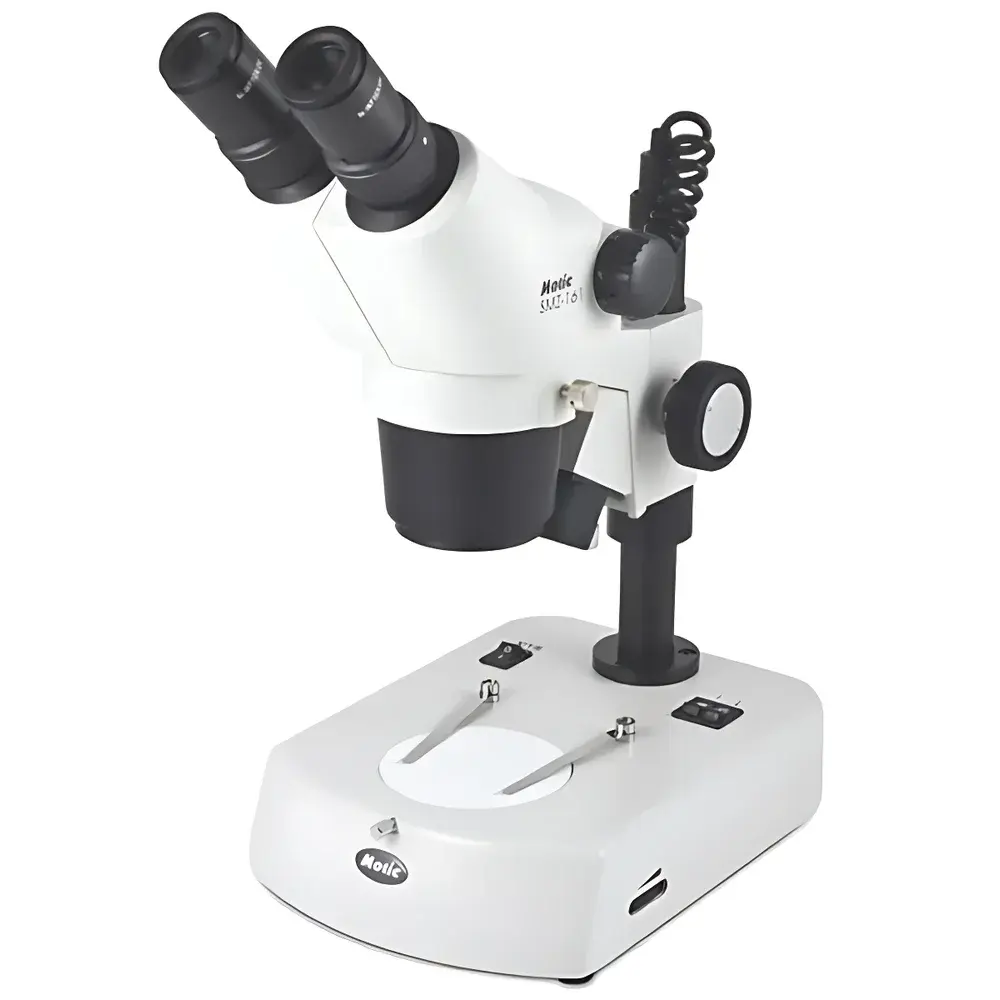
SDLATLAS G208G Stereo Microscope
| Brand | SDLATLAS |
|---|---|
| Origin | USA |
| Manufacturer Type | Original Equipment Manufacturer (OEM) |
| Import Status | Imported |
| Model | G208G |
| Pricing | Available Upon Request |
Overview
The SDLATLAS G208G Stereo Microscope is an ergonomically engineered dual-optical-path instrument designed for high-fidelity three-dimensional visualization of macro- to meso-scale surface structures. Based on the Greenough optical principle—featuring two separate, angled objective paths and matched eyepieces—the G208G delivers true stereoscopic depth perception without optical duplication or image fusion artifacts. Unlike compound microscopes optimized for thin-sectioned biological specimens, this system is purpose-built for industrial inspection, quality control, and materials evaluation where working distance, large field-of-view, and natural parallax are critical. Its 10–40× continuous zoom magnification range (achieved via a precision-calibrated zoom lens assembly) supports real-time observation of textile fiber architecture, weave geometry, yarn twist uniformity, and surface defect morphology under both incident and transmitted illumination. The modular optical train accommodates standardized 23.2 mm diameter eyepieces and interchangeable objectives, ensuring long-term serviceability and alignment stability per ISO 8578:2020 (Microscopes — Requirements for stereo microscopes).
Key Features
- Ergonomic 360° rotating binocular head with adjustable interpupillary distance (55–75 mm) and diopter compensation (±5 dpt) for extended operator comfort during routine QC workflows.
- Dual-illumination system: Integrated coaxial LED incident illuminator (5,000 K CCT, >90 CRI) for surface texture contrast enhancement; removable base-mounted transmitted light stage with diffuser plate and intensity control (0–100% linear dimming).
- Zoom optics with parfocal design: Maintains focus across the full 10×–40× magnification range without refocusing—critical for comparative analysis of heterogeneous textile samples.
- Large working distance (≥110 mm at 10×, ≥32 mm at 40×) enables unobstructed manipulation of bulky fabric swatches, knitted assemblies, or non-planar composite specimens using standard laboratory tools.
- Mechanically robust stand with dual-arm articulating boom (load capacity: 2.5 kg) and precision-machined aluminum housing compliant with IP42 environmental rating for dust resistance in shared lab or production-floor environments.
Sample Compatibility & Compliance
The G208G accommodates specimens up to 200 mm × 150 mm × 80 mm (L×W×H) on its stage platform, supporting raw fibers, dyed yarns, woven/knitted fabrics, nonwovens, coated textiles, and laminated composites. Its optical configuration conforms to ASTM D1777-21 (Standard Test Method for Thickness of Textile Materials), enabling direct correlation between visual assessment and standardized thickness measurement protocols. All optical components utilize BK7 glass substrates with MgF₂ anti-reflective coatings meeting MIL-C-48497A specifications. The instrument complies with IEC 61000-6-3 (EMC emission limits) and IEC 61000-6-2 (immunity requirements), and carries CE marking for conformity with EU Machinery Directive 2006/42/EC and Low Voltage Directive 2014/35/EU.
Software & Data Management
While the G208G operates as a standalone optical instrument, it integrates seamlessly with third-party digital imaging systems via C-mount (1×) or 0.5× reduction adapter. When coupled with SDLATLAS-certified USB3.0 CMOS cameras (e.g., SC-12M-USB3), users can capture calibrated still images and time-lapse video sequences with metadata tagging (magnification, illumination mode, timestamp). Image acquisition software supports DICOM-compliant export, histogram-based contrast optimization, and pixel-to-micron calibration using NIST-traceable stage micrometers. Audit trails—including user login, capture parameters, and annotation history—are retained in accordance with FDA 21 CFR Part 11 requirements when deployed in regulated textile testing laboratories operating under ISO/IEC 17025:2017 accreditation.
Applications
- Textile quality assurance: Identification and documentation of weaving defects (floats, mis-picks, broken ends), knitting faults (laddering, dropped stitches), dyeing inconsistencies (barre, streaking), and finishing anomalies (pilling, fuzzing, coating delamination).
- Fiber morphology analysis: Visual discrimination of natural vs. synthetic fiber cross-sections, crimp frequency quantification in wool, and staple length estimation in cotton lint.
- Technical textile inspection: Evaluation of geotextile aperture size distribution, filter media pore integrity, and medical textile suture knot security.
- R&D documentation: Pre- and post-abrasion surface imaging, seam strength failure mode analysis, and microstructural evolution tracking during accelerated aging tests.
- Forensic fiber comparison: Side-by-side simultaneous viewing of questioned and known fiber samples using dual-stage mounting options.
FAQ
What is the maximum field of view at lowest magnification?
At 10× total magnification (10× eyepiece × 1× objective), the field of view diameter is 32 mm, enabling full-width observation of standard ASTM D5034 grab-test fabric specimens.
Can the G208G be used with polarized light accessories?
Yes—optional strain-free polarization kits (linear polarizer + analyzer) are available as field-upgrade modules for birefringence assessment of synthetic filaments and crystalline polymer domains.
Is the illumination system compatible with fluorescence observation?
No—this model lacks excitation filters and UV-capable optics; fluorescence capability requires dedicated epifluorescence stereo platforms.
Does the instrument support motorized zoom or focus?
Not by default; manual zoom and coarse/fine focus controls are standard. Motorized Z-axis drive and programmable zoom modules are available as OEM-configurable options upon request.
What calibration documentation is provided?
Each unit ships with a factory calibration certificate traceable to NIST standards, including verification of magnification accuracy (±1.5%), resolution limit (≥450 lp/mm at 40×), and illumination uniformity (>85% across FOV).




