
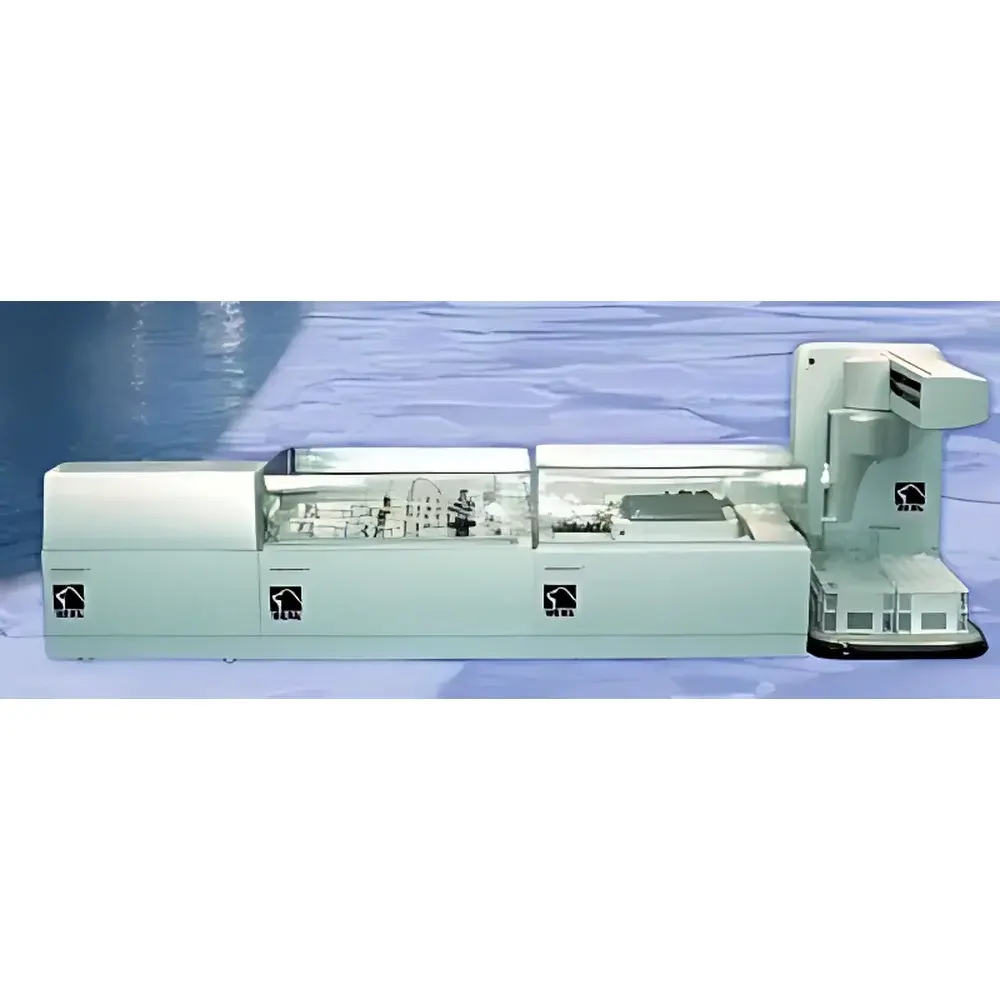
SEAL AA3 High-Performance Flow Injection Analyzer for NPK and Multi-Element Fertilizer Analysis
| Brand | SEAL |
|---|---|
| Origin | Germany |
| Instrument Type | Continuous Flow Analyzer (CFA) |
| Detection Principles | Colorimetric Spectrophotometry (NH₄⁺, NO₃⁻, PO₄³⁻, K⁺, Ca²⁺, B, SO₄²⁻, Urea) |
| Sample Throughput | Up to 50 samples/h (per channel) |
| Reagent Consumption | 50 µL – 2 mL per determination |
| Precision (RSD) | NH₃-N: 0.02–0.04% |
| P (available P) | 0.02–0.04% |
| K | 0.03–0.05% |
| Compliance | ASTM D5178, ISO 11261, ISO 13878, EN 15972, AOAC 971.22, USP <731> |
Overview
The SEAL AA3 High-Performance Flow Injection Analyzer for NPK and Multi-Element Fertilizer Analysis is a fully automated, modular continuous flow analyzer engineered for precision quantification of nitrogen (N), phosphorus (P), and potassium (K), alongside complementary macronutrients and micronutrients—including calcium (Ca), boron (B), sulfate (SO₄²⁻), and urea—in solid and liquid fertilizer matrices. Based on standardized segmented flow analysis (SFA) and colorimetric spectrophotometric detection, the system implements rigorously validated chemistries aligned with international reference methods including ISO 11261 (total N by Kjeldahl digestion followed by distillation and titration or photometric detection), ISO 13878 (total N by combustion), EN 15972 (water-soluble and citric acid–soluble P), and AOAC 971.22 (potassium by flame photometry or ion-selective electrode post-extraction). The AA3 platform replaces labor-intensive wet-chemistry workflows with reproducible, operator-independent determinations—reducing analyst exposure to hazardous reagents while ensuring traceability, audit readiness, and compliance with GLP/GMP laboratory practices.
Key Features
- Modular architecture supporting up to six independent analytical channels—each configurable for specific nutrient determinations (e.g., NH₄⁺, NO₃⁻, total N post-digestion, orthophosphate, total P, K⁺, Ca²⁺, B, SO₄²⁻, urea)
- Integrated sample introduction via programmable XYZ autosampler with 100–200 position capacity and temperature-controlled rack options for stabilized sample integrity
- Dual-wavelength photometers (520 nm, 660 nm, 700 nm, 880 nm) with ±0.5 nm wavelength accuracy and <0.001 AU absorbance resolution for high-fidelity colorimetric quantitation
- On-board digestion module (optional) for automated persulfate or sulfuric-peroxide oxidation of organic nitrogen and phosphorus prior to detection
- Real-time flow monitoring with pressure sensors and bubble detection to ensure uninterrupted segment integrity and prevent carryover
- Self-cleaning fluidic pathways using programmable backflush cycles and air segmentation to minimize cross-contamination between samples
- Compliance-ready firmware supporting 21 CFR Part 11–compliant electronic signatures, audit trails, and user access levels (admin/operator/auditor)
Sample Compatibility & Compliance
The AA3 accommodates diverse fertilizer sample types—including granular NPK blends, liquid suspensions, compost extracts, digestates, and foliar sprays—following standardized preparation protocols (e.g., ISO 11260 for water-soluble extraction, ISO 13879 for citric acid solubility testing). All method sequences are pre-validated against ISO/IEC 17025 requirements for method verification, linearity (r² ≥ 0.999 over 0–1000 mg/L ranges), limit of detection (LOD ≤ 0.05 mg/L for NH₄⁺; ≤ 0.02 mg/L for PO₄³⁻), and robustness across matrix variability. System validation documentation includes IQ/OQ/PQ reports, calibration curve archives, and daily performance qualification (DPQ) logs—all exportable in PDF or CSV format. The analyzer meets CE marking requirements and supports full integration into LIMS environments via ASTM E1384-compliant HL7 or XML data exchange.
Software & Data Management
SEAL’s AQ2 software provides a validated, Windows-based control interface with intuitive workflow configuration, real-time chromatogram visualization, and integrated calculation engines for stoichiometric conversion (e.g., P → P₂O₅ × 2.29, K → K₂O × 1.20). All raw absorbance data, peak integration parameters, calibration history, and QC flagging (e.g., drift correction, outlier rejection per Grubbs’ test) are stored in an encrypted SQL database with automatic daily backup and versioned archiving. Audit trail records capture timestamped actions—including method edits, calibration updates, result approvals, and user logins—with immutable hashing to prevent tampering. Reports comply with ISO/IEC 17025 clause 7.8.2 and may be exported in PDF/A-1b format for regulatory submission.
Applications
- Quality control of compound fertilizers (NPK blends) per ISO 8157 and national registration standards (e.g., EPA 40 CFR Part 152, EU Fertilising Products Regulation (EU) 2019/1009)
- Batch release testing for ammonium nitrate, monoammonium phosphate (MAP), and potassium chloride formulations
- Regulatory compliance testing for heavy metals co-extraction (when coupled with ICP-OES sample introduction)
- Research applications in agronomic trials assessing nutrient release kinetics and stabilization efficiency of slow-release formulations
- Environmental monitoring of leachate and runoff from agricultural sites for nutrient loading assessment (per OECD 308 guidelines)
FAQ
What digestion methods are supported for total nitrogen and total phosphorus analysis?
The AA3 accepts pre-digested samples (e.g., Kjeldahl, Dumas, or microwave-assisted persulfate oxidation) and optionally integrates an on-board high-temperature digestion unit for automated oxidation of organic N and P prior to colorimetric detection.
Can the system quantify urea without interference from ammonium?
Yes—using diacetyl monoxime (DAM) chemistry at 100 °C with selective masking agents, the AA3 achieves baseline separation of urea from NH₄⁺ in complex matrices with <2% cross-sensitivity.
Is method transfer possible from legacy segmented flow systems?
All AA3 methods are defined in human-readable protocol files (.aqm) and include full reagent recipes, timing diagrams, and calibration templates—enabling direct import and validation against existing SOPs.
How is calibration maintained across extended unattended runs?
The system executes automatic recalibration every 20 samples using dual-point standard verification, with drift compensation applied to subsequent results if deviation exceeds ±1.5% of mid-range standard response.
Does the analyzer support multi-element simultaneous analysis?
While each channel operates sequentially, up to six independent streams can run in parallel—enabling true concurrent measurement of N, P, K, Ca, B, and SO₄²⁻ within a single 60-minute cycle when configured with dedicated modules.
Related Products





