
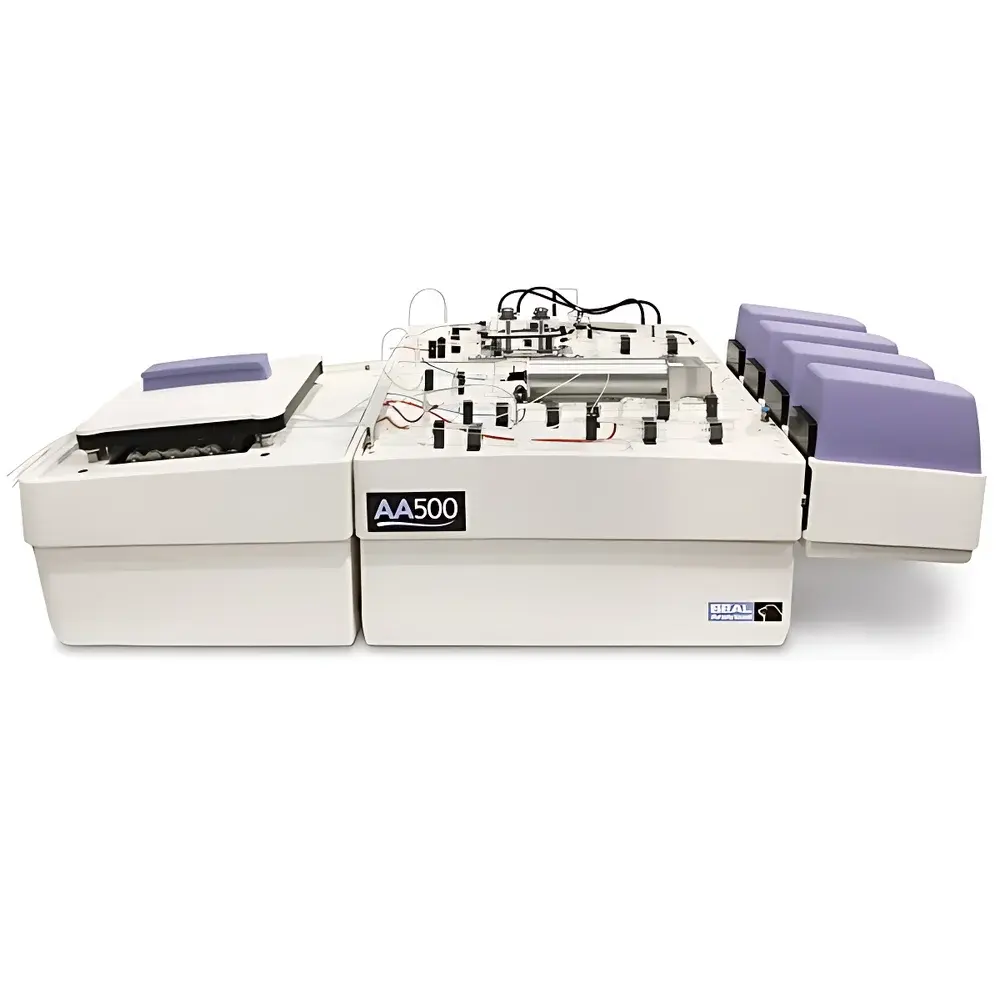
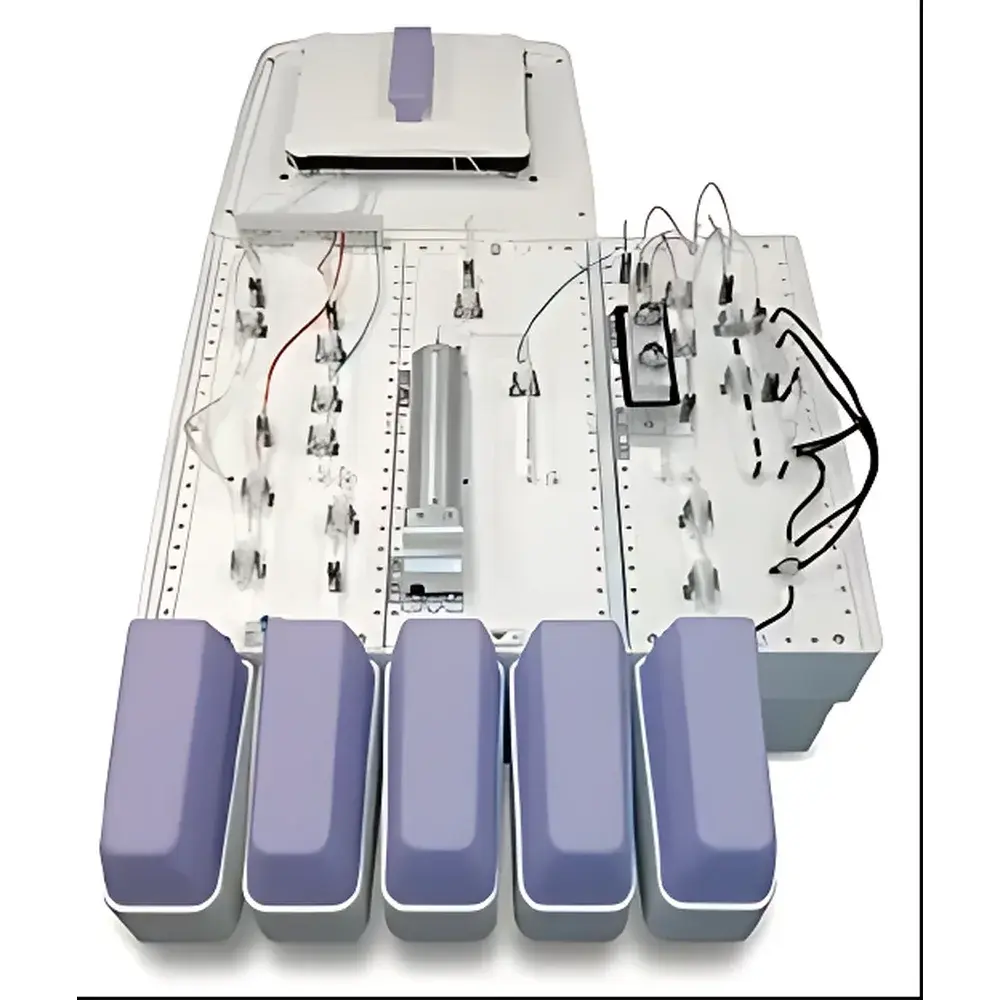
SEAL AA500 Continuous Flow Analyzer
| Brand | SEAL |
|---|---|
| Origin | Germany |
| Model | AA500 |
| Product Type | Continuous Flow Analyzer |
| Wavelength Range | 250–1000 nm |
| Sample Capacity | 180 positions / 120 cups |
| Reagent Positions | 34 |
| Flow Cell Path Length | 10–50 mm (selectable) |
| Light Source | LED |
Overview
The SEAL AA500 Continuous Flow Analyzer represents a generational advancement in segmented-flow continuous flow analysis (CFA), engineered for high-throughput, regulatory-compliant wet-chemistry quantification across environmental, food, agricultural, and industrial laboratories. Based on the well-established CFA principle—where discrete air segments separate sample and reagent streams within chemically inert glass tubing to eliminate carryover and ensure precise reaction timing—the AA500 integrates digital actuation, modular thermal control, and optical detection into a compact, single-chassis architecture. Unlike discrete batch analyzers or flow-injection systems, the AA500 maintains strict hydrodynamic segmentation under programmable flow rates, enabling reproducible kinetic reactions (e.g., colorimetric, enzymatic, distillation-coupled, or UV-digestion-based assays) with sub-microliter precision. Its design adheres to foundational principles of ISO 8289-1:2021 (water quality — determination of nutrients by continuous flow analysis) and supports method validation frameworks required under EPA Methods 353.2, 365.2, and AOAC Official Methods of Analysis®.
Key Features
- Modular, fully integrated chassis housing all fluidic, thermal, optical, and control subsystems—no external pumps, heaters, or manifolds required.
- Digital-controlled, Peltier-based heating blocks with ±0.2 °C stability for online digestion (up to 120 °C), distillation, and thermostated reaction zones.
- Computer-actuated peristaltic pump system accommodating up to 34 individual pump tubes; pump head pressure and rotation speed are software-adjustable for optimized segment formation and cleaning cycles.
- Electromagnetically actuated air injection valves synchronized precisely with pump rotation—eliminating mechanical wear and ensuring consistent bubble spacing (±0.5 s timing tolerance) critical for zone definition and dispersion control.
- Auto-shutdown and leak detection: real-time pressure monitoring triggers immediate pump stoppage and safe fluid evacuation upon anomaly detection.
- AS-series autosamplers with configurable rack formats (1–4 probe configurations), supporting 120- or 180-position trays; samples may be added mid-run without interrupting analysis.
- Optional automated dilution valve and up to 15 independent reagent selection valves for multi-analyte method sequencing.
Sample Compatibility & Compliance
The AA500 accommodates aqueous, digested, distilled, and filtered matrices from diverse sample types—including wastewater, soil extracts, tobacco homogenates, milk supernatants, grain digests, and beverage filtrates—without hardware modification. All wetted components (glass coils, flow cells, mixing tees) are constructed from borosilicate glass or PTFE-lined stainless steel to ensure chemical inertness and visual process monitoring. The system is validated for compliance with ISO/IEC 17025:2017 (general requirements for competence of testing and calibration laboratories), supports audit-ready electronic records per FDA 21 CFR Part 11 (when used with compliant LIMS integration), and implements full GLP/GMP traceability through timestamped method logs, calibration history, and operator authentication. Pre-validated application modules align with USEPA, ASTM D5179, DIN EN ISO 11905-1, CORESTA Recommended Methods, and Chinese national standards (e.g., HJ 636–2012 for TN, HJ 665–2013 for NH₃-N).
Software & Data Management
Control and data acquisition are managed via SEAL’s proprietary Analytical Studio™ software—a Windows-based platform featuring intuitive workflow scripting, real-time chromatogram visualization, peak integration with baseline correction algorithms, and customizable report generation. The software enforces method version control, user role-based access (admin/operator/auditor), and automatic metadata capture (including instrument status, ambient temperature, reagent lot numbers, and calibration curve parameters). Raw absorbance data, processed concentrations, QC flags, and audit trails are exportable in CSV, PDF, or XML formats compatible with enterprise LIMS and ELN systems. Optional 21 CFR Part 11 add-on provides electronic signatures, biometric login support, and immutable record archiving.
Applications
The AA500 delivers validated quantitative results for over 80 analytes across regulated sectors. In environmental labs, it performs simultaneous determination of NO₃⁻, NO₂⁻, NH₄⁺, PO₄³⁻, SiO₂, CN⁻, S²⁻, Cl⁻, SO₄²⁻, COD, DOC, hardness, and alkalinity in surface water, effluent, and sludge extracts. Food and beverage applications include B-vitamins, ascorbic acid, nitrate/nitrite in cured meats, free amino nitrogen in wort, bitterness units (IBU) in beer, and preservatives (benzoate, sorbate) in soft drinks. Agricultural testing covers Kjeldahl nitrogen, phosphate, potassium, calcium, magnesium, and micronutrients in plant tissue and fertilizer solutions. Tobacco analysis includes nicotine, total sugars, reducing sugars, volatile alkaloids, and nitrosamines precursors. Clinical and dairy applications extend to lactose, urea, alkaline phosphatase, free fatty acids, and vitamin A/C in raw and processed milk.
FAQ
What distinguishes continuous flow analysis (CFA) from flow injection analysis (FIA)?
CFA relies on segmented, air-isolated zones within continuous carrier streams to enable controlled reaction times and minimize dispersion—ideal for slow kinetic reactions (e.g., distillation, digestion, enzyme incubation). FIA uses unsegmented, transient injection peaks and is better suited for rapid reactions.
Can the AA500 perform online UV digestion or dialysis?
Yes—optional UV digestion modules (254 nm) and membrane-based dialyzers integrate directly into the fluidic path and are controlled via the same software interface.
Is method transfer from AA3-HR possible?
All AA3-HR methods are natively supported; hardware upgrades preserve legacy method files, calibration curves, and sequence templates without revalidation.
How is photometric accuracy maintained over time?
The dual-beam LED photometer self-calibrates before each run using reference and sample beam synchronization; drift compensation occurs automatically during measurement using internal dark-current and zero-reference routines.
What maintenance intervals are recommended?
Pump tubing replacement every 3–6 months (depending on usage), annual verification of thermal block accuracy and photometer linearity, and quarterly cleaning of glass manifolds using dilute nitric acid—documented in the included Preventive Maintenance Logbook.
Related Products





