
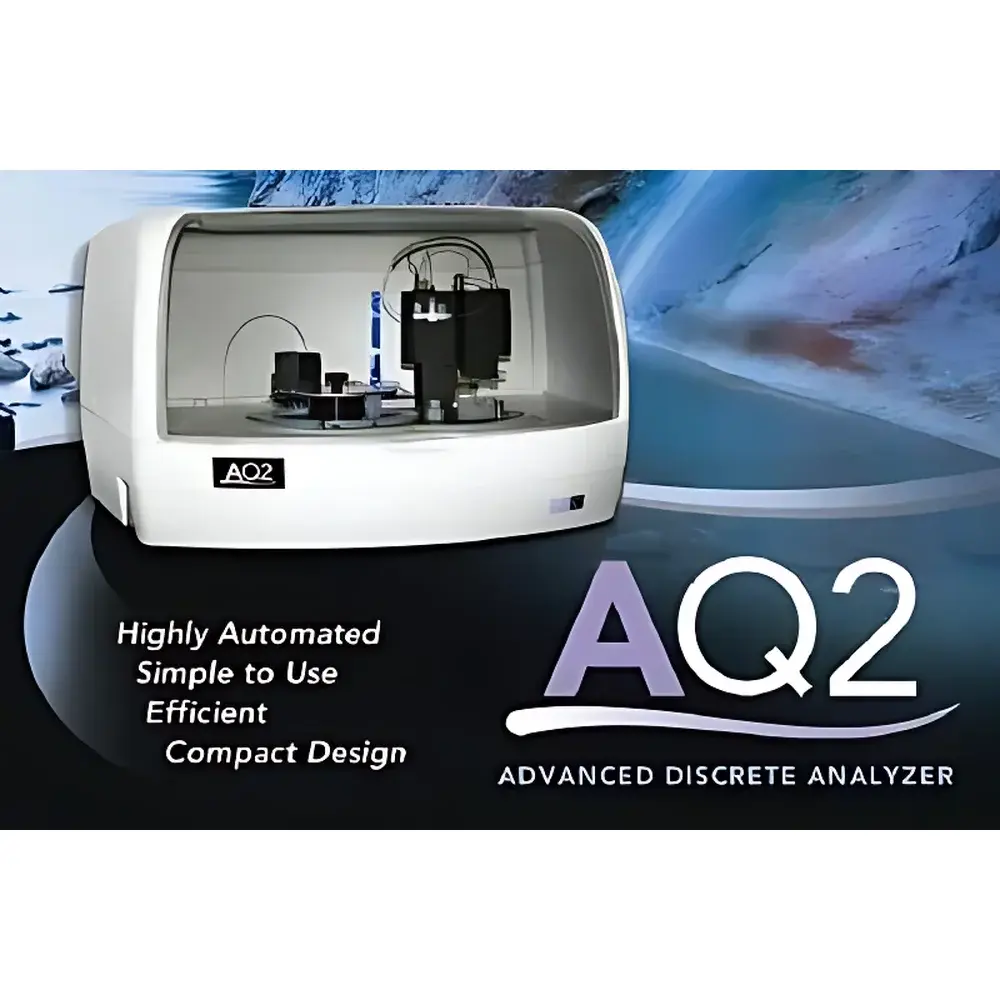
SEAL AQ2 Discrete Analyzer
| Brand | SEAL |
|---|---|
| Origin | Germany |
| Model | AQ2 |
| Product Type | Discrete Analytical System |
| Sample Volume | 3–500 µL per test |
| Reagent Consumption | 250 µL per test |
| Wavelength Range | 400–900 nm |
| Flow Cell | 20 mm thermostatted quartz cuvette |
| Sample Capacity | 100 positions |
| Reagent Positions | 15 × 45 mL refrigerated vials |
| Reaction Time | Up to 16 min |
| Power Supply | 100–250 V, 50/60 Hz, 450 W |
| Dimensions (W×D×H) | 680 × 550 × 410 mm |
| Weight | 40 kg |
Overview
The SEAL AQ2 Discrete Analyzer is a fully automated, benchtop analytical platform engineered for high-precision, low-volume wet-chemistry analysis based on the principle of discrete (segmented) reaction kinetics and endpoint spectrophotometric detection. Unlike continuous-flow or flow-injection systems, the AQ2 performs analyses in isolated, temperature-controlled reaction vessels—eliminating cross-contamination, baseline drift, and reagent waste associated with continuous fluidic pathways. Each sample and reagent pair is precisely metered into a dedicated disposable reaction well, mixed under controlled agitation, incubated for programmable durations (up to 16 minutes), and then transferred to a thermostatted 20 mm quartz flow cell for static absorbance measurement. This static measurement mode ensures maximum signal-to-noise ratio, photometric stability, and long-term calibration integrity—critical for compliance-driven environmental, regulatory, and quality control laboratories.
Key Features
- Discrete Reaction Architecture: Eliminates carryover and dilution artifacts by isolating each reaction in a dedicated, recyclable plastic reaction segment—ensuring method independence and true multi-parameter flexibility.
- Programmable Reaction Kinetics: Supports incubation times up to 16 minutes, enabling complete reaction development for slow-kinetic assays (e.g., Kjeldahl nitrogen, total oxidized nitrogen) without compromise to sensitivity or interference rejection.
- Integrated Peltier-Cooled Reagent Module: Maintains reagents at precise, user-selectable temperatures (typically 4–10 °C); modular design allows rapid swapping of pre-configured reagent kits without system shutdown.
- Real-Time Reagent Monitoring: Optical level sensing detects residual volume in each 45 mL reagent vial; software alerts users prior to depletion and prevents incomplete assay runs.
- Automated Sample Handling: 100-position random-access autosampler with adjustable aspiration volume (3–500 µL); supports direct injection from standard microtubes, vials, or custom racks.
- Static Photometry: Absorbance measured in a thermostatted quartz flow cell under zero-flow conditions—delivering superior photometric reproducibility (CV < 0.5% typical) and eliminating pulsation-induced noise.
- Self-Calibrating Workflow: Built-in blank correction for colored or turbid matrices; automatic dilution capability for out-of-range samples with pre-programmable dilution factors and re-measurement logic.
Sample Compatibility & Compliance
The AQ2 is validated for use across diverse aqueous and extractive matrices—including drinking water, surface water, wastewater, soil and plant leachates, fertilizers, food extracts, and industrial process streams. Its discrete architecture inherently supports heterogeneous sample types within a single run without cross-method interference. Method development adheres to internationally recognized protocols: EPA Methods 300.0, 353.2, 365.4; DIN 38405 Parts 1–12; ISO 6878, 11908, 15681; and USP . All factory-loaded methods are pre-validated and documented to support GLP/GMP environments. The system logs full audit trails—including reagent lot tracking, operator ID, timestamped calibration events, and raw absorbance data—enabling compliance with FDA 21 CFR Part 11 requirements when deployed with appropriate IT infrastructure and procedural controls.
Software & Data Management
AQ2 is operated via SEAL’s proprietary AQ Analyst software—a Windows-based application designed for method configuration, sequence programming, real-time monitoring, and compliant data export. The interface supports drag-and-drop assay sequencing, graphical reaction timeline visualization, and dynamic calibration curve management (linear, quadratic, or cubic fitting with forced-zero intercept options). Raw spectral data (absorbance vs. wavelength) and kinetic traces are stored in vendor-neutral formats (CSV, XML) and can be exported directly to LIMS or statistical platforms (e.g., JMP, Minitab). Audit trail functionality records all user actions, parameter changes, and instrument status events with immutable timestamps—supporting traceability for internal QA reviews and external regulatory audits.
Applications
The AQ2 delivers standardized, high-fidelity results for over 30 routine parameters critical to environmental monitoring and industrial QC, including but not limited to: alkalinity, aluminum, ammonia-N, nitrate-N, nitrite-N, orthophosphate, boron, calcium, chloride, cyanide, volatile phenols, total hardness, iron, magnesium, silicate, sulfate, total oxidized nitrogen (TON), Kjeldahl nitrogen, and Kjeldahl phosphorus. Its adaptability extends to custom method development per national standards (e.g., China’s GB/T series), enabling laboratories to translate manual wet-chemistry procedures into robust, automated workflows with minimal validation effort—typically completed within one day of operator training.
FAQ
How does the AQ2 differ from continuous-flow analyzers?
The AQ2 uses discrete reaction wells instead of continuous tubing and mixing coils—eliminating memory effects, reducing reagent consumption by up to 70%, and enabling true multi-method concurrency without hardware reconfiguration.
Can I develop my own methods on the AQ2?
Yes. The AQ Analyst software includes a full method editor supporting custom reagent sequences, incubation steps, wavelength selection, and calibration models—validated against GB, EPA, DIN, and ISO reference methods.
What maintenance is required for long-term reliability?
Routine tasks include monthly cleaning of probe tips and reaction well carriers; annual verification of photometer linearity and temperature stability; no consumable pumps or valves require replacement—only disposable reaction segments and reagent vials.
Is the system compatible with laboratory information management systems (LIMS)?
Yes. Data export supports CSV, XML, and ASTM E1384-compliant formats; optional OPC UA or HL7 interfaces available for enterprise integration.
Does the AQ2 meet regulatory requirements for auditable data handling?
When configured with user access controls, electronic signatures, and enabled audit trail logging, the system satisfies core requirements of FDA 21 CFR Part 11, EU Annex 11, and ISO/IEC 17025 for accredited testing laboratories.




