
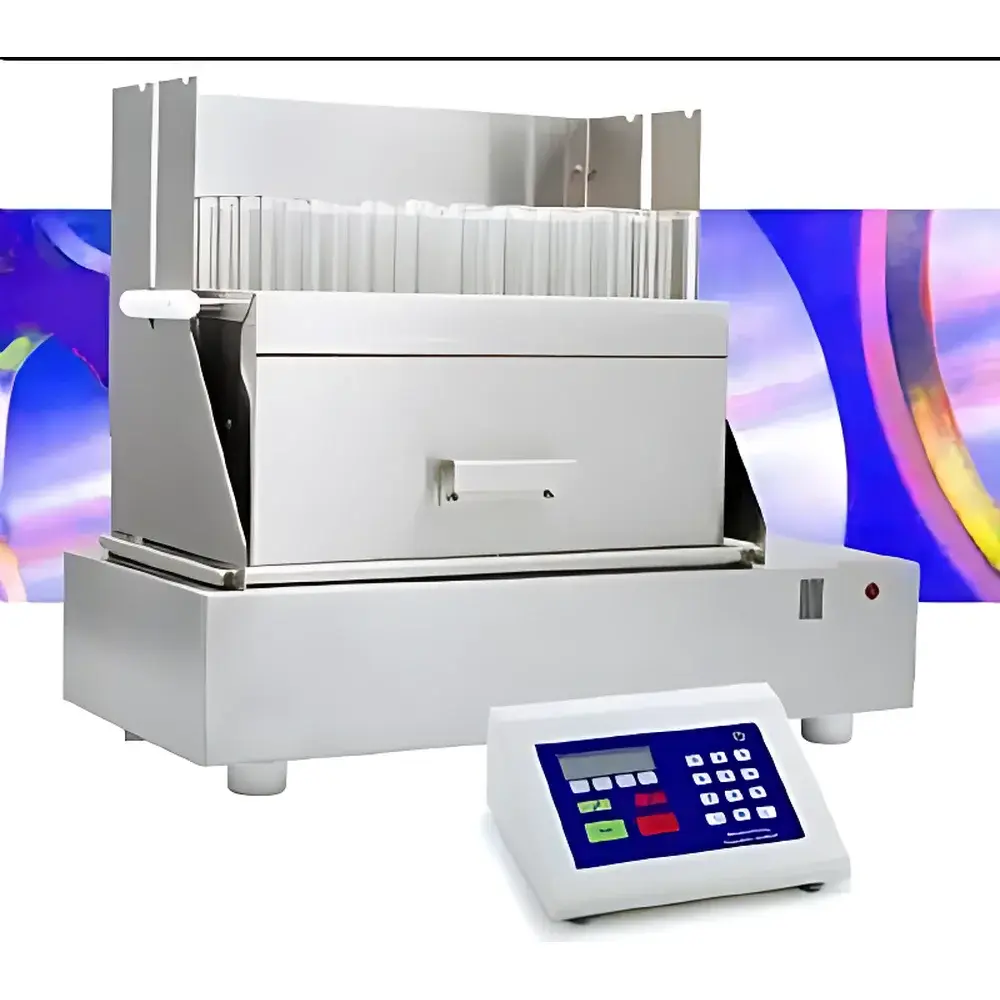
SEAL BD50s Automated Block Digestion System
| Brand | SEAL |
|---|---|
| Origin | Australia |
| Manufacturer Type | Authorized Distributor |
| Origin Category | Imported |
| Model | BD50s |
| Instrument Type | Electric Heating Block Digestion System |
| Power Supply (Digestion Block) | 220–260 VAC, 50/60 Hz |
| Power Supply (Controller) | 100–260 VAC, 50/60 Hz |
| Dimensions (Block) | 60 cm W × 28 cm D |
| Dimensions (Controller) | 25 cm W × 24 cm D |
| Weight (Block) | 21.5 kg |
| Weight (Controller) | 2.5 kg |
| Capacity | 50 × 75 mL or 50 × 100 mL or 28 × 250 mL |
| Temperature Range | Ambient to 450 °C |
| Temperature Accuracy | ±2 °C |
| Max Ramp Rate | As low as 1 °C/min |
| Programmable Methods | Up to 20 methods, each with up to 30 steps |
Overview
The SEAL BD50s Automated Block Digestion System is a precision-engineered electric heating digestion instrument designed for high-throughput, reproducible acid digestion of environmental, agricultural, food, and industrial samples. Based on controlled conductive heating via a solid-state aluminum heating block, the BD50s employs uniform planar thermal distribution—eliminating radial hot/cold zones common in traditional rod-heated digestion units. This architecture ensures spatial temperature homogeneity across all sample positions, critical for achieving consistent decomposition of organic matrices under aggressive acidic conditions (e.g., HNO₃, H₂SO₄, HClO₄, HF). The system operates under programmable time-temperature profiles, enabling full automation of multi-stage digestion protocols required for standardized methods such as EPA 3015A, ISO 11466, ASTM D3682, and AOAC 985.01. Its modular design separates the acid-resistant digestion block (to be installed inside a fume hood) from the electronics-integrated controller (operated externally), fulfilling both safety and ergonomic requirements in regulated laboratory environments.
Key Features
- Uniform planar heating block delivering ±2 °C temperature accuracy across all 50 positions—no cold spots, no manual repositioning required.
- Programmable ramp-and-hold profiles: up to 20 independent methods stored onboard, each supporting up to 30 discrete temperature/time steps.
- Gradual ramp control down to 1 °C/min to prevent violent boiling, foaming, or splashing during initial acid addition and oxidation phases.
- Power-failure recovery: automatically resumes digestion from the exact step and temperature where interruption occurred.
- Dual-layer safety architecture: integrated overtemperature cut-off (trip point at +30 °C above setpoint) and physical separation of controller electronics from corrosive acid vapors.
- Transparent hinged lid on the tube rack enables real-time visual monitoring without opening the fume hood or disturbing thermal equilibrium.
- Compact footprint (60 × 28 cm) optimized for standard fume hood integration—reducing spatial constraints in QC and environmental testing labs.
Sample Compatibility & Compliance
The BD50s supports digestion of diverse sample types—including soils, sediments, plant tissues, animal feed, wastewater sludge, and biological fluids—across standard applications such as total Kjeldahl nitrogen (TKN), total phosphorus, heavy metals (Pb, Cd, As, Cr, Ni), mercury (Hg) by cold vapor AAS, and chemical oxygen demand (COD) preparation. It complies with methodological prerequisites of ISO/IEC 17025-accredited laboratories and aligns with operational expectations under GLP and GMP frameworks. While the BD50s itself does not carry FDA 21 CFR Part 11 certification, its method storage, timestamped run logs, and uneditable protocol execution support audit-ready documentation when paired with validated LIMS or ELN systems. All digestion tubes are constructed from borosilicate glass or PTFE-lined quartz, compatible with USP , EPA Method 3050B, and ISO 17294-2 workflows.
Software & Data Management
The BD50s features an embedded microcontroller with an intuitive LCD interface for local programming, real-time temperature display, and status feedback (e.g., “Ramp”, “Hold”, “Cooling”, “Complete”). No external PC or proprietary software is required for routine operation; however, optional RS-232 or USB connectivity allows integration with laboratory information management systems (LIMS) for automated log export. Each digestion run records start time, end time, peak temperature, and active method ID—providing traceable metadata essential for internal QA reviews and regulatory submissions. Method files are non-volatile and retained during power cycling, ensuring continuity across shifts and analysts.
Applications
- Environmental analysis: digestion of soil and sediment for ICP-OES/MS quantification of trace metals per EPA 3050B and ISO 11466.
- Food safety testing: TKN determination in dairy, cereals, and meat products per AOAC 985.01 and ISO 5983-1.
- Wastewater compliance: COD sample prep using closed-vessel reflux alternatives under ISO 6060.
- Pharmaceutical excipient screening: heavy metal testing per USP and ICH Q3D guidelines.
- Research laboratories: method development for novel digestion matrices requiring precise thermal profiling and kinetic control.
FAQ
Is the BD50s suitable for hydrofluoric acid (HF) digestion?
Yes—when used with HF-compatible digestion tubes (e.g., PTFE or quartz) and appropriate fume hood containment. The heating block surface is chemically inert to HF vapors under normal operating conditions.
Can digestion methods be exported or backed up externally?
Method parameters are stored internally and cannot be exported directly; however, users may manually document settings or integrate via serial output for third-party logging.
What maintenance is required for long-term reliability?
No consumables or scheduled calibration are needed. Routine cleaning of the heating block surface with dilute nitric acid and lint-free wipes is recommended after high-salt or silicate-rich digestions.
Does the BD50s meet CE or UL safety standards?
The system complies with IEC 61010-1:2010 for electrical safety in laboratory equipment and carries CE marking for EMC and low-voltage directive conformity.
How is cooling managed post-digestion?
The BD50s does not include active cooling; natural convective cooling occurs after program completion. Optional forced-air coolers or ambient cooling racks may be deployed externally to accelerate cooldown before tube handling.



