
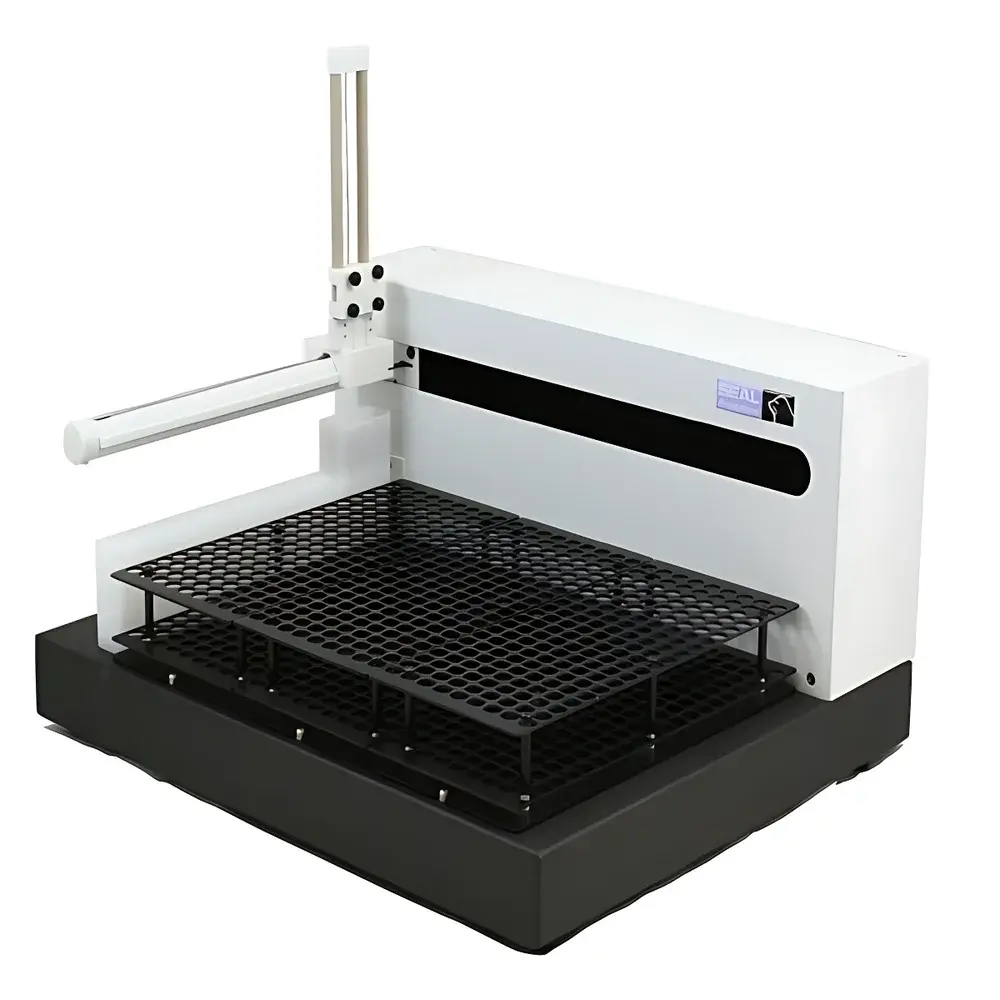
SEAL Sampler540 3D Automated Sample Introduction System for Flow Injection and Continuous Flow Analyzers
| Brand | SEAL |
|---|---|
| Origin | Germany |
| Instrument Type | 3D Robotic Autosampler |
| Sample Capacity | Up to 540 positions (6 sample racks) |
| Needle Configuration | Single, dual, or quad needle options |
| Compatible Platforms | SEAL AA3 and QuAAtro continuous flow analyzers |
| Sample Vial Sizes | 4 mL, 5 mL, and 11 mL |
| Dedicated Standard & QC Racks | Yes |
| Random Access Sampling | Yes |
| Acid-Resistant Needle Material | PTFE-coated stainless steel |
| Compliance | Designed for GLP/GMP environments with audit-ready operation |
Overview
The SEAL Sampler540 is a high-precision 3D robotic autosampler engineered specifically for integration with continuous flow analysis (CFA) and flow injection analysis (FIA) platforms—including the SEAL AA3 and QuAAtro systems. Unlike conventional linear or carousel-based samplers, its three-dimensional Cartesian coordinate architecture enables true random-access sampling across up to six independently configurable sample racks, supporting a maximum capacity of 540 positions. The system operates on a robust gantry-driven motion platform with microstepping stepper motors and optical position feedback, ensuring repeatable positioning accuracy within ±0.15 mm. Sampling is executed via chemically inert, PTFE-coated stainless-steel needles capable of handling aggressive matrices—including nitric, hydrochloric, and sulfuric acid solutions—without degradation or carryover. The Sampler540 functions as an intelligent sample introduction module that decouples sample loading from analytical sequence execution, allowing asynchronous rack insertion, real-time re-sampling, and dynamic method-driven reruns—all without interrupting ongoing analyses.
Key Features
- Three-axis robotic motion system (X-Y-Z) enabling full spatial access to all sample positions across up to six modular racks
- Configurable needle options: single, dual, or quad needle assemblies—each independently addressable and programmable for parallel or sequential aspiration
- Dedicated, physically segregated racks for standards, quality control (QC) samples, and unknowns—reducing cross-contamination risk and simplifying calibration workflows
- Support for multiple vial formats: standardized 4 mL, 5 mL, and 11 mL polypropylene or glass vials, with auto-detection of vial height and depth compensation
- True random-access capability: any sample position can be targeted at any time—enabling immediate re-analysis of flagged results (e.g., out-of-specification, high carryover, or drift-compensated replicates)
- Integrated wash station with programmable solvent selection (water, dilute acid, organic solvents), dwell time, and aspiration/vacuum cycles to minimize memory effects
- Real-time positional logging and mechanical fault diagnostics accessible via Ethernet-connected service interface
Sample Compatibility & Compliance
The Sampler540 accommodates heterogeneous sample types common in environmental, clinical, and industrial water testing—including turbid, particulate-laden, viscous, and low-volume extracts. Its needle design and sealing mechanism prevent aerosol generation and ensure consistent aspiration volume across viscosity ranges (0.8–15 cP). All wetted materials comply with USP Class VI and ISO 10993-5 biocompatibility standards. From a regulatory standpoint, the system supports 21 CFR Part 11-compliant operation when paired with SEAL’s Quantos software: electronic signatures, user-level permissions, immutable audit trails, and method-locking functionality are natively implemented. It meets ASTM D3764 (for petroleum product analysis), ISO 15681-1 (phosphate in water), and EPA Method 365.4 requirements for automated sample handling in certified laboratories.
Software & Data Management
Control and configuration are managed through SEAL Quantos software—a Windows-based application with integrated method editor, sequence scheduler, and real-time monitoring dashboard. Each sampling event is timestamped and logged with metadata including rack ID, position coordinates, needle ID, wash cycle parameters, and aspiration pressure profile. Data exports conform to ASTM E1384 and ISO/IEC 17025 traceability requirements: CSV, XML, and LIMS-ready ASCII formats are supported. Remote diagnostics, firmware updates, and calibration verification reports are delivered via encrypted HTTPS channel. Audit logs retain ≥18 months of operational history by default and support SQL-based querying for internal QA reviews or external accreditation audits.
Applications
- Automated nutrient analysis (nitrate, nitrite, phosphate, silica) in wastewater, surface water, and seawater per ISO 15681 and EPA methods
- Heavy metal speciation (e.g., Cr(VI), As(III)/As(V)) using hydride generation CFA with pre-reduction modules
- Pharmaceutical excipient testing (chloride, sulfate) under ICH Q2(R2) validation guidelines
- Food and beverage quality control—e.g., total phosphorus in dairy effluents or sulfite in wine—using colorimetric CFA protocols
- Long-duration unattended operation in remote monitoring stations, enabled by rack-swapping during active runs and power-fail recovery protocols
FAQ
Can the Sampler540 be retrofitted to existing AA3 or QuAAtro systems?
Yes—hardware integration requires only standard RS-232 or TCP/IP communication; no mechanical modification of the analyzer is needed.
What maintenance intervals are recommended for the robotic drive system?
Linear guides and timing belts require visual inspection every 6 months; lubrication is not required due to sealed polymer bushings and self-lubricating belt materials.
Is carryover correction handled automatically during re-sampling?
Yes—the system executes a user-defined post-aspiration wash protocol before each subsequent draw from the same vial, with wash volume and composition adjustable per method step.
Does the Sampler540 support barcode scanning for sample tracking?
Optional 2D barcode reader module (SEAL BCR-200) is available and fully integrated into Quantos for LIMS synchronization and chain-of-custody documentation.
How is positional accuracy verified during routine operation?
Built-in reference fiducial markers on each rack allow automated calibration checks; results are logged and compared against factory-certified tolerance limits (±0.15 mm) in daily startup diagnostics.





